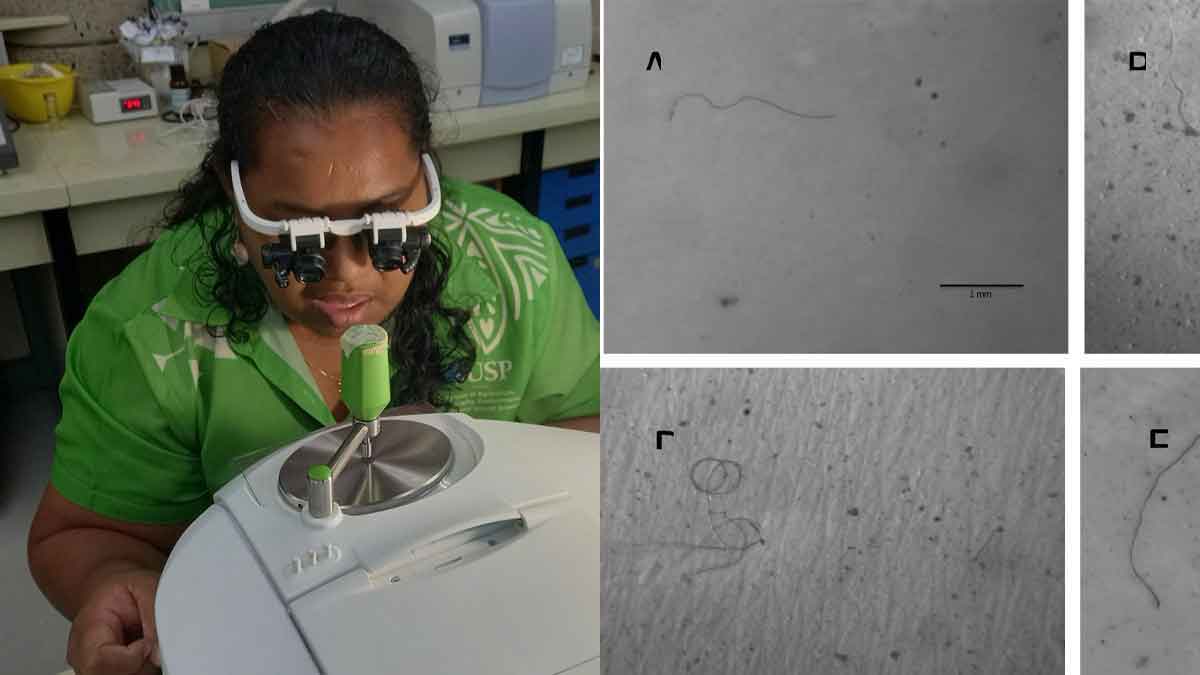
A University of the South Pacific baseline study has found that tiny plastic particles, less than 5 millimetres in size, are present in water that Fijians consume every day.

Associate Professor, David Rohindra says the findings show that people of Fiji are ingesting microplastics through drinking water, and this highlights the need for enhanced monitoring, treatment and public awareness to safeguard both people and ecosystems.

He adds that this baseline should be seen as an opportunity to act – rather than a cause for panic.
The findings add to growing global evidence of plastic pollution as an emerging environmental and public health concern.
The detected levels remain below critical pollution thresholds, although global standards for microplastics in drinking water are still evolving.
Led by Associate Professor Rohindra with researchers Roselyn Lata, Timaima Waqainabete, and Steven Aru, the USP team conducted the first baseline assessment of microplastic contamination across multiple drinking water sources in Fiji, including tap water, groundwater, rainwater and bottled water.

The study found microplastic concentrations ranging from 0.10 ± 0.03 to 2.90 ± 0.57 particles per litre in tap water, with bottled water also showing variable contamination and some brands containing up to 2.20 ± 0.41 particles per litre.
Rainwater, by contrast, recorded the lowest levels at 0.20 ± 0.05 particles per litre, indicating lower exposure.

The team stresses that this provides an important opportunity to act early.
Associate Professor Rohindra emphasises that we are still below critical thresholds, which means we have a window of time to respond wisely.
He says if we strengthen our water systems now, we can protect our people, especially women and children, from bearing the heaviest costs of future pollution.
The presence of microplastics in drinking water is not only a scientific issue, it is also a question of equity.
Research such as USP’s microplastics baseline study can help guide policies and investments to reduce this challenge and promote more equitable results.
USP’s research situates Fiji within a global and regional context where microplastics are now found from mountaintops to deep ocean trenches.
The results underscore the importance of protecting water catchment areas, especially those near densely populated or industrial zones where microplastic loads tend to be higher before water even reaches treatment plants.
They have advised at the household level for people to use certified water filters (for example, filters that are tested to remove fine particles) where possible, and maintain them according to manufacturer guidelines, prioritise protected rainwater harvesting systems, ensuring tanks are covered, regularly cleaned, and connected to clean roof catchments, reduce single-use plastics at home, properly dispose of plastic waste, and avoid burning plastic, which can create other pollutants.
At the community level, they advise to support local clean-up campaigns around rivers, streams and coastal areas to prevent plastic litter from entering water sources, work with local leaders, schools and churches to educate communities about plastic pollution, the importance of protecting catchments, and simple water safety practices, encourage village and settlement committees to discuss low-cost filtration and rainwater solutions,and to share local knowledge about safe water sources.
At the policy and institutional level, USP sees its role as a long-term partner in solutions.
Associate Professor Rohindra says USP can help our communities not only by diagnosing the problem but by co-designing the solutions.
He says they are ready to work with governments, utilities and communities on better monitoring, new treatment options and awareness programmes across the region.
Beyond monitoring, the USP team is also exploring innovative ways to remove microplastics from the aquatic environment.
Building on the Pacific’s long tradition of using marine resources wisely, the researchers are developing a hydrogel derived from waste crab shells that can capture and remove microplastics from water.
If successful, this low-cost, locally sourced technology could offer Pacific Island countries a home-grown solution to a global problem, transforming fisheries waste into a tool for environmental protection and water security.
The World Health Organization has called for more research into the human health impacts of microplastics, noting potential chemical, physical and microbial risks.