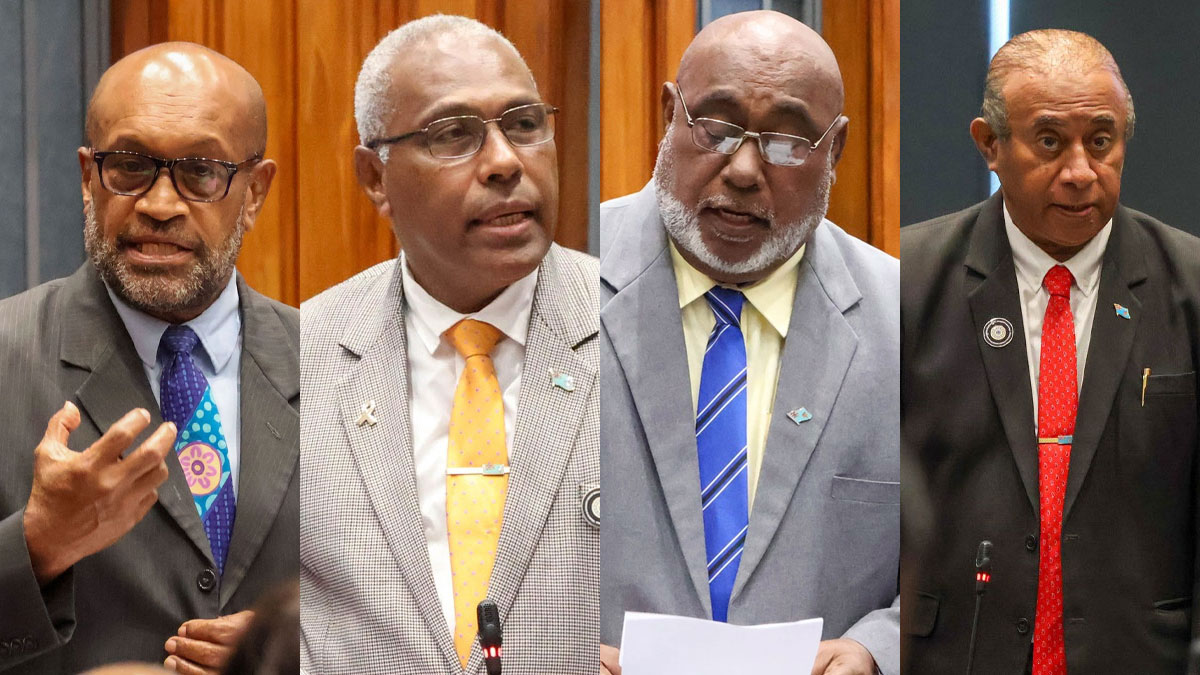
While contributing to the debate, Opposition MP Jone Usamate says there are a lot of things in the Bill that are already protected to some extent in the Constitution, but there are some things that go beyond that.
Usamate says there is nothing wrong with duplicating the rights that are already in the Constitution, but what they see is that the Bill is trying to blend the rights established under the Constitution with what is coming out of this particular Bill.
He says one of the things about this Bill is that it is an action plan and people can interpret it in the way they want to.
He adds that the action plan will depend on the point of view of the people.
Usamate also raises concern over Article 26 of the Bill where it states that indigenous people have the right to lands, territories, and resources which they have traditionally owned.
He questions what that means for State Land.
He says the Constitution right now does not allow someone to change the classification of land.
Opposition MP Semi Koroilavesau says the Bill raises serious concerns about practicality, coherence, and the balance of rights within our constitutional framework.
He says the Bill is creating legal uncertainty.
Koroilavesau says infrastructure, energy and resource projects are vital to Fiji's economy and could be delayed or blocked entirely, not because they are unjust, but because the consultation process is undefined and may be potentially unworkable.
He adds that the Bill introduces parallel legal and institutional systems, and while cultural autonomy is important, this could fragment Fiji's legal order, creating uncertainty about which laws apply in disputes.
The Opposition MP says the Bill risks legal fragmentation, economic paralysis, unequal treatment and unrealistic obligations.
He adds that this Bill in its current form threatens that balance.
He says the Bill does not alter constitutional land protections and does not diminish the rights of any other community.
He further says it does not grant an indigenous or iTaukei group a veto over development and it does not transfer ownership of land or resources.
While supporting the Bill, Minister for Justice and acting Attorney General Siromi Turaga says the introduction of this Bill marks a significant step towards aligning our national laws with international standards, extending the dignity and rights of indigenous people, affirming the principles of equality and inclusion that lie at the heart of our democracy.
While responding to Koroilavesau, Turaga says the is a misconception that the UNRIP creates new special rights for indigenous peoples.
He says the reality is that the Declaration does not invent new human rights but affirms and applies existing, long-established universal human rights or norms like self-determination and non-discrimination to the specific historical, cultural, and material context of indigenous peoples
Turaga says another misconception is UNRIP is not enforceable but merely aspirational document, however, the reality is that while the Declaration is a non-binding UN General Assembly resolution and not a legally enforceable treaty in itself, it carries significant moral and political weight, especially for this government.
He also says it principally reflects international consensus and serves as a vital guide for states to adopt international laws and policies.
The Acting Attorney General adds that another misconception is that the principle of free, prior and informed consent gives indigenous peoples an absolute veto over resource development.
He says this is not the case and the principle is a crucial right that requires states to obtain the consent of Indigenous Peoples before proceeding with projects that affect their land or rights.
Minister for Transport Ro Filipe Tuisawau stresses the Bill is not to dominate anybody or a threat.
While contributing to the debate, Ro Filipe says the FijiFirst government was operating under an ideology that is contrary to the rights for indigenous protection or the UN Declaration on the Rights of Indigenous People.
He says the ideology the last government operated under was all-encompassing and could be used to dominate the population, to brainwash them, to tell them that this is the best way forward for the country.
The Minister says that the 2013 Constitution is an imposed document aligned to a specific ideology, and that ideology is reflected in its approach to cultural autonomy.
Ro Filipe says Usamate mentioned, the term "common citizenship" which is in the Bill, but it was an element which was repeatedly mentioned during the last government to nullify cultural autonomy or cultural identity.
Ro Filipe says capturing culture in institutions makes it prone to manipulation, not in the interest of others and irrelevant.
The Minister stresses that the State and cultural institution can coexist and they are witnessing that today.
Ro Filipe notes that the current Bill is intended to correct that situation and that any remaining concerns will be addressed through the committee process.
Assistant Minister for Justice Ratu Josaia Niudamu says this Bill will pave the way for the rightful recognition of iTaukei leadership.
Ratu Josaia says it has been many years since the iTaukei, as the owners of land and mineral resources, have had their rights as indigenous landowners overlooked and unrecognised by some previous governments.
He says there was even a time when it was suggested that indigenous people and their chiefs should “go and drink homebrew under the mango trees,” referring to how their voices were ignored, as seen during the introduction of Bill 17 in 2021.
He adds that this new Bill will ensure that the iTaukei are respected, along with their rights.
He says this Bill will also bring an end to how the iTaukei have been treated over the past 16 years.

Stay tuned for the latest news on our radio stations