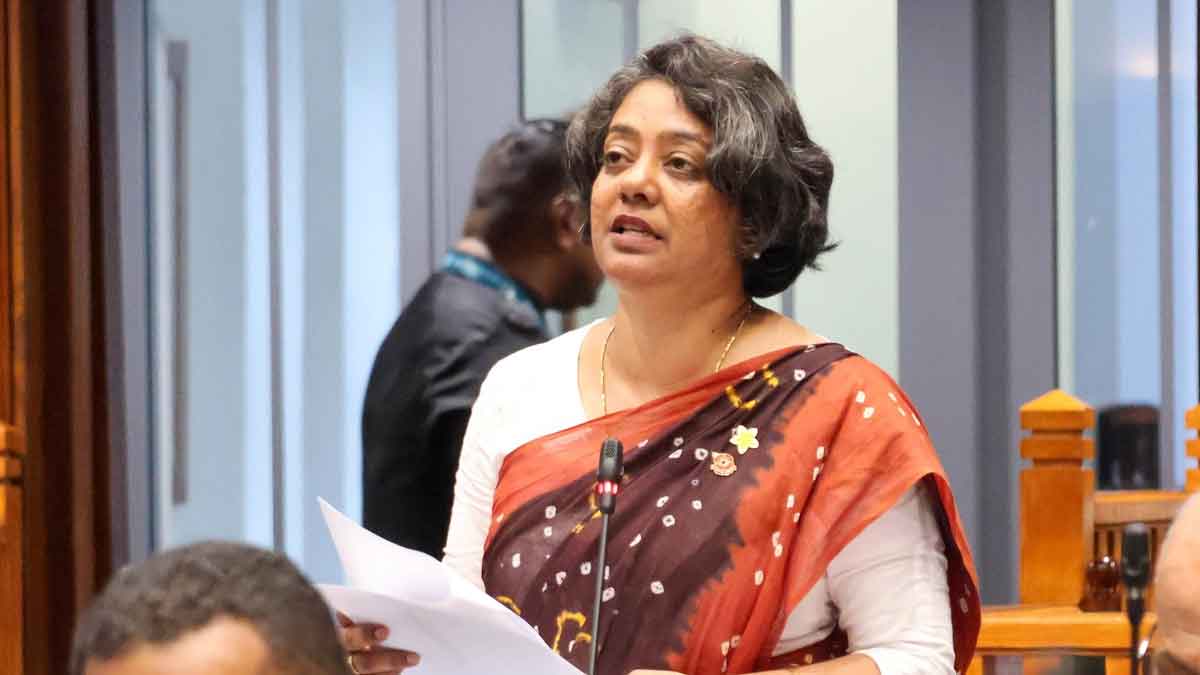
In 4 years from 2020 to last year, 7,283 crimes were reported against children in Fiji, and 5,085 or 70 percent of these involved girls.
This has been highlighted by Minister for Women, Children and Social Protection Sashi Kiran in her ministerial statement in Parliament where she says that adolescent girls aged 13 to 17 are the most affected, accounting for nearly 69 percent of all child crime victims.
She says the majority of these are sexual offences such as rape, defilement, and sexual assault.
Kiran says this means too many of our girls are not safe, not even in their own homes and these numbers are not acceptable.
The Minister stresses that no child should live in fear of abuse in our country and no girl should lose opportunity to grow to her full potential.
Kiran says to address this, the Ministry, in partnership with the Ministry of Education and other agencies, coordinated Divisional activities across the communities where the programmes featured awareness sessions, and discussions on teenage pregnancy, early marriage, HIV/AIDS, substance abuse, leadership, and sports inclusion.
Kiran has also highlighted that data shows that many of our girls are still falling through the cracks where in rural areas, the school dropout rate between Year 8 and Year 12 is almost 40 percent, compared with a national average of 20 percent.
She says according to the FEMIS Term 3 data for 2024, 73,295 girls are enrolled in primary school compared to 79,240 boys, a 6.5 percent gap that has remained consistent since 2020.
The Minister says at the secondary level, 7,554 girls remain in Year 12, and 5,258 in Year 13.
She says as girls reach senior levels, thousands seem to drop out of school system and a large numbers of boys also seem to be dropping out, many eventually go to vocational or employment opportunities.
Kiran says when girls drop out of school, they face severe consequences, including reduced earnings, lower standards of living, and a higher risk of early marriage and childbearing.
She says other impacts include poorer health outcomes, less agency in household and community decisions, and a cycle of limited opportunities for themselves and their children.
Kiran says the Coalition Government is strengthening child protection systems and promoting girls’ access to education and health through counselling services, school-based awareness, and improved coordination among key agencies.
She says community consultations have highlighted the need for ongoing awareness, vernacular education materials, and leadership training for girls.
While responding, Opposition MP Virendra Lal says that data shows that high school completion for girls reaches up to 97 percent compared to 79 percent for boys but the moment our daughters leave the classroom, they are met with the betrayal of potential.
He says we have the best educated generation of young women in our history but we allow their talent to be sold by old beliefs that a woman's place is only in the home.
Lal says statistics show that the government's failure to address key policy gaps fail to provide affordable, quality national child care.
The MP says this policy gap ensures that the responsibility for care falls entirely on women who spend nearly three times more hours on unpaid care work than men.
Lal says this lack of support is the structural barrier that keeps the female labour force participation rate locked at a mere 36.2 percent and girls are twice as likely to be out of the formal workforce as our sons.
He says the World Bank confirms that closing this gender employment gap by unblocking women's time would boost Fiji's GDP per capita by a massive 30 percent.
The MP further says that they talk about women's leadership, but female representation in this parliament remains crucially low and when civil society and women's advocates call for structural change to bring women to the decision-making table, prominent voices within the government call it tokenistic.

Stay tuned for the latest news on our radio stations