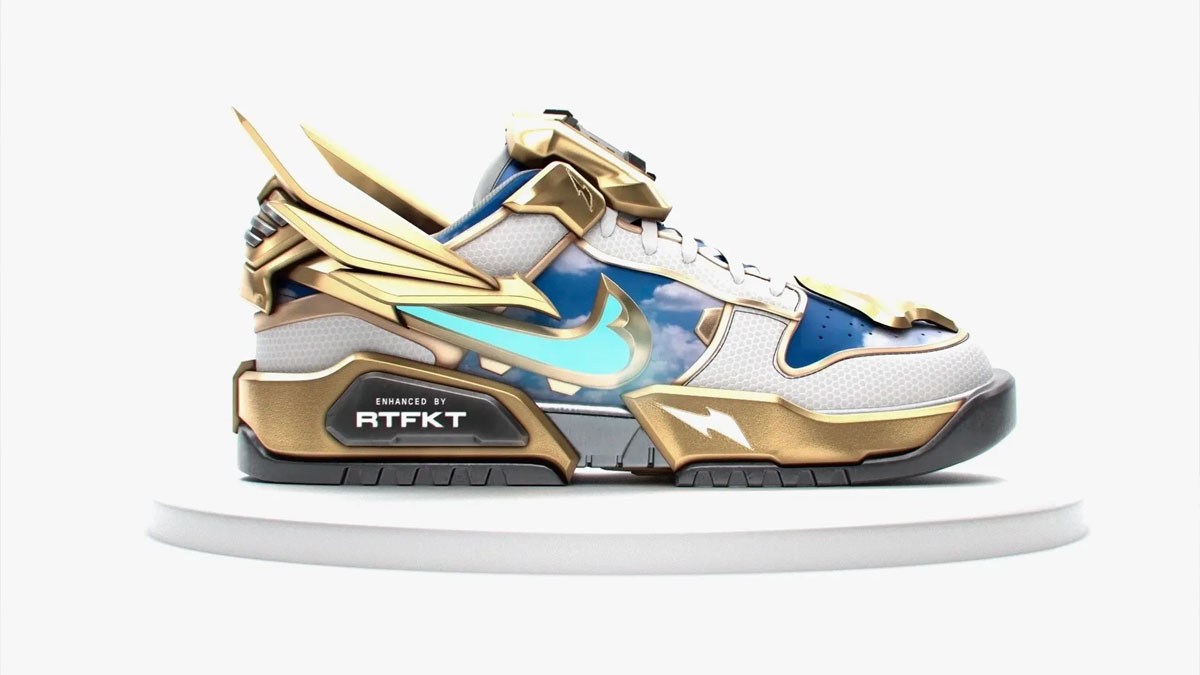
THE ICONIC BRAND’S latest venture is a metaverse play called .Swoosh, a Web3-enabled platform where people will be able to buy its virtual products. It’s essentially a marketplace, which makes sense because the breathlessly hyped internet of the future is much like the internet of the present: dominated by commerce.
Swoosh exists on a domain named “.nike” and will be an experimental digital space for registered members. It’s currently in beta, and registration to join opens on November 18.
The platform will initially focus on community building and present members with “challenges” to get a sense of what they want to see. The brand’s first virtual collection—of footwear, apparel, and accessories—will launch on Swoosh in January 2023, shaped through activities such as interactive voting. Members will subsequently be able to collect and trade these digital-only products; the platform will use cash (USD), not cryptocurrency, though all transactions will be recorded on the Polygon chain.
Virtual clothing from brands is nothing new, but Nike has teased that Swoosh’s community challenges will expand next year to include competitions in which members can win a chance to codesign virtual Nike products with the brand’s designers and earn a percentage of royalties.
But before would-be sneaker designers get too excited, details on just how this creator economy will work—the selection process, how design collaborations will take place, what percentage of revenue will people receive, what legal frameworks will be in place to ensure codesigners get paid—are extremely vague.
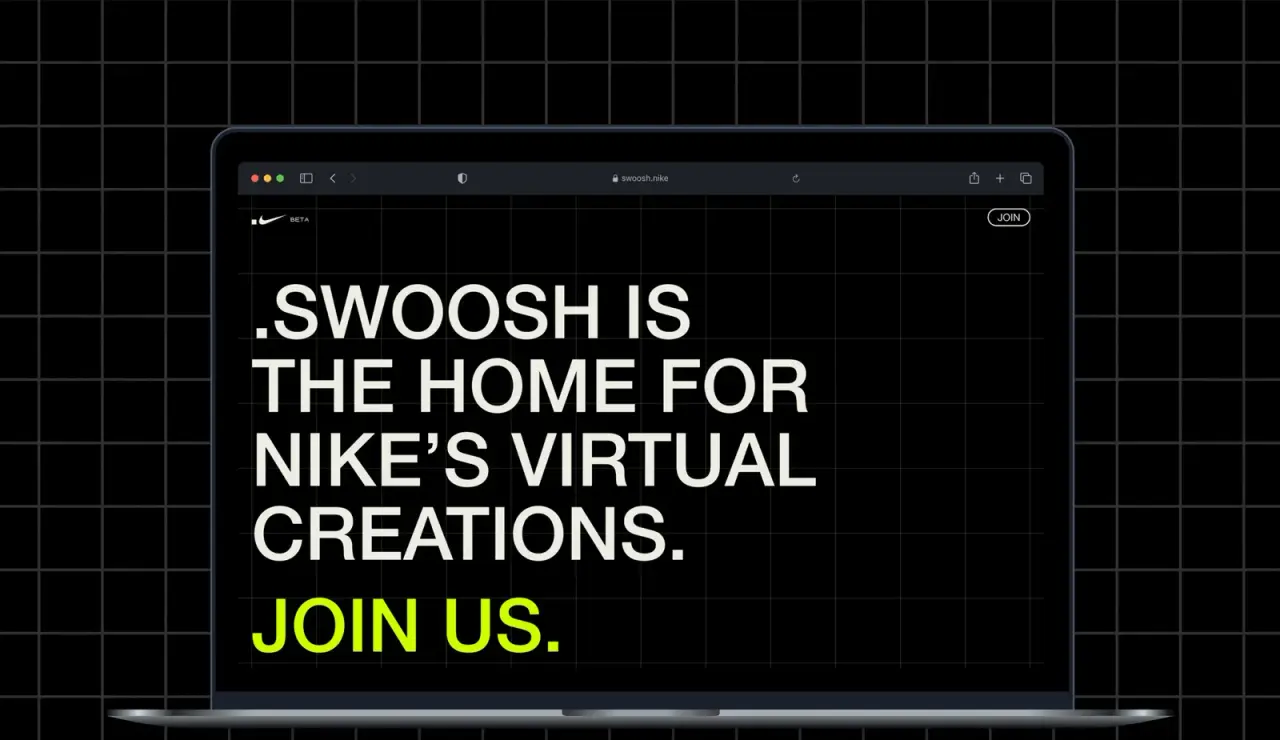
Nike states that its domain exists to “ensure it is a safe, trusted space” where members can collect virtual creations, “such as virtual shoes or jerseys.” What seems clear is that the competition structure, as with the branded domain, will safeguard Nike’s ultimate ownership and oversight of activities, which doesn’t exactly chime with the decentralized Web3 ethos.
Although there will be no avatars at the time of launch, the brand’s stated ambition is for the virtual products released on Swoosh to become wearable on and off the platform. “I can imagine the avatars on RTFKT being able to wear our wearables, as well as avatars in games you already play,” says Ron Faris, VP/GM of Nike Virtual Studios, the brand’s arm launched in early 2022 to focus on the virtual sphere.
Of course, the NFT studio RTFKT (pronounced “artifact”) was bought by Nike in December 2021, so the porting of “codesigned” virtual clothing to that platform is hardly surprising. Beyond this, there are no specific details on the interoperability of Swoosh items with other platforms or metaverses, but Faris says the plan is to “work where our wearables will start to become more operable across more experiences or games that you find yourself playing.” In other words, wait and see. Meta’s recent announcement that its avatars will have legs seems like an ideal opportunity for virtual sneakers.
Nike already has a metaverse space on Roblox—Nikeland—where users can buy and wear virtual goods using not cash or crypto but in-game currency. Launched in November 2021, the branded virtual world has seen more than 26 million visitors, according to Roblox. Again, Faris does not seem to know how Swoosh will interact with Nikeland. “We haven’t contemplated exactly what that looks like,” he says.
By launching Swoosh, Nike may be creating its own virtual world that won’t need to rely on other platforms. Nikeland could be subsumed into Swoosh, but interoperability will surely have to be front and center for that to succeed. This is the very reason MSquared, Improbable’s division that builds metaverses for third parties, requires clients to ensure all of its virtual spaces be interoperable.
Nike isn’t the first high-end apparel brand to take on virtual products. Gucci has been somewhat of a pioneer: In 2021, the brand launched digital-only sneakers Gucci Virtual 25, which can be worn on VRChat and Roblox, and created Gucci Town on Roblox, an immersive space in which users can buy other virtual Gucci apparel. The bet has seemingly paid off: A digital-only Gucci bag on Roblox sold for more than the price of its physical counterpart (in in-game currency, of course). Vault, Gucci’s online concept store which hosts various crytpo and NFT projects, was introduced to The Sandbox in October 2022, solidifying the brand’s relationship with the metaverse.
Givenchy, Ralph Lauren, and Tommy Hilfiger also have spaces on Roblox where digital merchandise is sold. And in June 2022, Balenciaga, Thom Browne, and Prada partnered with Meta to create virtual products for sale on the platform’s new Avatars Store. According to Bloomberg, the metaverse market may reach $783.3 billion in 2024, up from $478.7 billion in 2020—and virtual products no doubt play a role in this projection.
Nike may see a virtual product marketplace as the next logical step in its digital successes. The brand saw huge boosts in online sales in the wake of the pandemic, and by March 2022, digital channels and applications accounted for more than a quarter of its revenues, with digital sales rising robustly.
Certainly, the attraction to Web3 is a powerful one; the last thing brands want is to be left behind. “This is us serving the marketplace of the future, led by meeting the consumer where they play or shop,” says Faris.
Although Nike acquired RTFKT last year and made $3.1 million selling 600 pairs of “Cryptokicks” NFT sneakers in April 2022, it is sidestepping currently tarnished NFTs for the Swoosh launch. “We’re calling these ‘Nike virtual creations’ because we think that it has broader implications than NFTs,” Faris says. The NFT bubble may have burst, at least for now, but it’s not yet clear whether the broader market for virtual goods will be as volatile.
Perhaps as a way to avoid this, Nike is planning to attach services and utilities to its virtual products. “When we look at a virtual shoe, we don’t just see the shoe,” says Faris. “This is a shoe that one day could unlock a preorder for a physical product, or another day it unlocks access to a secret chat room with our designers, helping to cocreate. We’re learning that buying a virtual product isn’t the end of a purchase journey, it’s the beginning of it.”
Nike is not just betting on the future of virtual goods, but on successfully selling them in its own new world, rather than on established and well-visited platforms owned by Roblox and others. Industry analyst Benedict Evans thinks that such a move, even from a brand like Nike, carries significant risk. “The market for virtual products that exist outside of specific use cases like Roblox or Fortnite is still extremely experimental,” he says.
Faris seems to be aware of this uncertainty. “We’re going to be trying and testing and learning many different things,” he says. “We’re looking to assess [people’s] behavior.”
This could turn out to be costly market research, or it could help scope out retail in the Web3 age. Faris believes society and technology are at a pivotal moment: “This world that we’re in right now … this is like the internet before the browser was invented.”
Nike fans will have to wait until next year for the first cocreated virtual sneakers, and Web3’s evolution remains unclear—but it is undoubtedly another opportunity for companies wanting to market products. What was initially touted as a decentralized utopia is looking increasingly like a continuation of the status quo—only with brands taking even greater ownership, if Swoosh is anything to go by. When it comes to the future of the internet, the revolution will be monetized. Get your virtual kicks now.
Source: Wired.com

Stay tuned for the latest news on our radio stations