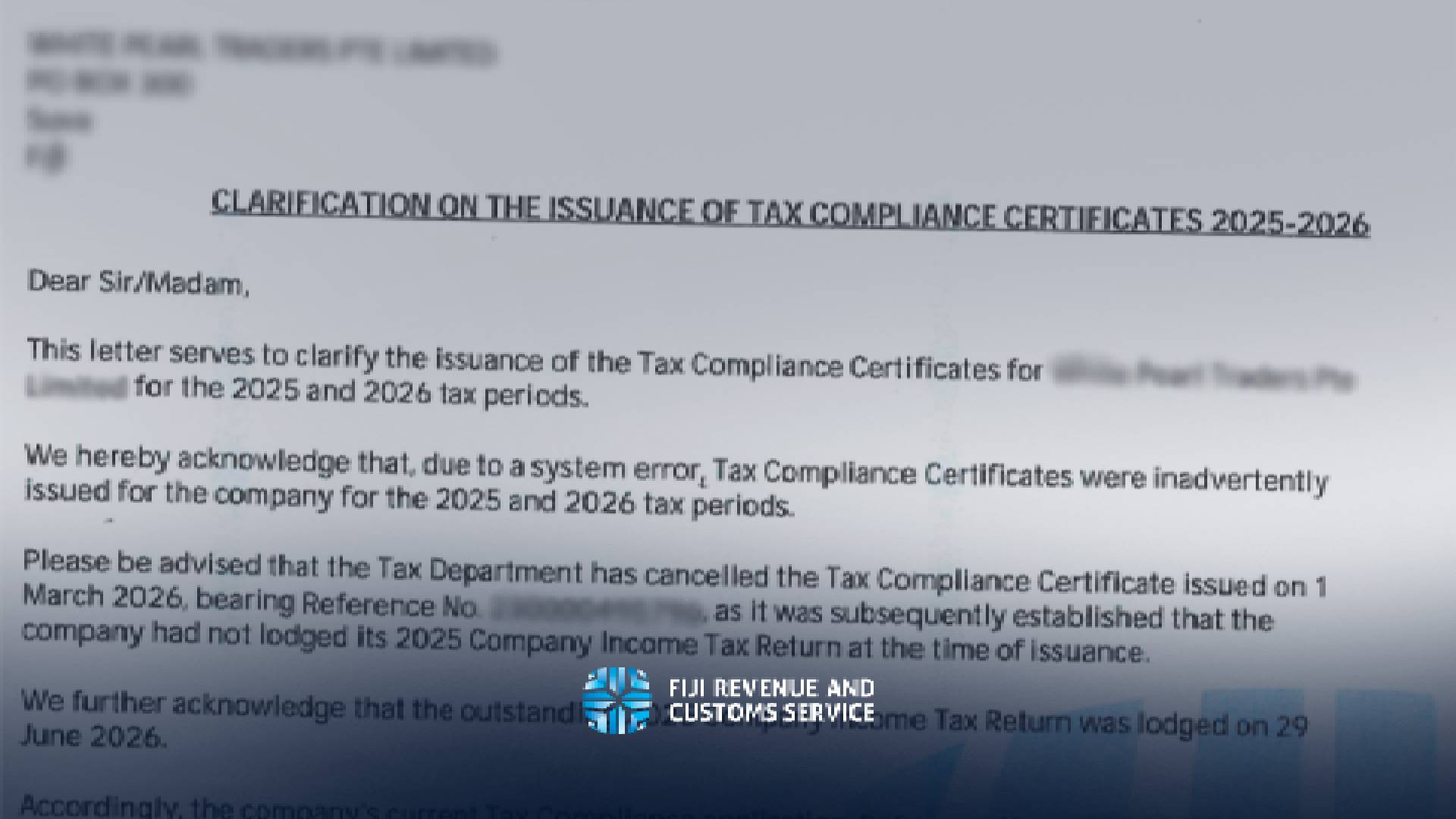
Members of the public, businesses, government ministries and departments, statutory bodies, financial institutions, and procurement entities are being urged to exercise extreme caution after the Fiji Revenue and Customs Service (FRCS) detected fraudulent Tax Clearance and Tax Compliance Certificates (TCCs), as well as fake letters falsely claiming that legitimately issued certificates had been cancelled due to a system error, circulating in the country.
FRCS says the documents are fraudulent, unauthorized, and do not originate from the Service.
The Service warns that the creation, distribution, possession, use, or presentation of false tax documents may constitute serious criminal offences and could result in investigation and prosecution under Fiji's laws, with offenders facing substantial fines, imprisonment, or both.
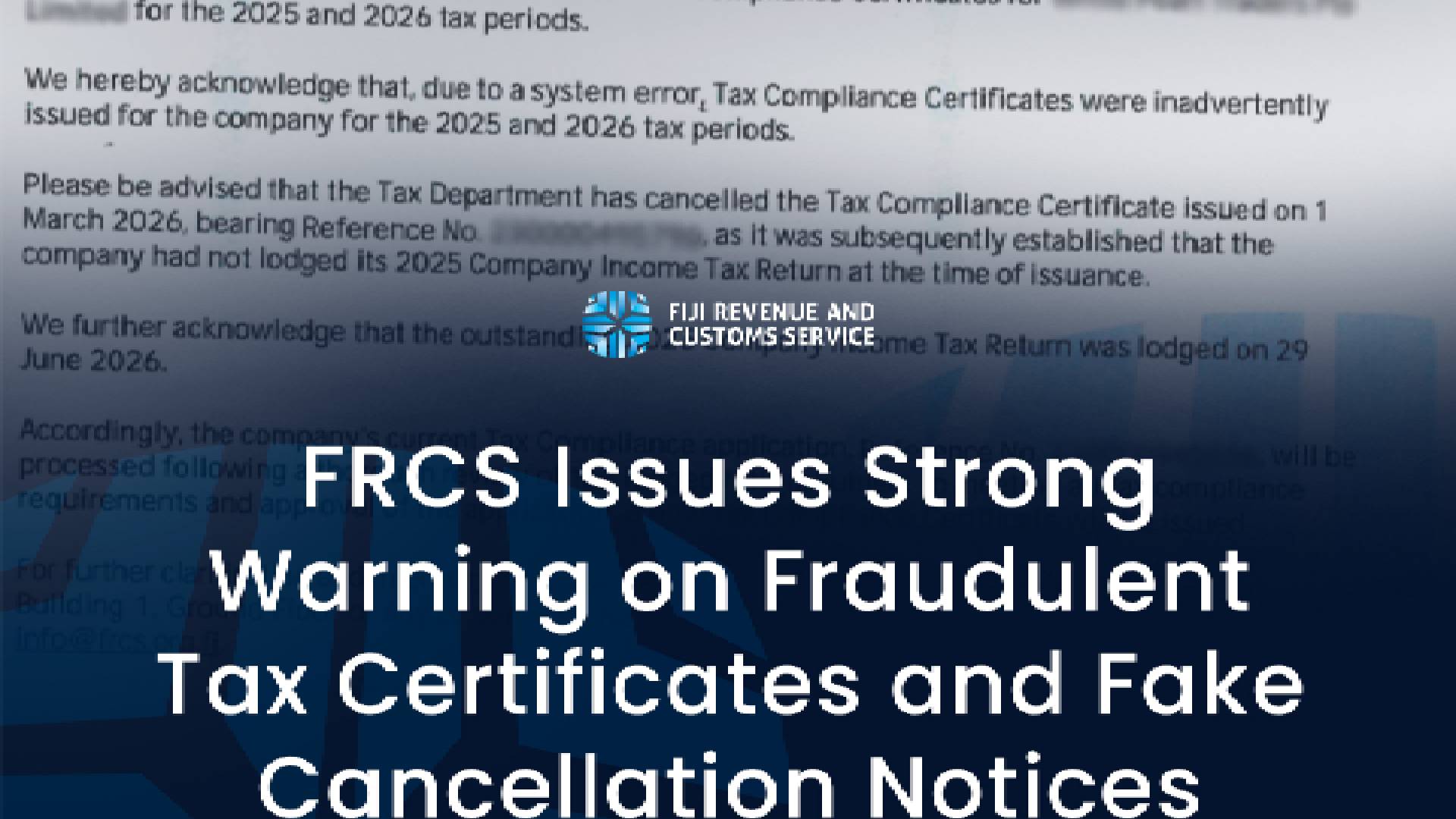
FRCS says it wishes to clarify that it does not cancel, revoke, or invalidate Tax Clearance or Tax Compliance Certificates through informal emails, third-party correspondence, or unverified letters.
The Service adds that any change to the status of a certificate is reflected through its official systems and can be verified via the FRCS Taxpayer Online Services Certificate Validation Portal.
FRCS Chief Executive Officer Udit Singh says the Service takes any attempt to undermine the integrity of Fiji's tax administration system very seriously.
He says the circulation of fake tax certificates and fraudulent cancellation notices is a deliberate attempt to deceive businesses, government agencies, and the public.
Singh says FRCS will not tolerate any activity that compromises the integrity of its systems and processes.
He stresses the importance of verifying certificates through official channels before accepting them as valid and strongly urges all organisations and individuals not to accept any tax certificate at face value.
Singh adds that verification should be undertaken immediately through the official certificate validation portal or directly with FRCS.
He is advising organisations that if they encounter suspicious certificates, they should take immediate precautionary measures.
Singh says where a fraudulent or suspicious certificate is identified, organisations should retain a copy of the document, suspend the relevant transaction or process, and report the matter immediately to FRCS, together with details of the individual or entity that submitted the document.
He warns that those involved in producing, distributing, possessing, or using fraudulent tax documents could face significant legal consequences.
The CEO says any person found producing, distributing, possessing, or using fraudulent tax documents will be subject to investigation and appropriate action under the law.
Singh says these activities may constitute serious criminal offences, and FRCS will work closely with relevant enforcement agencies to ensure those responsible are held accountable.
FRCS encourages anyone who receives a suspicious certificate, cancellation notice, or related correspondence to report the matter immediately.