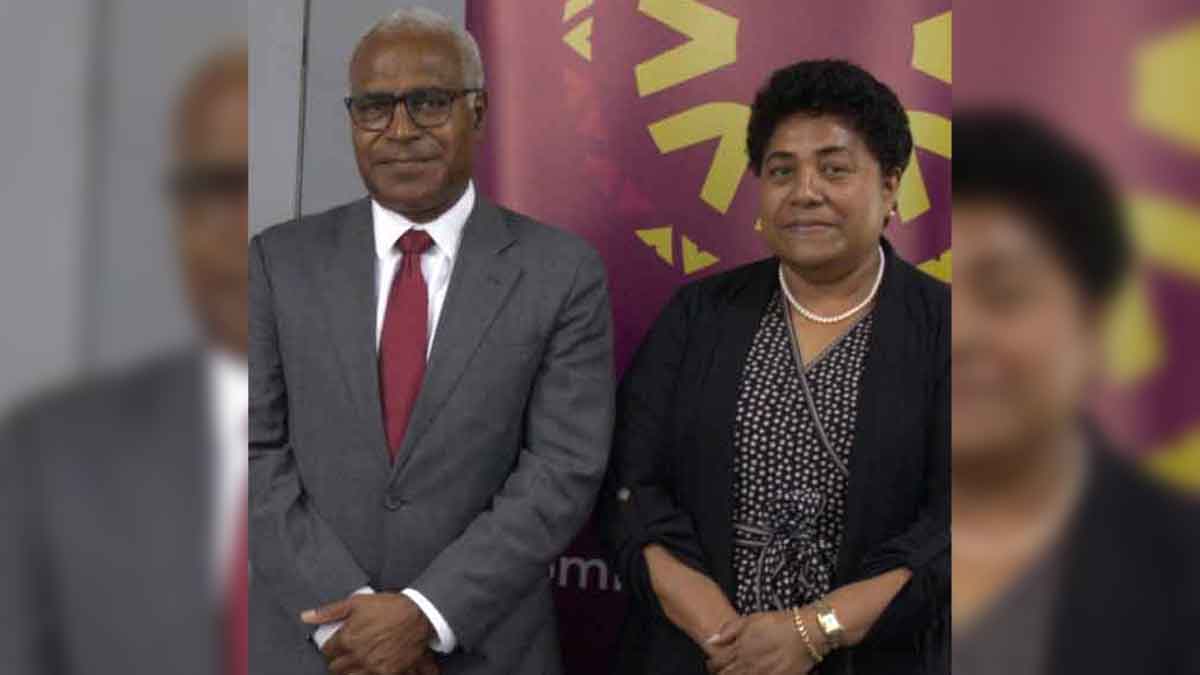
Former Republic of Fiji Military Forces Lieutenant Colonel (Retired) and Fiji’s Permanent Representative to the United Nations, Ambassador Filipo Tarakinikini with his wife, Amele Tabuya-Tarakinikini
If Fiji is to move forward, the country must confront its history honestly, acknowledge the suffering experienced across communities, and commit to building trust through transparency and national unity.
That is the message of former Republic of Fiji Military Forces Lieutenant Colonel (Retired) and Fiji’s Permanent Representative to the United Nations, Ambassador Filipo Tarakinikini, as he appeared before the Fiji Truth and Reconciliation Commission.
Tarakinikini shared a reflective account of Fiji’s political upheavals dating back to 1987, with particular focus on the 2000 political upheaval that shook the nation and tested the resilience of its democratic institutions.
He became the military spokesperson during that difficult time in Fiji when the Mahendra Chaudhry led government was held hostage in the parliament complex by the George Speight led rebel group.
Tarakinikini's reflections underscored the need for shared responsibility across society, highlighting truth-telling, moral leadership, and ethics education as key pillars for sustainable reconciliation.
The hearing, held in Suva, was presided over by Commission Chairperson Joaquim da Fonseca and Commissioner Ana Laqeretabua.
During the 2000 coup, Filipo Tarakinikini was serving as a Lieutenant Colonel in the RFMF, and his role in the military during the crisis placed him at the centre of one of the most delicate and volatile situations in Fiji’s modern history.
As events unfolded at Parliament during the 2000 political upheaval, Tarakinikini recalled becoming involved in communications and negotiations that required balancing military command decisions with the urgent responsibility of protecting lives.
His story provided insight into the complex institutional pressures, operational realities, and difficult decisions that defined the period.
In recounting these events, Tarakinikini described the tension between maintaining military discipline and navigating a rapidly evolving national crisis.
Beyond recounting the historical events themselves, Tarakinikini used his testimony to reflect on the broader lessons Fiji must confront as it continues its reconciliation journey.
He emphasised the importance of re-professionalising the military, strengthening ethical leadership, and ensuring that national resources are used responsibly and transparently.
According to Tarakinikini, the relationship between military culture and political influence has shifted over time, and these changes have had lasting implications for governance, public trust, and the stability of national institutions.
He spoke about the need for shared responsibility across society, highlighting truth-telling, moral leadership, and ethics education as key pillars for sustainable reconciliation.
His wife, Amele Tabuya-Tarakinikini also described the personal toll that the aftermath of the 2000 crisis took on their family.
She shared about the allegations made against her husband, the uncertainty and displacement that followed, and the emotional and financial strain that weighed heavily on their marriage, their children, and their extended family.
She briefly recalled years marked by fear, social isolation, stigma, and hardship.
Mrs Tarakinikini shared how their children carried the emotional burden of those years, including the discovery that one daughter’s learning difficulties were linked to trauma experienced during that period.
She also spoke of resilience, and described how faith, trusted friendships, counselling support, and a shared commitment to family helped them endure the years of uncertainty.
She says they made the decision to stay together and keep moving forward.
Lieutenant Colonel (Retired) Filipo Tarakinikini was born in Delailasakau, Naitasiri, and began his military career in the late 1970s and was commissioned as an officer in 1981.
Over the next two decades he served in senior operational and staff roles within the RFMF, including Aide-de-Camp, Adjutant, Senior Plans Officer, and Battalion Commander with the United Nations Interim Force in Lebanon (UNIFIL).
His military training included studies at the Royal Military Academy Sandhurst in the United Kingdom and the Senior Command and Staff College in Camberley, reflecting his advancement through the officer corps.
Following his departure from the military in 2002, Tarakinikini embarked on a distinguished career with the United Nations Department for Safety and Security, serving in senior advisory roles in Israel, Nepal, and across the Middle East and North Africa, including missions in Iraq, Sudan, Syria, Yemen, and Libya.
In 2018, he returned to the UN HQ in New York and served as Chief Middle East and North Africa with UNDSS (Department of Safety and Security) until taking early retirement in December 2022.
In 2023, he returned to public service as Fiji’s Permanent Representative to the United Nations in New York.