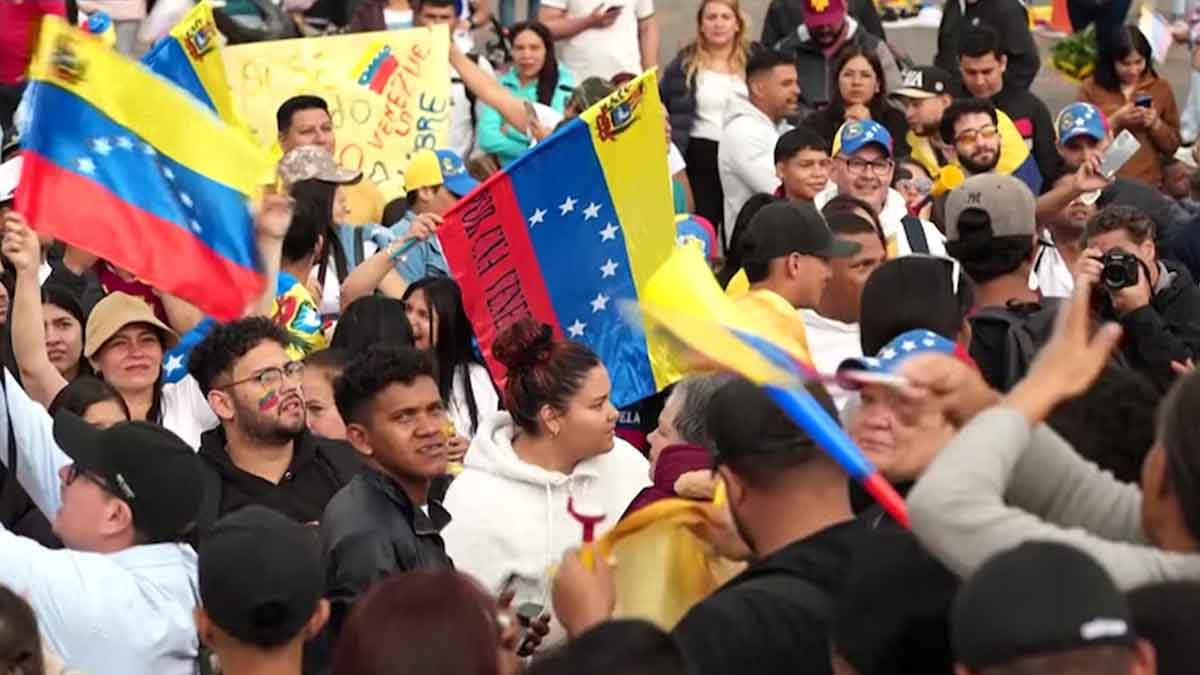
The US will temporarily "run" Venezuela after American forces captured the country's now-deposed president Nicolás Maduro and first lady Cilia Flores in an extraordinary military strike.
The move has garnered celebration and condemnation across the globe.
Here's how world leaders have reacted:
Australia
Australian Prime Minister Anthony Albanese said the government was "monitoring developments".
"We urge all parties to support dialogue and diplomacy in order to secure regional stability and prevent escalation. Australia has long held concerns about the situation in Venezuela, including the need to respect democratic principles, human rights and fundamental freedoms," he wrote on X.
"We continue to support international law and a peaceful, democratic transition in Venezuela that reflects the will of the Venezuelan people."
Britain
British Prime Minister Sir Keir Starmer said he wanted to "establish the facts first".
"I want to speak to President Trump," he said.
"I want to speak to allies.
"I can be absolutely clear that we were not involved … and I always say and believe we should all uphold international law."
Follow our blog for live coverage after the US action in Venezuela.
Ukraine
Ukrainian President Volodymyr Zelenskyy asked reporters, "How should I react to this?"
"What can I say?" he mused with a wry smile.
"If it's possible to deal with dictators this way, then the US knows what to do next." Israel Israel's Benjamin Netanyahu congratulated Mr Trump for "bold and historic leadership on behalf of freedom and justice".
"I salute your decisive resolve and the brilliant action of your brave soldiers," he said.
Germany
Germany's Foreign Ministry called for all parties to "avoid an escalation of the situation and to seek ways for a political settlement".
"International law has to be respected … Venezuelans deserve a peaceful and democratic future."
China
China's Foreign Ministry said it was "deeply shocked".
"[China] strongly condemns the use of force by the US against a sovereign country and the use of force against the president of a country," a ministry statement said.
France
France's Foreign Minister Jean-Noel Barrot said the capture of Mr Maduro "violates the principle of not resorting to force, that underpins international law".
"France reiterates that no lasting political solution can be imposed from the outside and that only sovereign people themselves can decide their future," he wrote on X.
South Africa
South Africa's Department of International Relations called on the UN Security Council to "urgently convene".
Russia
Russia's Foreign Ministry called the US act an "armed aggression against Venezuela", adding it was "deeply concerning and condemnable".
"The pretexts used to justify such actions are unfounded. Ideological animosity has prevailed over business pragmatism and the willingness to build relationships based on trust and predictability," it said.
"In the current situation, it is important, first and foremost, to prevent further escalation and to focus on finding a way out of the situation through dialogue."
Argentina
Argentine President Javier Mileir said Mr Maduro was rigging elections and "despite that, he clinged on to power".
"That's why I'd say that today's news is excellent news for the free world," he added.
Mexico
Mexico's Ministry of Foreign Affairs "strongly condemns and rejects the military actions".
"[The actions] carried out unilaterally in recent hours by the armed forces of the United States of America against targets in the territory of the Bolivarian Republic of Venezuela, [are] in clear violation of Article 2 of the Charter of the United Nations," it added.
Canada
Canada's Foreign Minister Anita Anand called on parties to "respect international law".
"We stand by the people of Venezuela and their desire to live in a peaceful and democratic society," she said. "Canada is engaging with its international partners and monitoring developments closely."
Paraguay
In a government statement, Paraguay said it was "closely monitoring current developments in Venezuela".
"[Paraguay's government] calls for prioritising democratic means that guarantee an orderly transition," it added.
Bolivia
Bolivia's Foreign Affairs Ministry reiterated its "commitment to peace, democracy, and coordination with the international community".
Panama
Panama's President José Raúl Mulino said his government was in favour of "democratic trials and in favour of accepting the legitimate wishes of the Venezuelan people".
"As expressed emphatically at the polls, where Edmundo González was elected," he added.
Brazil
Brazilian President Luiz Inácio Lula da Silva said the bombings "cross an unacceptable line".
"These acts represent a grave affront to Venezuela's sovereignty and yet another extremely dangerous precedent for the entire international community," he said. "Attacking countries in flagrant violation of international law is the first step toward a world of violence, chaos, and instability, where the law of the strongest prevails over multilateralism."
Belarus
Russian ally President Alexander Lukashenko said Belarus "categorically condemns" the US's actions.
Ecuador
Ecuador's President Daniel Noboa said the "time is coming for all the narco-Chavista criminals".
"Their structure will finally collapse across the entire continent," he wrote on X.
Uruguay
Uruguay's Foreign Ministry said it had always rejected the "military intervention by one country in the territory of another".
"[Uruguay] reaffirms the importance of respecting international law and the UN Charter, in particular the basic principle that States must refrain from resorting to the threat or use of force against the territorial integrity or political independence of any State, or in any other manner inconsistent with the Purposes of the United Nations," it said.
Chile
Chile's President Gabriel Boric said his country expressed its "concern and condemnation of the military actions of the United States in Venezuela".
"[Chile calls] for a peaceful solution to the serious crisis affecting the country." Colombia Colombia's President Gustavo Petro said he viewed the strikes with "deep concerns".
Iran
Iran's Foreign Ministry condemned the strikes "as a blatant violation of its national sovereignty and territorial integrity".
It called on the UN Security Council to "act immediately to halt the unlawful aggression" and hold those responsible accountable.
Cuba
Cuban President Miguel Díaz-Canel denounced the Venezuelan attacks, calling them an "unacceptable attack on international law".
"We do not accept or recognise the Monroe Doctrine, or kings or outdated emperors," he added.
Spain
Spain's Foreign Ministry called for "de-escalation and moderation".
"And for action to always be taken in accordance with international law and the principles of the UN Charter."
Italy The office of Italian Prime Minister Giorgia Meloni said the US external military action was "not the way to end totalitarian regimes".
"But at the same time [the PM's office] considers defensive intervention against hybrid attacks to its security to be legitimate, as in the case of state entities that fuel and promote drug trafficking," it added.

Stay tuned for the latest news on our radio stations