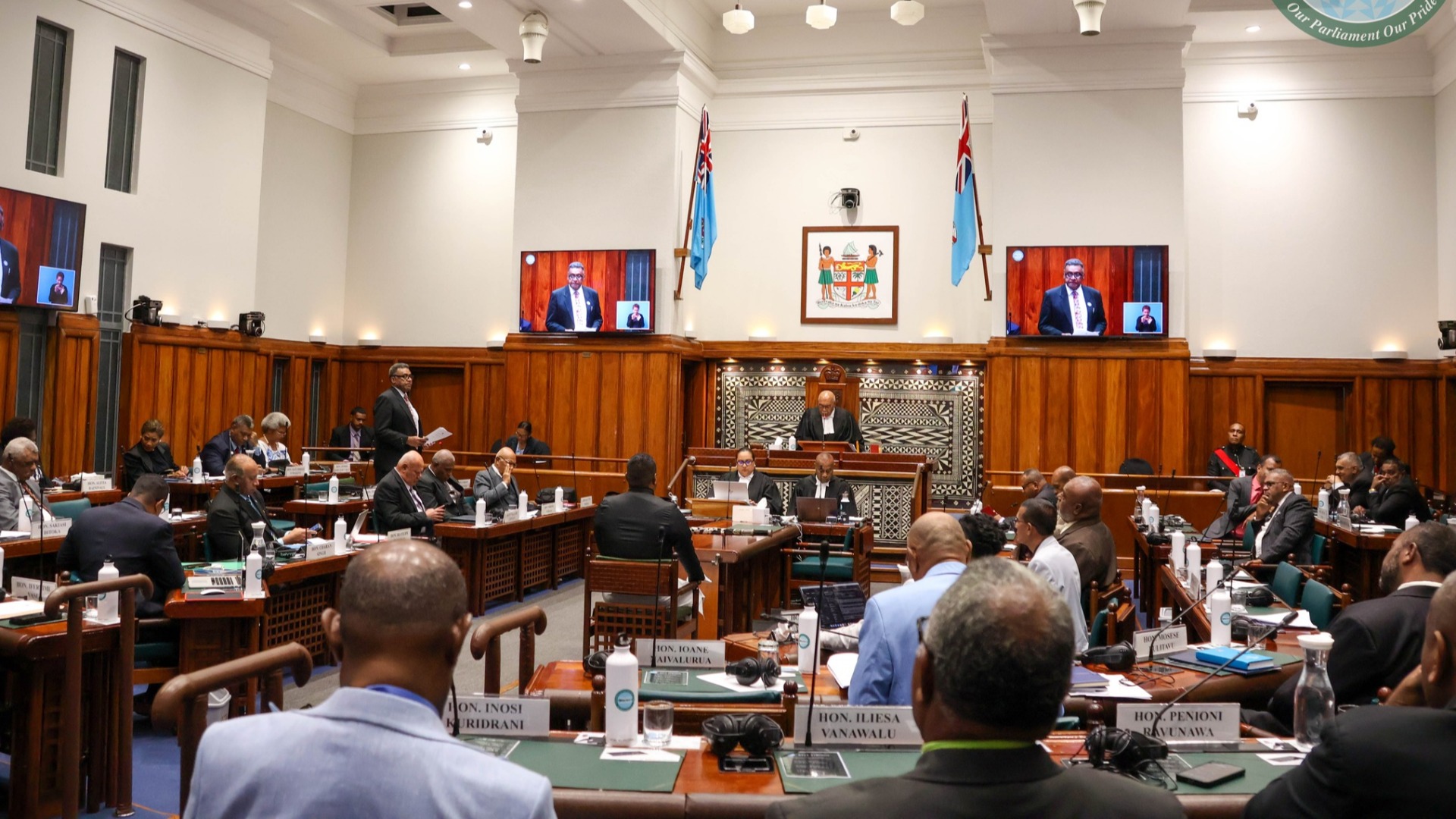
Parliament has unanimously passed a motion to increase the Government guarantee limit for the Fiji Development Bank borrowings from $190 million to $220 million for the period from 1st March 2026 to 28th February 2027.
The motion also states that the Bank will pay a guarantee fee of 0.075 percent on the cumulative utilised guarantee.
Parliament also approved that the Government guarantee for Fiji Development Bank borrowings will cover the 12-month period from 1st March 2026 to 28th February 2027 through the issuance of short and long-term bonds, promissory notes, term deposits, any Reserve Bank of Fiji financing facility and other short-term borrowings.
While supporting the motion, Opposition MP Faiyaz Koya cautioned Parliamentarians that they should know what they are signing today, quoting a particular paragraph in the medium-term fiscal strategy for the years 2025 to 2028 by the Ministry of Finance.
He says at the end of July 2024, the Government's total contingent liabilities stood at $1.6 billion, which is equivalent to about 11.4 percent of GDP.
Koya says this poses risks to public finances as around 60.1 percent of contingent liabilities are Government guarantees of public corporation debt.
He adds that public corporations such as Fiji Sugar Corporation Limited and Fiji Development Bank have already been assessed as high risk and this poses substantial fiscal risk and cost to Government should the contingent liabilities materialise.
While tabling the motion in Parliament, Finance Minister Esrom Emmanuel says the 2026-2027 Government guarantee request from the Bank is to continue the facilitation of government's policy by lending to the essential sectors of the economy, particularly resource-based sectors, including agriculture, mining and quarrying, manufacturing, transport, communication, Micro Small and Medium Enterprises, wholesale, retail and hotels, sustainable energy from fossils to renewable sources, and professional and business services.
He says FDB is operating well and based on the Bank's latest unaudited financial statement as of 31st January this year, it recorded a total loan portfolio of around $557.52 million as
compared to $550.92 million in 2025.
He also says this will assist disadvantaged people in the community to earn a decent livelihood.
Supporting the motion, Prime Minister Sitiveni Rabuka says the Fiji Development Bank was set up to assist in the development of the nation and its people.
He says the Bank has long had a strategic partnership with the people of Fiji in national development and as a development finance institution, the Bank plays a critical role in bridging the gap between commercial finance and the needs of sectors and communities that require targeted support to grow and prosper.
Rabuka says the Bank's mandate extends beyond conventional banking and it is fundamentally about empowering communities and individuals, enabling entrepreneurship and catalysing sustainable economic transformation, particularly in sectors where access to credit remains constrained.
He adds that through its development-orientated financing and advisory services, the Bank continues to support farmers, small business owners, co-operatives, rural entrepreneurs and emerging industries, helping to transform ideas into viable economic opportunities and improving livelihoods across the provinces.
The Prime Minister says the Bank's strategic direction aligns closely with the priorities of the Fiji National Development Plan and Vision 2050, particularly in advancing inclusive growth, strengthening rural development and expanding opportunities for Micro, Small and Medium Enterprises.
Rabuka says by focusing its investment in productive sectors such as agriculture, MSMEs and emerging value chains, the Bank plays a vital role in supporting diversification of the economy while strengthening resilience.
Former Minister for Finance Professor Biman Prasad says FDB has done very well over the years and if people look at the profit they made is an an indication of good management.
He says FDB has shown that despite these risks, they have been able to do well.