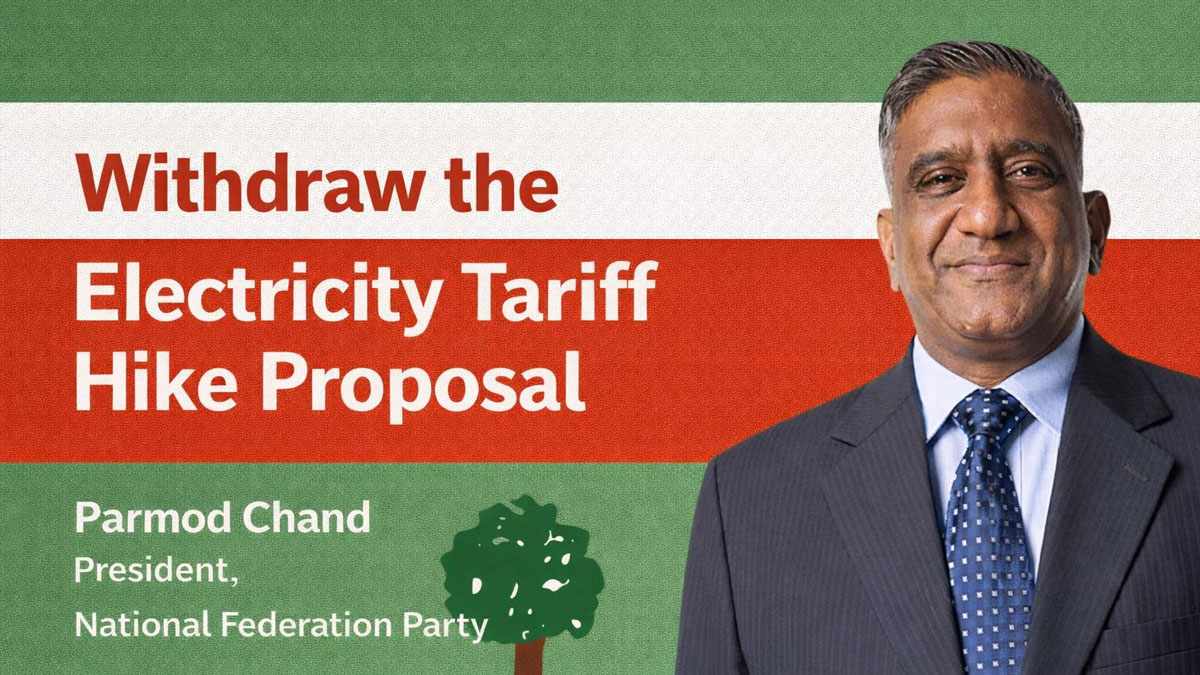
The National Federation Party is urging both Energy Fiji Limited and the Fijian Competition and Consumer Commission to withdraw the electricity tariff hike proposal in the national interest.
In a statement, NFP President Parmod Chand says there is no need whatsoever to increase electricity tariffs for residential, commercial and industrial consumers.
Chand says this is the only logical solution to end the uncertainty and controversy caused by what the vast majority rightly believe to be the unjust and secretive manner in which it was made public.
He says the Party has made its position known to the FCCC through a submission.
He adds that the electricity tariff hike, approved by the FCCC following a submission in May 2025 by EFL, has received widespread public condemnation, and the manner in which it was rolled out without any public consultation has been a catastrophic disaster.
Chand says even the public consultations now being carried out by the FCCC have been controversial, with many claiming they are not genuine.
The NFP President says EFL’s statement that 99,000 residential consumers will not be affected by the tariff increase is illogical, as the massive increase proposed for commercial customers will have severe consequences and raise the prices of goods and services.
He says this will affect people as businesses try to recoup revenue by raising prices.
He adds that inevitably the pockets of the people will be severely hit and inflation, which has been at record low levels in 2025, will rise.
Chand says the primary objective at all times must be to protect Fijians from unfair price and tariff hikes, as well as to safeguard the interests of the business community and increase investment.
He says the withdrawal of the proposal would be in conformity with what the Coalition Government has done since taking office to raise income levels, bring down inflation and generate investment to boost the national economy.
He also says that in the last three budgets, the Coalition Government has implemented several policies and strategies to reduce the cost of living for households through direct support and other measures.
He adds that among these measures, domestic customers who consume less than or equal to 100kWh per month and have a combined household income of less than or equal to $30,000 per annum qualify for a government subsidy.
The NFP President says the proposed electricity tariff would directly impact businesses and households that consume more than 100kWh per month.
He says while this will not directly affect households that consume less than or equal to 100kWh per month, the impact could still be felt through higher prices of goods and services as businesses pass the increased costs on to consumers.
Chand says business customers, for instance, will see an average increase of approximately 34 percent across four usage tiers.
He adds that any increase in the cost of living through this tariff hike would also dent the momentum of government strategies implemented in the last three budgets to ease cost-of-living pressures.
Chand says while investment in energy is crucial for security and sustainability, it must be balanced with the broader economic and social impacts on society and the economy.
He says in this regard, it is important to continue dialogue and discussions with the government and key stakeholders to source innovative financing.
The NFP is strongly encouraging EFL and the FCCC to consider the impact of any change in electricity tariffs on households, businesses and the overall economy.
They reiterate that, in the national interest and to protect the people, the proposal must be withdrawn.