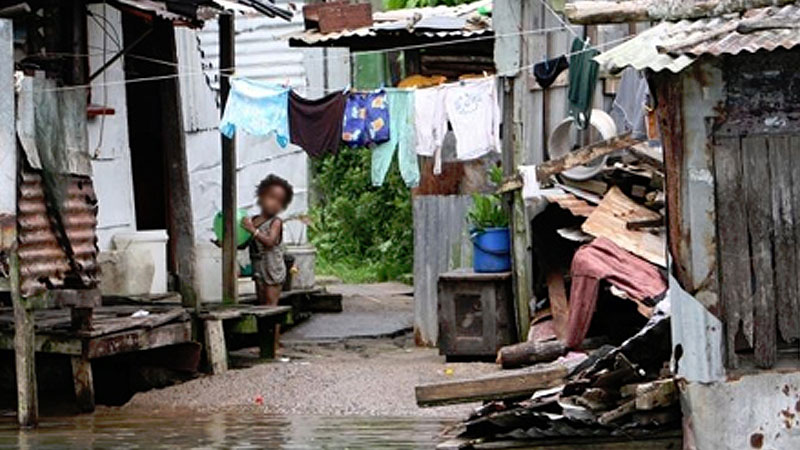
The Asian Development Bank says Fiji’s poverty rate has been rising, even before the impact of the COVID-19 pandemic, and the most recent household income and expenditure survey found Fiji’s cost-of-basic-needs poverty rate reached 29.9% in 2019– 2020.
In it’s recent reclassification of Fiji by the ADB from Group C to group B countries which means that Fiji will now be able to access concessional financing from the ADB, the report had highlighted that with modest economic growth rates (averaging 3.1% from 2015 to 2019) Fiji has found it challenging to significantly reduce remaining poverty.
It says at current rates, Fiji is unlikely to meet its 2030 Sustainable Development Goals poverty reduction target, which requires halving poverty in all its dimensions according to national definitions.
According to the ADB, Fiji’s human development index rating for 2019 was 0.743, second highest among Pacific Island countries. That positions Fiji in the high human development classification at 93 of 189 countries and territories.
It also says Fiji’s growth from 2010 to 2019 averaged 3.3 percent.
The ADB says the economy contracted by 0.4 percent in 2019, largely because of lower public spending coinciding with a global downswing, before plunging by 19 percent in 2020 as the COVID-19 pandemic impacted tourism and related sectors.
Fiji’s contraction during 2020–2021 was the third largest among ADB’s developing member country in the Pacific (after Palau and the Cook Islands).
The ADB says like other small island developing member countries, Fiji relies on tourism, which can be a volatile source of growth and revenues.
Tourism accounted for about 32 percent of Fiji’s gross domestic product in 2019; that share declined to 10.9 percent of GDP in 2020 because of travel restrictions associated with COVID-19.
Fiji’s economic outlook has been severely affected by the COVID-19 pandemic—both through the sudden stop in tourism and the effects on related sectors, and by extended domestic lockdowns in response to major virus outbreaks in 2020 and 2021.
ADB’s latest forecast is for a 5 percent contraction in 2021.
It says a rebound could occur in 2022 and 2023, but that would be contingent on a resumption in tourism.
The ADB says even if a recovery does start in the coming 1 to 2 years, the depth of Fiji’s depression means that it will take many years to return to pre-pandemic income levels.
It also says that even before the COVID-19 pandemic, Fiji’s public debt-to-GDP ratio was higher than other Small Island Developing States and had been steadily rising from 43 percent in the 2014 financial year to 48 percent of GDP in 2019, driven by sustained fiscal deficits coupled with major natural disaster-events requiring large reconstruction.
Public debt-to-GDP is projected to have jumped to 62.3 percent of GDP in the 2020 financial year because of the COVID-19 pandemic and the International Monetary Fund estimates this to reach 82 percent of GDP in the 2021 financial year. The government currently forecasts that public debt will peak at a record level of 91.6 percent of GDP in the 2022 financial year.
It also says the latest published IMF Article IV assessment, conducted in early 2020, noted that Fiji’s debt profile already showed moderate levels of risk of debt distress at the onset of the COVID-19 pandemic.
Nonresidents held 32 percent of public debt at the end of the 2021 financial year, while the remaining 68 percent was held by residents.
About half of the public debt is held by one entity: the Fiji National Provident Fund.
At this time, the IMF noted its expectation for public debt to increase steadily, posing greater risks to debt sustainability.
Disasters triggered by natural hazards and contingent liabilities from state-owned enterprises were also highlighted as posing further risks to public debt sustainability.
The IMF also notes that contingent liabilities have continued to surge during the pandemic as the government extended loan guarantees to state-owned enterprises and will require close monitoring.
A public expenditure and financial accountability assessment in 2020 scored Fiji a “B” for the quality of its debt management and an “A” for (i) recording and reporting of debt management and (ii) approval of debt and guarantees. However, Fiji earned a “D” for the absence of an endorsed debt management strategy.
To address this weakness, the government approved a new medium-term debt management strategy in January 2021 for the 2021 to 2023 financial year.
The strategy articulates the government’s debt objectives and outlines the framework for formulating and implementing a prudent borrowing program for the 2021 to 2023 financial years. It expresses the government’s intention to (i) source its financing needs and payment obligations at the lowest possible cost, balanced with acceptable levels of risk; and (ii) support the development of a wellfunctioning domestic market for debt securities.
To track the progress of the new strategy, the government is publishing information on debt cost and risk indicators in its quarterly and annual debt bulletins, which are made available to the public through the Ministry of Economy’s website.

Stay tuned for the latest news on our radio stations