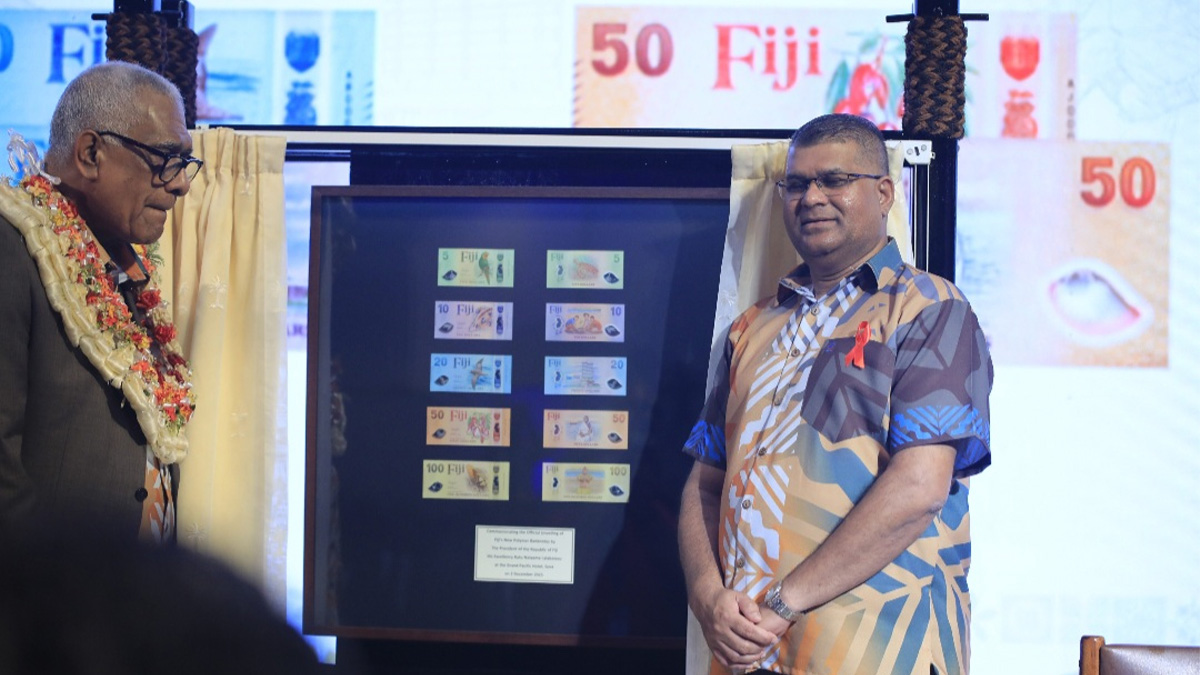
The Grand Pacific Hotel in Suva was the setting for a historic moment today as the Reserve Bank of Fiji unveiled the country’s newly designed banknotes, marking a major leap in currency modernisation, security and national identity.
RBF Governor Ariff Ali says the launch represents “a significant milestone in the ongoing modernisation of Fiji’s currency,” noting that while digital payments continue to expand, cash remains central to Fiji’s economic trust and inclusion.
Ali says the new polymer banknote series introduces vivid imagery celebrating Fiji’s culture, environment and heritage.
The $5 note features the endangered Vonu Dina (green sea turtle).
The $10 note shows children planting mangroves, symbolising Fiji’s climate resilience efforts.
The $20 note displays the Reserve Bank of Fiji building, recognising its central role in monetary governance.
The $50 note pays tribute to the girmit history, depicting a girmit woman with the Leonidas ship in the background.
The $100 note honours indigenous culture with an iTaukei man in traditional attire holding a bilo of kava.
Ali says he was confident that the new $100 note could be a contender for international design awards, given Crane Currency’s global recognition.
He adds that the shift to polymer notes will extend durability, reduce replacement costs and enhance security features against counterfeiting.
The Governor also highlighted the RBF’s commitment to environmental responsibility, revealing that the bank has offset carbon emissions associated with the production of the new notes and is working with recyclers to explore recycling opportunities throughout the cash cycle.
The launch also marks Fiji’s first collaboration with Crane Currency, a global banknote manufacturer with over 200 years of expertise.
Executives, designers and technical specialists travelled to Suva for the event.
He also clarified that Fiji’s coins are unlikely to undergo review before 2030 due to their durability and lower counterfeiting risks.

Stay tuned for the latest news on our radio stations