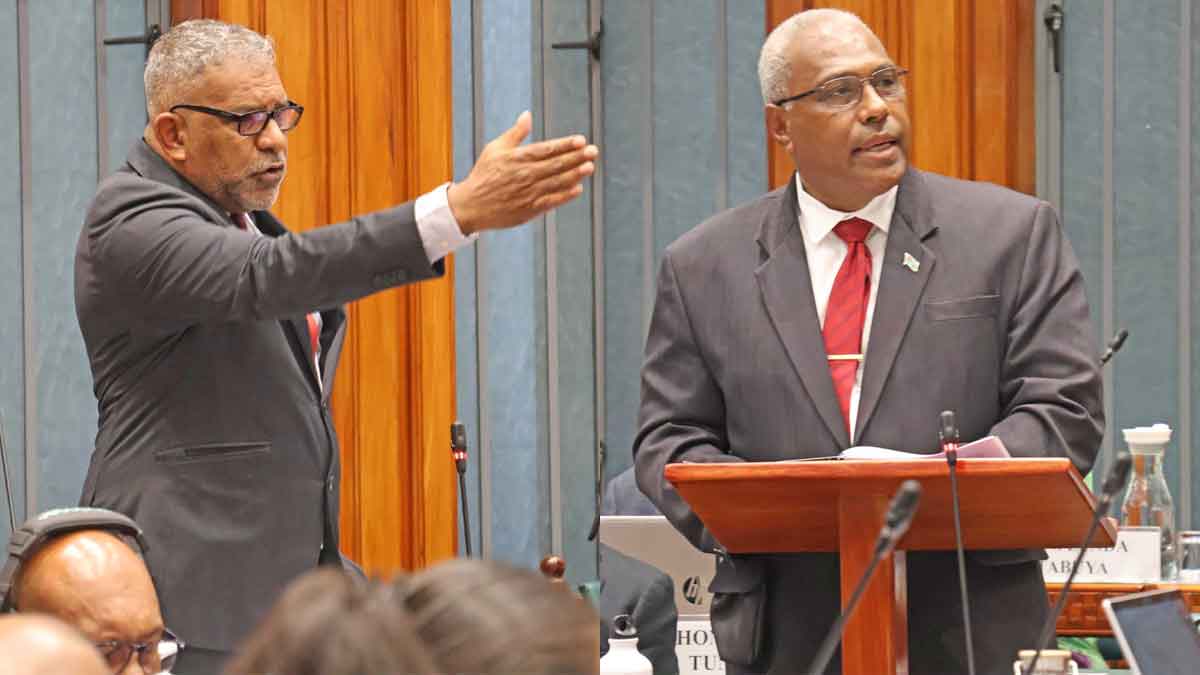
Opposition MP, Faiyaz Koya highlighted in Parliament today that he had a bone to pick with Acting Attorney General, Siromi Turaga for not inviting the Parliamentary Standing Committee on Justice, Law and Human Rights when having the first ever Justice Summit which also looked at the final report on the functional status of the Fiji Law and Justice Sector and the Law and Justice Sector Roadmap for Reform 2025-2029.
While responding to Turaga's ministerial statement, Koya says when you speak of legislative coordination, you must remember that Parliament forms one of the most basic parts of any Justice Sector Roadmap.
He says this is where the laws are made, this is where the laws are actually looked at, and one of the most important parts of the machinery in all of this is the Standing Committee on Justice, Law and Human Rights.
Koya says it is a very sad day that the committee was not invited as it is a also a very bipartisan committee.
He adds obviously, they will coordinate this through a minister, and through a law and justice advisory council.
Koya says it is not too late to seek an audience and sit with the actual committee.
@fijivillage.com Koya asks Turaga why Parliamentary Committee not invited to Justice Summit
♬ original sound - fijivillage
Turaga says Fiji's first-ever Justice Summit held last Wednesday at the Crowne Plaza in Nadi, hosted by the Ministry of Justice, with the support from the Australian Department of Foreign Affairs and Trade, brought together a diverse range of voices from across the sector, including members of the Judiciary, the Office of the Attorney General, Fiji Law Society, Fiji Corrections Service, law enforcement agencies, civil societies, the Great Council of Chiefs, and partners such as UNDP, UNICEF, SPC and the European Union.
The Acting AG says this was the first time ever in over two decades that such a comprehensive review of the law and justice system was undertaken.
Turaga says that some issues highlighted include the structural fragmentation and unclear mandates, judicial inefficiencies and persistent case backlogs, digital infrastructure deficits, human resource constraints, limited community engagement and legal awareness.
The report also revealed that 87 percent of Fijians are unable to access formal legal redress due to cost and complexity.
It also noted outdated laws, with some dating back to 1879, and institutions operating in silos without adequate coordination.
Turaga says the report now provides them with a roadmap to transform the resilience into reform and to move from coping to thriving.
He adds the law and justice sector reform roadmap 2025 to 2029, endorsed by cabinet, turns the finding of the report into clear, actionable priorities.
It is structured around seven reform pillars that collectively envision a modern, efficient and people-centred justice system.
The first is the justice system efficiency and backlog reduction, the second pillar is anti-corruption and oversight, the third pillar is the registry and legal identity modernization, the fourth is the access to justice and legal inclusion, law enforcement and rehabilitation reforms, legislative reform and inter-agency coordination, and the last pillar is the community engagement and legal awareness.

Stay tuned for the latest news on our radio stations