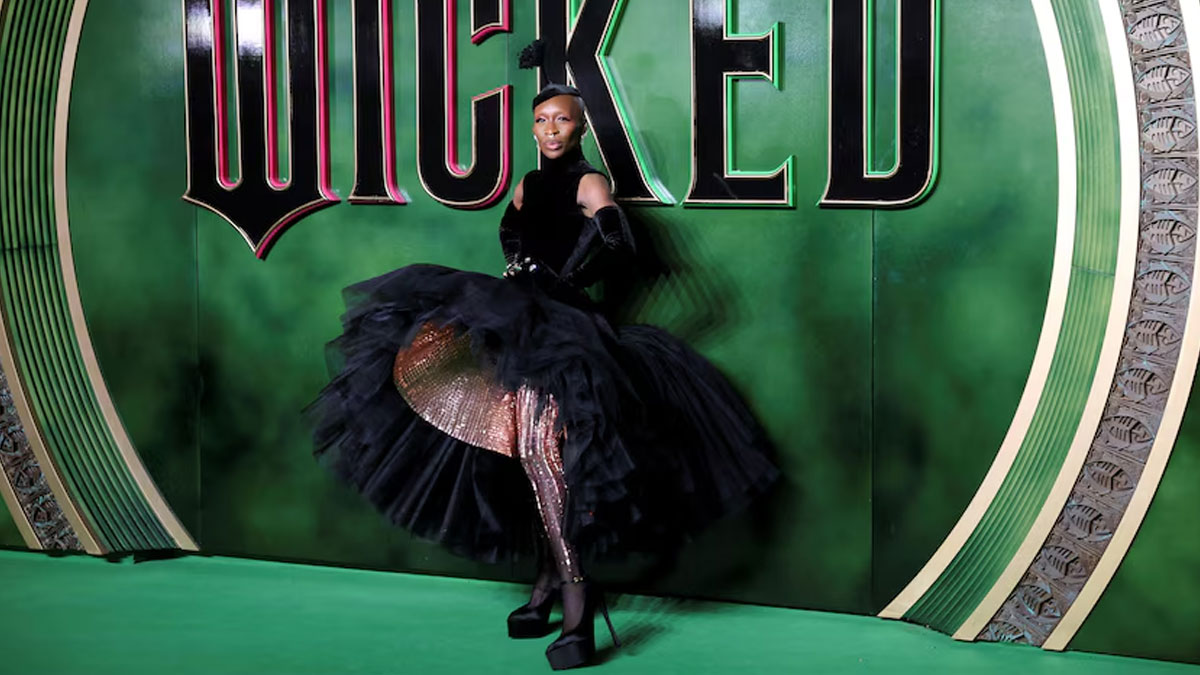
Her name is Look 28. She walked the haute couture runway in Paris earlier this year: a simple black velvet bodice, a butterfly-curved explosion of black tulle for a skirt, decorated below with a mosaic of fine beading, that continued down the leg of the model, making her part robot, part ancient Byzantine ceiling.
A little felt skull cap with a small spout of feathers completed the whimsy.
It was an astonishingly beautiful and intricate dress made by the creative designer of the storied house of Schiaparelli, Daniel Rosebery, and it stepped off the runway and into the real world this week, worn by Cynthia Erivo in London, one of the stars of the new movie juggernaut, Wicked.
The dress looked glorious on a singer and actor who knows the power of costume and design to transform. It is a dress of dreams — one we mere mortals will never get to wear. And that's its point.
It is almost embarrassing to admit how much pleasure seeing this dress out in the world gave me, but then again, I am well past apologising for the pleasures of design, fashion, couture and the remarkable creations that have entranced us for millennia. It's not just me. The stolen Egyptian and Roman costumes and jewellery treasures found in museums around the world prove it's not just me.
That dress represents the pinnacle of an industry that here in Australia is worth $27 billion, and while our designers may never work at the level of true haute couture, the trickle-down effect in fashion is real, just as Miranda Priestly reminded us all those years ago: our "cerulean blue" version of Look 28 is coming for us soon.
Fears for Australian Fashion Week The Australian fashion community is in survival mode at the moment, trying to draw attention to the critical need for Australian Fashion Week to continue, now that the entertainment juggernaut IMG has abandoned the event they have owned and run since 2005.
Designers and labels have made public representations to state and federal governments to help save an event that is tied to fashion, manufacturing and retail industries that employ thousands and economically contribute billions.
The event has always represented a significant moment of tension between Sydney and Melbourne, which had to take a more retail-based approach with its Melbourne Fashion Week (fashion that was in the stores and ready to buy at the time of runway) while AFW instead was an attempt at an industry event representing our highest echelons of style and design, the closest you might get to a London or New York fashion week.
Over the years the event has launched genuine design stars like Akira Isogawa, Collette Dinnigan and the Zimmermann sisters, and was always the happy hunting ground of icons like Carla Zampatti.
Australian designers now fear that if they lose the focus of the signal event that is fashion week, the industry loses as well in terms of attention and ultimately sales.
I find it sad that a significant industry event that follows a celebrated runway tradition might be about to end, but I also have a nagging question in mind: what is a fashion show anyway?
If you are not actually revealing a new season collection to potential local or international buyers anymore — and nobody comes over the waves these days to see our designs — then what is the purpose? In a digital-led space, do you hold a costly event like fashion week just to keep sweet with influencers, who certainly seem to be the majority presence at the Melbourne event?
We, the consumers, don't help Like filmmakers and musicians, our contemporary designers work in a connected, international world: one well aware of what the Schiaparellis are up to and what their artistry and innovation means for the fashion lover of the towns and suburbs of Australia. They need to continue presenting designs that may be aspirational only for some, but in reality, become the bedrock of a local, retail market.
But we the consumers don't help. Our addiction to cheap, fast fashion — one of the biggest in the world — throttles design, production and sales of Australian fashion in ways that I'm sure many of us don't allow ourselves to admit.
Clothing and the fashion industry are well-known now as some of the biggest polluters on earth: so how much new stuff – well-made or mass-produced — do we really need?
In my many years of journalism I've been an industry and manufacturing reporter — a private passion of mine in the state of Victoria that has lived through both rust-belt and innovation periods. I've been an art, fashion and design reporter, as well as a happy consumer of new styles, so I feel the pull of many influences when I write this.
I want Australian fashion to survive — and I want it to develop into the leading aesthetic industry that is has always had the potential to be. But the making of clothes is a morally fraught concept now.
I am delighted and creatively stimulated by the brilliance of Cynthia Erivo's frock: a mad folly of extraordinary craft, labour and money that will be worn only once, maybe donated to a museum, but will live on in memory and in the diffusion of its aesthetic down through the more affordable items we will be buying next.
So, even extravagant confections like this play a role, and not only in keeping alive crafts that we revere enough to fill our museums with their examples, but also employ generations, and keep alive retail markets that still matter.
You may wish that that such retail wasn't as economically significant as it is — but I bet you weren't thinking that when you last found that perfect little black dress at 50 per cent off. Or paid only $14 for a dress that won't last you a month.
This weekend we have a lovely little reflection on the magical acting partnership that is at the heart of Wicked, as well as insight into the murder mystery that still shrouds one of our greatest designers.

Stay tuned for the latest news on our radio stations