A sophisticated Chinese spy ship monitored Australian, Philippines, United States and New Zealand naval forces as they conducted joint exercises in the South China Sea last week, with Beijing again labelling Manila a "troublemaker" intent on undermining "regional peace".
Meanwhile, Defence Minister Richard Marles used a weekend meeting with his Chinese counterpart to again raise Australia's concerns about the Chinese military in the region after another potentially dangerous encounter between a Chinese fighter jet and Australian surveillance aircraft last month.
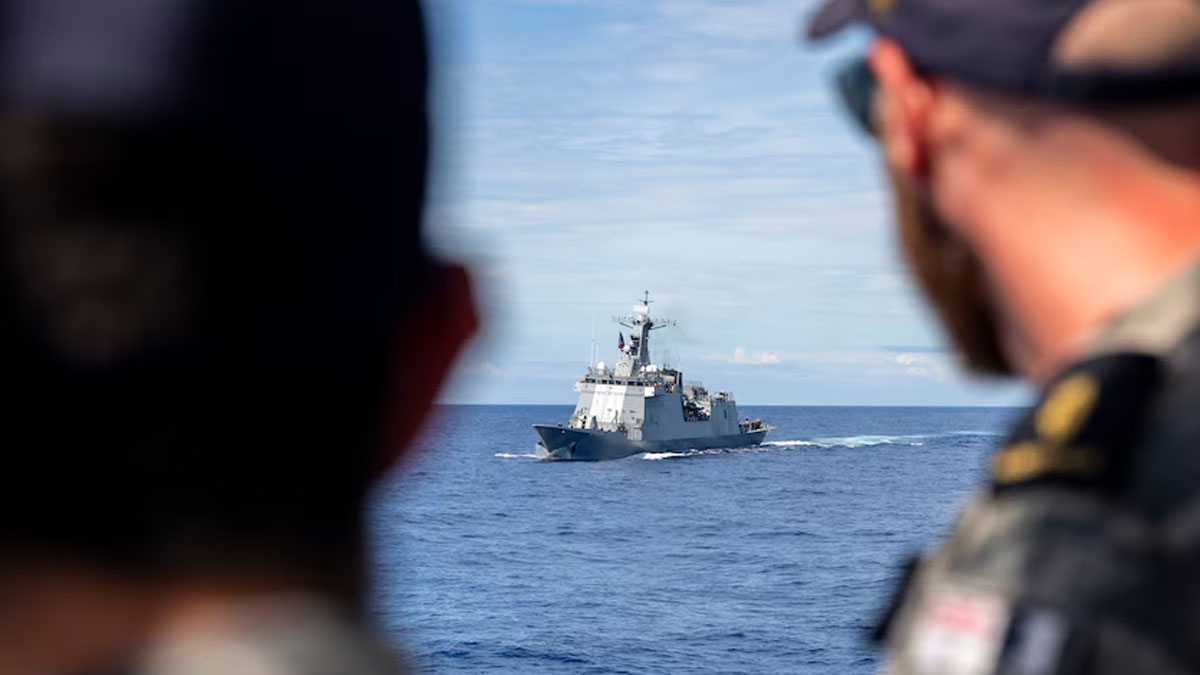
Late last week, the Australian warship HMAS Ballarat joined a Philippines frigate, a New Zealand refueller, a US destroyer and a US P-8 surveillance plane for what the Defence Department called a "multilateral maritime cooperative activity" in the eastern South China Sea.
Defence said the exercises showed all nations were determined to "uphold the right to freedom of navigation and overflight" in the region, while "enhancing interoperability and strengthening cooperation in support of a peaceful, stable and prosperous Indo-Pacific".
Men look towards a ship.
Australia, New Zealand, the Philippines and the United States ran a joint exercise within the Philippines’ waters. (Supplied: Department of Defence)
The activity took place within the Philippines Exclusive Economic Zone, with Defence saying Australia "reaffirms" a "final and legally binding" 2016 international legal decision that rejected the bulk of China's claims to disputed maritime features in the region.
China labels Philippines 'troublemaker'
There have been clashes between China and the Philippines near contested features and a growing number of democratic nations — including the US, Japan, Australia, Canada and New Zealand — carrying out joint exercises with Philippines naval forces to demonstrate their support for Manila.
China's military sharply criticised the latest defence activities, with Chinese People's Liberation Army (PLA) Southern Theatre Command spokesperson Tian Junli saying the "so-called joint patrols" from "non-regional countries" had "severely undermined regional peace and stability".
"The recent developments further confirm that the Philippines is acting as a troublemaker in the South China Sea issue and a disruptor of regional stability," Mr Tian said.
He also said that the PLA Southern Theatre Command had "mobilised forces to closely track and monitor the activities".
A Philippines military spokesman said five Chinese naval ships had been spotted nearby during the exercises.
Online analysts identified at least one of those ships as a Type 815 Dongdiao-class surveillance ship, which uses powerful radar and antennae to gather intelligence.
Euan Graham, from the Australian Strategic Policy Institute (ASPI), said it was "no surprise" to see China continuing to "thicken its presence" in the region.
"It has the means to do so with its artificial islands nearby and it's consistent with China's modus operandi with South-East Asian nations: they are progressively trying to crowd them out," he said.
Dr Graham said the Philippines felt like "it was in the crosshairs of strategic interest" from Beijing in the South China Sea, and the Marcos administration was seeking more support from countries that shared its concerns about China's aggressive behaviour.
"These activities have become more complex and are bringing in more outside players," he said.
"I think the frequency has also increased … it's a gathering coalition coming into being. It makes the point that the Philippines has support both diplomatically and also militarily. Start typing here
[Source: ABC]

Stay tuned for the latest news on our radio stations