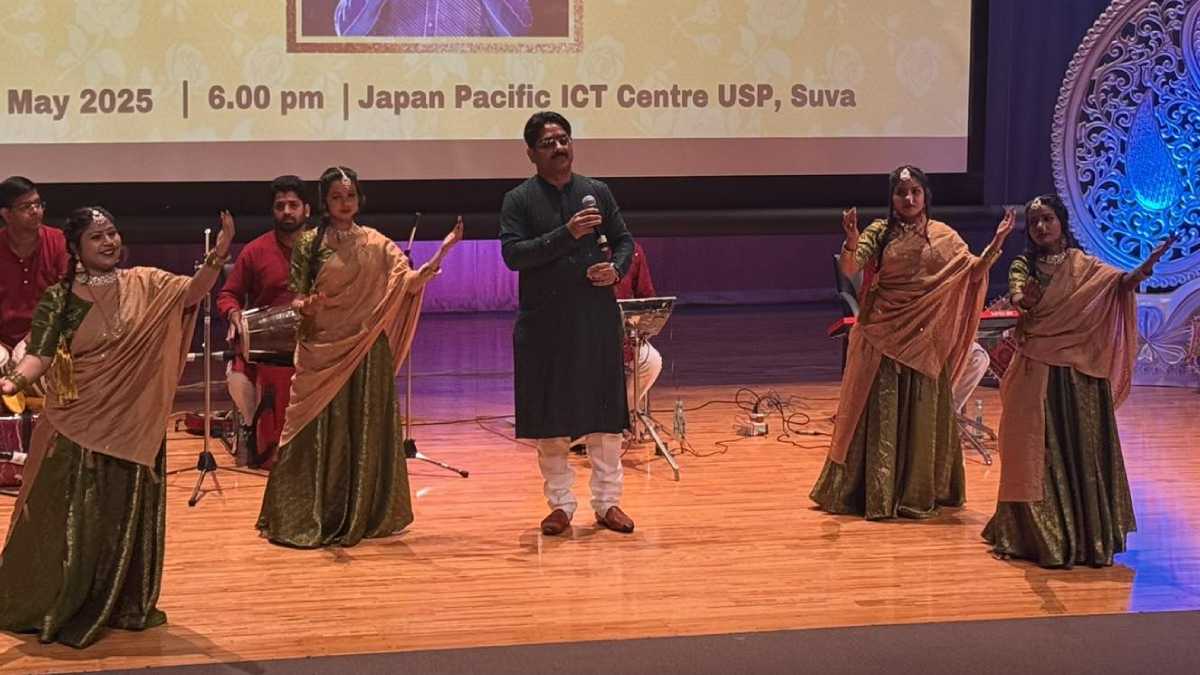
The Indo-Fijian community turned out in large numbers to enjoy a vibrant evening at the Bhojpuri Folk Dance and Music Show, held at the Japan-Pacific ICT Centre at the University of the South Pacific yesterday.
A special dance and music performance was presented by Rakesh Upadhyay and his group from India, in the Bhojpuri language, reflecting the journey of the girmitiyas from their homeland to a new land.
Bhojpuri is a dialect spoken primarily in the western part of Bihar and the eastern part of Uttar Pradesh, places from which most Indians came to Fiji during the indenture system.
India’s High Commissioner to Fiji, Suneet Mehta says the girmitiyas have laid the historical foundation of both countries.
The High Commissioner also notes the recent visit of the Indian Minister of State for External Affairs, Pabitra Margherita, which strengthened the relationship between the two nations through the signing of a memorandum of understanding with Fiji’s Ministry of Health. This agreement enables Fiji to source medications directly from India.
Speaking at the event, Deputy Prime Minister and Minister for Finance, Professor Biman Prasad acknowledged the support of the Indian Government.
He says that much has changed in the country since the arrival of the first Indian migrants, but the people-to-people links have endured and continued to grow over time.
Professor Prasad says India's relationship with Fiji has been strengthened through several initiatives, whether through the Indian Council for Cultural Relations (ICCR), the Know India Programme, or the various scholarships provided by the High Commission of India.
He adds that having a group from India perform in the language of Indo-Fijian ancestors gives the community a sense of affinity with India.
The Deputy Prime Minister also emphasises that the Prime Minister of India, Narendra Modi, has publicly recognised the significance of the girmit history and has called on all countries with Indian diaspora communities to undertake more research, as well as promote cultural and linguistic activities to keep the history of girmit alive for future generations.

Stay tuned for the latest news on our radio stations