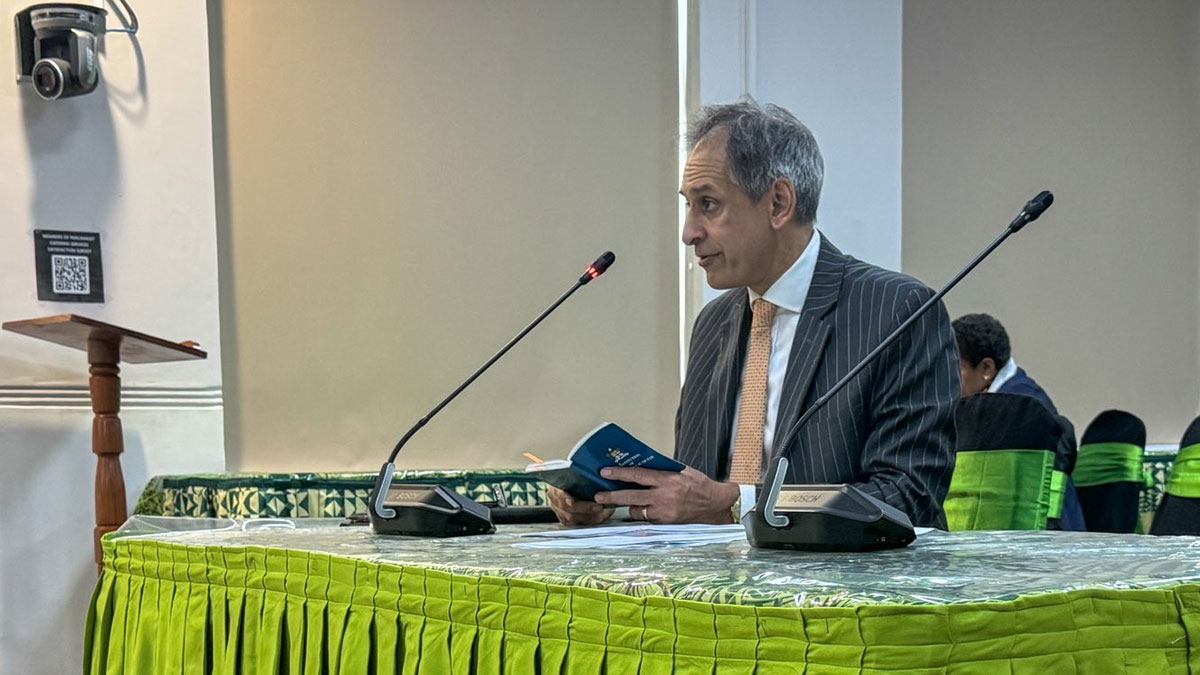
Prominent lawyer Richard Naidu has strongly objected to clauses 22, 23 and 27 of the National Referendum Bill, arguing that they unjustifiably restrict freedom of expression and political rights guaranteed under the Constitution.
While making his submission to the Parliamentary Standing Committee on Justice, Law and Human Rights during consultations on the Bill, Naidu has warned that the Bill’s attempt to regulate “misleading and deceptive” material risks criminalising legitimate political opinion.
Focusing on clause 23, Naidu says the provision fails to recognise the subjective nature of political debate, particularly in a referendum that is not about political parties but about competing ideas and causes.
He questions why the Bill appears to restrict basic campaign activities such as door-to-door canvassing.
He says home visits are a fundamental part of democratic participation.
INSERT: Naidu on voting 20th Jan
Naidu also criticised clause 27, which limits the involvement of people under 18 years in referendum-related activities.
He questions why children cannot be taught about how democracy works in practice.
Naidu expresses concern that, despite objections being raised publicly and during the consultation process, the government continues to defend the clauses.
He says the government has not really explained why these clauses are there and that, when objections were raised, instead of saying they had been noted, the government appeared to double down and justify why the clauses existed.
Naidu rejected the government’s claim that the provisions reflect international best practice, particularly comparisons with Singapore, saying that similar clauses in Singapore’s referendum law date back to 1961.
He says Singapore is hardly a model of freedom of expression, adding that international rankings place Fiji ahead of Singapore on civil and political rights.
@fijivillage.com Prominent lawyer Richard Naidu says the government should remove Clauses 22, 23, and 27 from the National Referendum Bill (No. 46 of 2025)
♬ original sound - fijivillage
He says the law is 65 years old and does not make sense in 2025 or 2026.
Despite his criticism, Naidu says he supports the need for a referendum law, noting that the Supreme Court has made it clear that constitutional change must be approved by referendum.
He says there needs to be a Bill, but in the course of preparing a document that may not be perfect, clauses that restrict people’s fundamental rights, such as clauses 22, 23 and 27, should not be included.
Naidu told the committee that the three clauses are unnecessary and that the legislation would remain workable and intact without them.
Public consultations on the National Referendum Bill continue at the Parliament Complex.
@fijivillage.com Naidu warns clauses in Referendum Bill restrict freedom of expression and political rights #FijiNews ♬ original sound - fijivillage

Stay tuned for the latest news on our radio stations