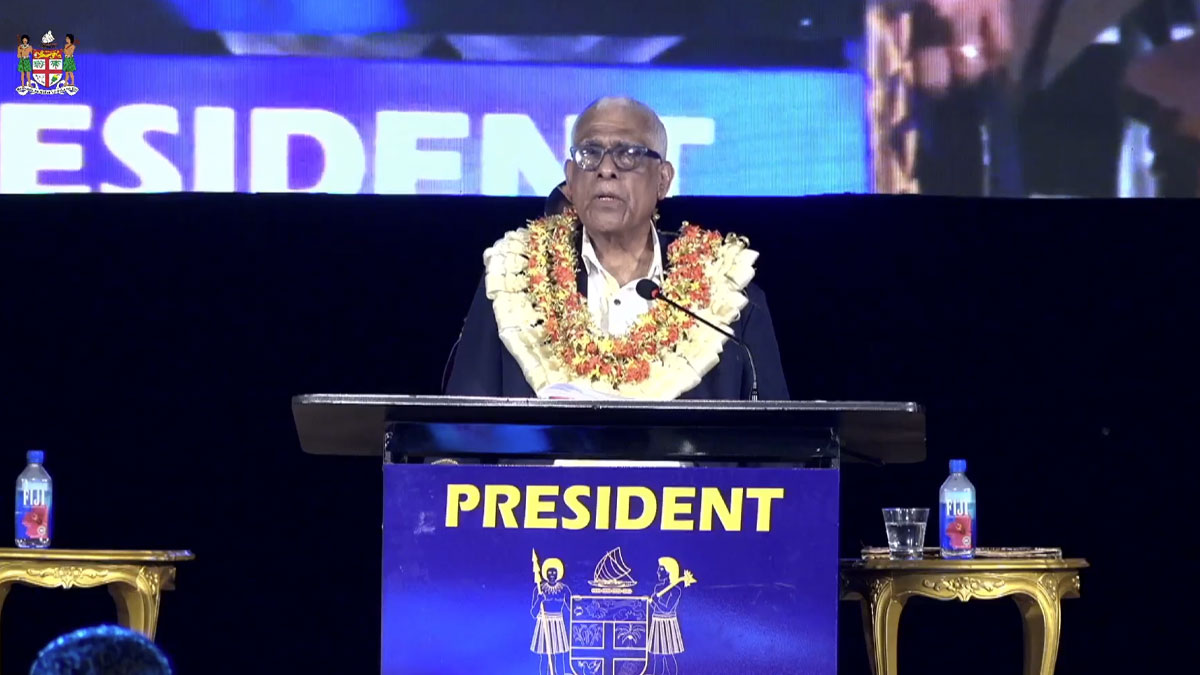
The fact that we have had four Constitutions means that we have tried and failed to establish a foundation that is acceptable to the majority of the people.
That is the comment by President, Ratu Naiqama Lalabalavu at the Attorney General's Conference currently underway at the Sheraton Resort in Denarau.
The President says the challenge that we now face collectively as a nation, is to get the Constitution right this time, and to strengthen our Institutions of State, to ensure that never again will we go through the political disruptions that have scarred our nation.
He says the people of Fiji have had to grapple with the effects of the political events that preceded the changing of our Constitution four times in the last 38 years.
Ratu Naiqama says he is encouraged by the work of the Truth and Reconciliation Commission where the Prime Minister testified last week.
The President says there is much pain in our nation and the Truth Commission offers us the opportunity to listen to each other and to learn to come together to rebuild our nation.
The conference program requires attendees to review the structures that underpin the functioning of our State which include the design of our electoral system and institutions, the governance of native land, the protection of our children, the threat of transnational crime, and the imperative of securing our digital domain.
The President stresses that as we consider constitutional reform, we must be guided by a fundamental truth: that a Constitution must be made “by the people, for the people.”
Ratu Naiqama says electoral systems must be trusted, understood, and embraced by the people.
He says the discussions on the strengths and weaknesses of previous and current electoral frameworks form an integral part of the broader national conversation on constitutional review.
The President stresses that for both the Constitution and the Electoral laws, a robust consultation process is essential.
He also emphasises that let us not have constitutional consultations merely to tick a box.
He reiterates that the people should be heard at every stage: from the very beginning, including the preparation of the Terms of Reference, the appointment of members of the Constitution Review Commission, the formulation of consultation documents, through public hearings and the people should be able to see the draft law or Bill, and to comment on it, before it is tabled in Parliament.
The President says this is because the people of our nation will have a stake or ownership in a law that they have contributed to, have of that law, and will support and participate in its implementation.
He also says all documents including consultation documents, the Final Report, and the Bill should be translated into our main languages.
Ratu Naiqama says the Attorney General’s Office must work closely with the Great Council of Chiefs.
He says the Fijian Affairs Act, as it then was, required the Government to table Bills or draft laws to the Great Council of Chiefs, which has an advisory role, to Government.
The President says he is not sure whether that provision is in the new legal provisions that revived the GCC in 2023 but he would urge the Attorney General to look into this matter, especially with the Constitution review coming up, as announced by the Prime Minister.
Ratu Naiqama says earlier this week, the Indigenous Rights Bill was tabled in Parliament, and he hopes the Bill was tabled to the GCC.
The President says the United Nations Declaration on the Rights of Indigenous Peoples (UNDRIP) on which the Bill is modeled, requires the “free, prior, informed consent” of indigenous peoples to any laws, programs or decisions that affect them.
He says the Referendum Bill, to guide the process to be undertaken to table the Constitutional amendments to the people of Fiji, was tabled yesterday.
He strongly urges the Attorney General to ensure that the Great Council of Chiefs is involved in the consultations.
Ratu Naiqama says this is because sovereignty is not absolute so we must have the free, prior, informed and consent of the people, to the most important, foundational document for our nation, the Constitution.