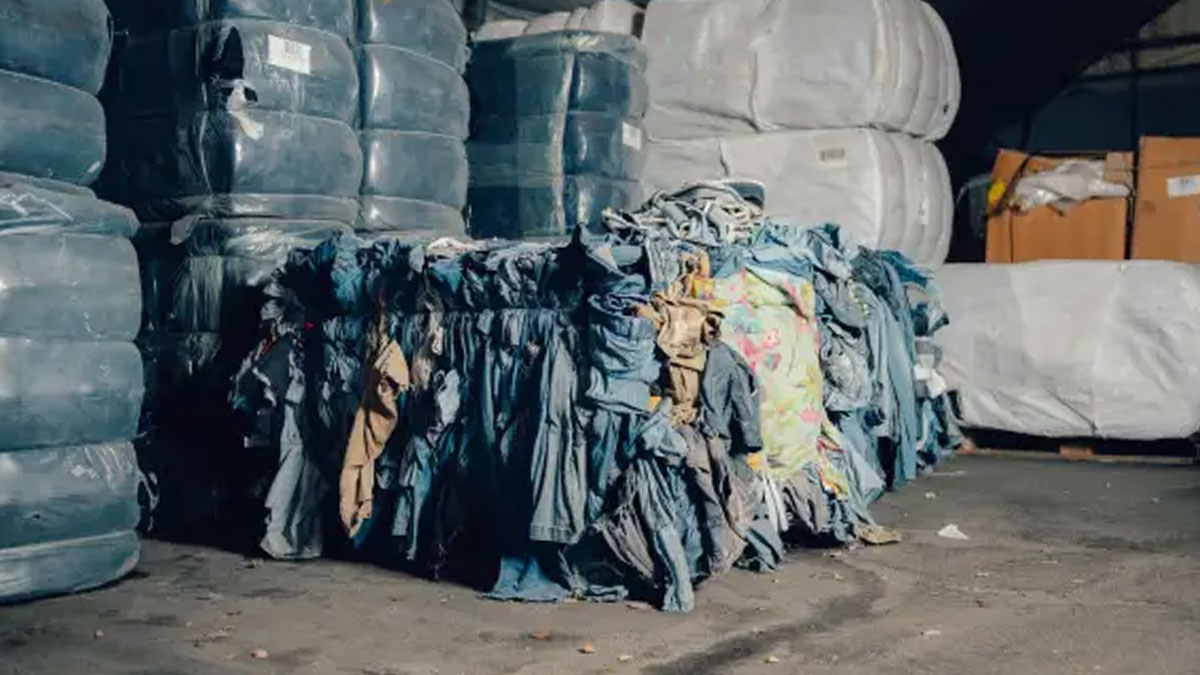
The fashion industry has a very well-known waste problem.
Almost all (roughly 97%) of clothing eventually ends up in a landfill, according to McKinsey, and it doesn’t take very long for the lifecycle of the latest apparel to reach its end: 60% of clothing manufactured hits a landfill within 12 months of its manufacturing date.
In the last two decades, that concerning trend in clothing production has accelerated enormously with the rise of fast fashion, multinational production, and the introduction of cheaper plastic fibers.
The multi-trillion dollar fashion industry contributes significant greenhouse gas emissions, between 8% to 10% of total global emissions, according to the United Nations. That is more than all international flights and maritime shipping combined. And as other industries make progress on carbon reduction solutions, fashion’s carbon footprint is forecast to grow — it is predicted to account for over 25% of the world’s global carbon budget by 2050.
The apparel industry wants to be taken seriously when it comes to recycling, but even the simplest solutions haven’t worked. According to sustainability experts, as much as 80% of Goodwill clothing ends up going to Africa because the U.S. secondhand market can’t absorb the inventory. Even local drop-off bins send clothing to Africa due to the complexity of the domestic supply chain and overflow.
So far, refashioning old clothing into new clothing has barely made a dent in the industry. Currently, less than 1% of textiles produced for clothing are recycled into new clothing, which comes at a cost of a $100 billion a year in revenue opportunity, according to McKinsey Sustainability.
One big problem is the blending of textiles now common to the manufacturing process. With the majority of textiles in the fashion industry blended, it is harder to recycle one fiber without harming another. A typical sweater can contain multiple different types of fibers including a blend of cotton, cashmere, acrylic, nylon and spandex. None of the fibers can be recycled in the same pipeline, as has been economically done in the metals industry.
“You would have to decouple five intimately blended fibers and send them to five different recycling scenarios in order to recover most sweaters,” said Paul Dillinger, head of global product innovation at Levi Strauss &
The complexity of the fashion recycling problem is behind new business models that have emerged at companies including Evrnu, Renewcell, Spinnova, and SuperCircle, and some big new commercial operations.
Spinnova partnered with the world’s largest pulp and paper company this year, Suzano, to turn wood and waste into recycled textile fiber.
“Increasing the textile-to-textile recycling rate is at the heart of the issue,” said a Spinnova spokeswoman. “There is very little economic incentive to collect, sort, shred, and bale textile waste, which are the first steps in the recycling loop,” she said.
Textile waste, by some measures, is a bigger issue than plastics waste, and it has a similar problem.
“It is a really low-cost product where the output doesn’t have significantly high value and the cost to identify, sort, aggregate, and collect items is much higher than what you can get from the actual recycled output,” according to Chloe Songer, CEO of SuperCircle, which offers consumers and brands the ability to have a variety of finished products mailed to its warehouses for sorting and recycling — and credit towards the purchase of items from the Thousand Fell recycled sneaker brand run by its CEO.
“Impact unfortunately costs money, and it’s figuring out how to make that make business sense that’s important,” Songer said
Source: CNBC

Stay tuned for the latest news on our radio stations