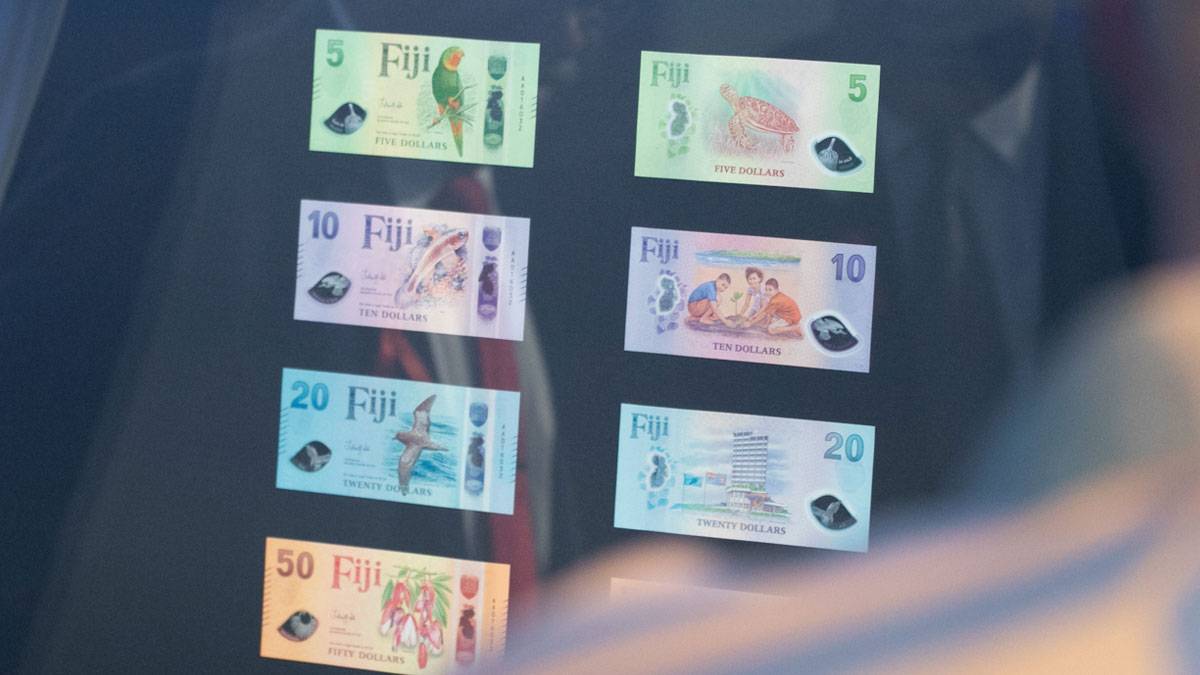
A note identifier card is set to be introduced as an interim measure to help persons with visual impairment distinguish between Fiji’s new banknotes.
The development follows high-level discussions between the United Blind Persons of Fiji and the Reserve Bank of Fiji, after blind and low-vision users across the country reported ongoing difficulties in independently identifying denominations since the new banknotes entered circulation this month.
UBP Office Manager Josaia Suqesuqevanua confirmed to fijivillage News that the meeting attended by the Deputy Governor of the Reserve Bank and the Manager for Currency, focused on accessibility challenges experienced by members when handling the new notes, challenges he says directly affect independence, confidence and financial safety.
As Fiji’s national organisation representing persons with visual impairment, Suqesuqevanua says UBP has expressed deep concern that the current banknote series does not adequately meet accessibility needs.
He says they have reported confusion and uncertainty when handling cash, increasing reliance on others and raising the risk of financial error or exploitation.
Suqesuqevanua says one of the most significant issues identified is the lack of clear size differentiation between denominations.
He says previous banknote series featured a consistent two-inch size difference between notes, a tactile design element introduced following consultation with UBP.
He says this feature enabled blind and low-vision users to identify denominations independently.
In the new series, however, the size variation is no longer easily detectable.
UBP has also criticised the absence of meaningful consultation during the design and development of the new banknotes.
Despite having previously served on the Currency Committee and contributing to successful accessibility improvements in earlier series, Suqesuqevanua says they were not consulted at any stage of the latest redesign.
Although the new banknotes include raised dot features intended to support tactile identification, he says these markings do not conform to recognised braille standards and therefore fail to provide meaningful assistance.
Suesuqevanua says the $50 note reportedly contains eight raised dots, while the $100 note features dots arranged horizontally — neither of which corresponds to any recognised braille character.
He says in braille, symbols are based on a six-dot system.
He says UBP have acknowledged that changes to the current banknote series are unlikely in the short term, however, he says constructive discussions with the Reserve Bank have resulted in practical interim steps, including the provision of note identifier cards and joint awareness programmes to assist users in adapting to the new currency.
He adds that Reserve Bank is expected to engage directly with UBP members during the organisation’s Annual General Meeting in March, where nationwide awareness and education on the new banknotes will be carried out.
He stresses that if something is being designed for persons with disabilities, they must be included from the very beginning, from planning and design through to implementation.

Stay tuned for the latest news on our radio stations