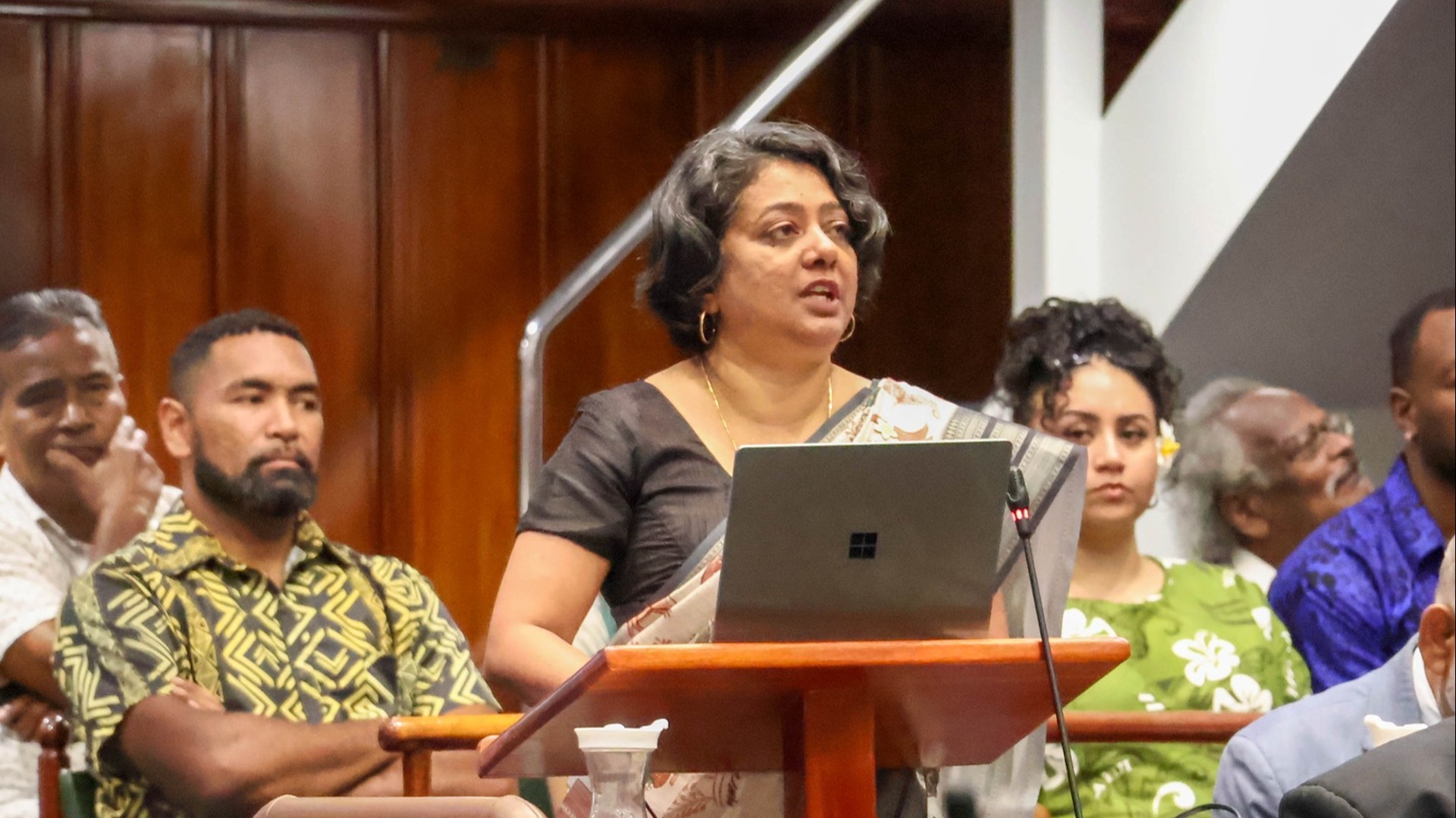
Minister for Women, Children, and Social Protection, Sashi Kiran says that it is very concerning that over 70 percent of young men aged 18 to 35 years endorse beliefs and norms that normalise or justify violence against women under certain circumstances.
While presenting on the Social Cohesion and Reconciliation (SCORE) Index Assessment for Fiji during her ministerial statement, Kiran says specifically, 31 percent believe that women who speak openly about abuse by their husbands should be shamed, and 22 percent believe women should tolerate violence to preserve family unity.
The Minister says these attitudes reflect the deep entrenchment of harmful gender norms and the social acceptance of coercion and silence, underscoring the urgent need for transformative, gender‑responsive approaches and targeted engagement with young men to challenge norms, shift attitudes, and prevent violence.
She says the SCORE Assessment measures perceptions and attitudes; it captures how people perceive and feel about trust, inclusion, leadership, democracy, and coexistence, across ethnicities, provinces, gender and age groups, education levels, and socio-economic backgrounds.
The Fiji SCORE assessment focused on three social cohesion dimensions including intergroup social dynamics - examining intergroup trust, harmony and tolerance and shared national identity; positive Citizenship - measuring trust in institutions, support for democratic values, reconciliation, and human rights, ang gender equality and social norms - assessing support for women’s leadership, gender stereotypes and violence against women and girls
Kiran says it is important to emphasise that SCORE does not label, categorise, or stigmatise any group or community, and does not prescribe political positions.
She says instead, it provides a mirror - a structured reflection of lived experience, perceptions and attitudes.
The Minister says SCORE is, therefore, a tool to support informed, responsible decision‑making and social development planning at all levels.
She says the SCORE Assessment presents a nuanced and balanced picture of social cohesion in Fiji – one that reflects both our strengths and areas requiring attention: Firstly, it indicates Strong Foundations of Social Cohesion but with Underlying Strains.
Kiran says the findings also show that there is generally a high level of trust and openness to peaceful coexistence and reconciliation among Fijians.
She says for example, over 80 percent of iTaukei and Indo-Fijians report trust and acceptance of their families and communities.
The Minister says this itself gives us much hope, as the assessment also shows there is a shared sense of national pride and attachment to Fiji and the Fijian identity across different communities.
She says at the same time, the assessment identifies that we are operating in a climate where polarising stories and harmful stereotypes still hold ground, threatening to pull us apart.
Kiran says for example, 49 percent of iTaukei respondents believe that Indo Fijians do not respect the iTaukei way of life and culture, while 50 percent of Indo Fijians believe Fiji’s development would be stronger with more equal participation in politics and access to land.
She says these narratives tend to gain traction when people perceive competition over resources and power, insecurity, exclusion, or unfair governance.
The Minister says secondly, the assessment indicates that there is trust in institutions where the assessment indicates generally strong but varying levels of trust in public institutions and political leadership.
She says while Institutional legitimacy and support for democratic and multiethnic government are strong, there is a weak attachment to democratic culture, including civic engagement, participation and accountability.
Kiran further says the results indicate strong pro-democracy sentiment.
She says majority of respondents (59 percent) state that they prefer democratic governance even if it involves negotiation, compromise, and delays.
The Minister says furthermore, 72 percent expressed support for a democratic and multi‑ethnic system of government, even when this may require sacrificing some interests of their own ethnic group.
She says that together, these findings suggest a strong commitment to inclusive governance and pluralism, prioritising democratic principles over narrow group interests.
The Minister says however, it is worrying to note that 40 percent of respondents agree to strong-arm leadership to achieve a goal.
She says the fourth insight is about Women’s Leadership which shows positive but uneven support for women’s leadership.
Kiran says support is particularly strong among young women, people in rural communities, and those with higher levels of education.
She adds for example, 81 percent of young women support women’s political leadership compared to 66 percent of young men, and in provinces such as Lau and Kadavu, over 85 percent of respondents endorse women as leaders.
