For most of her life, Lagueria Davis "hated" dolls.
Her reasons are all the usual ones. Davis, who is Black, felt like the white dolls she reluctantly played with as a child were telling her "all the things [she] was supposed to be as a little girl that [she] didn't really embrace", making her feel like "less of a girl" since she wasn't interested in changing nappies or fashion, and wasn't a white, blonde woman with blue eyes.
While Davis spent most of her life wondering what there is to like about dolls, her 86-year-old aunt Beulah Mae Mitchell has dedicated much of hers to them. In the 50s she got a job on the factory assembly lines at Mattel, the company behind Barbie, and went on to work as a receptionist at the toy maker's head office until she retired.
Just like her niece, Mitchell grew up playing with white dolls for lack of any that looked like her — but today the walls in her home are lined with Black dolls. And they mean everything to her.
"For me, the word 'hate' means having a lack of understanding," Davis explains. So began Davis's journey to understand why dolls — Black ones, in particular — are more than just dolls to people like her aunt.
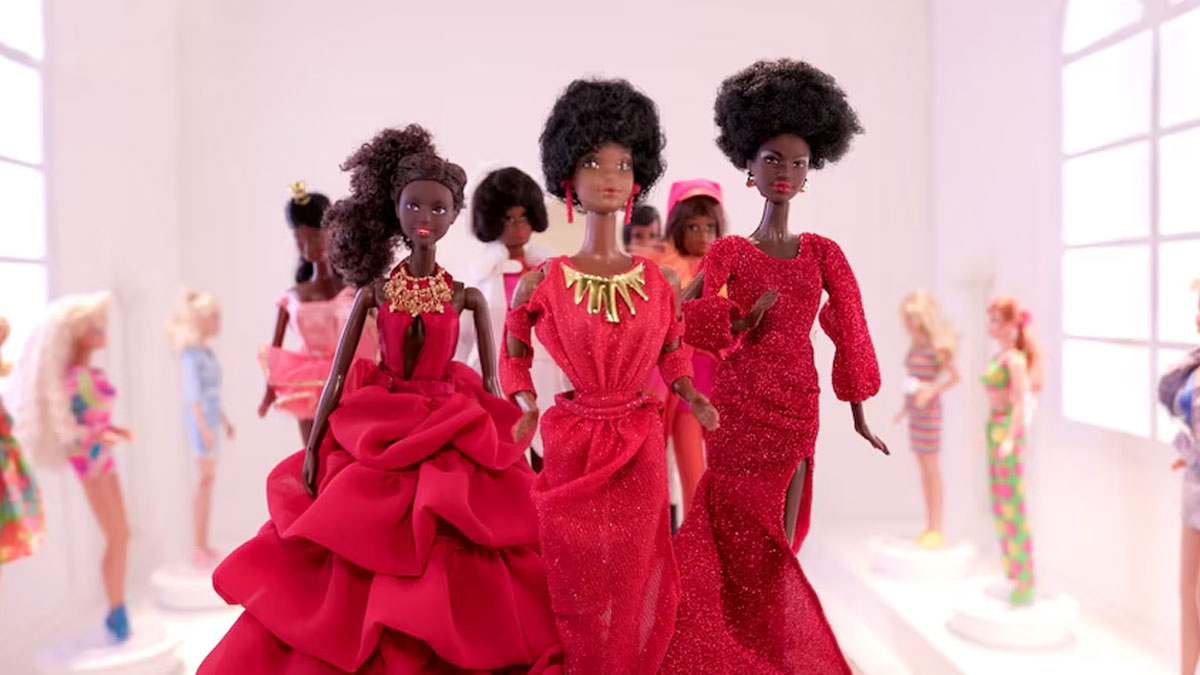
After 13 years of development, Davis has turned what she learned into a documentary about the history of Black Barbie.
It starts in the early 60s, when Davis's aunt told Barbie's creator Ruth Handler: "We want a Black Barbie."
Later that decade, Mattel released two different Black dolls, but they had Eurocentric features and didn't carry the name Barbie, instead being marketed as Barbie's "babysitters" and "best friends".
After looking at what life was like for children before Black dolls in the first part of the documentary, the second act explores the era where they tried to make Mitchell's dream come true.
Unsurprisingly, hiring more Black women was a big part of making real progress.
Kitty Black Perkins was Mattel's first Black designer, and she would go on to create the Black Barbie in 1980.
Stacey McBride-Irby was another crucial hire, creating and designing new Black Barbie lines from 1996 to 2011.
The film's final act looks at what's changed since Black Barbie's introduction nearly 45 years ago (not as much as you might hope or expect).
"On the one hand, it feels ridiculous in the sense of … you can't place this on a doll's shoulders. It's a piece of plastic," says Davis.
"And I've come across a lot of people in my research saying, 'You can't rely on a doll to teach your children.' But, one, why not? And, two, without even trying to be, it has become a tool for that."
In the 40s there was a landmark study called the Clark Doll Test, in which Black children were given a Black doll and a white doll and asked which doll was the "nice" doll and which was the "bad" doll, with the goal of determining the effect racial rejection has on self-esteem. The majority of Black children at the time ascribed the positive characteristics to the white doll and the negatives to the Black doll.
In Black Barbie, modern researchers sit down with several groups of children and show them a diverse range of some of the Barbies available today to hear how they perceive them.
This is interwoven with commentary from real-life Black Barbies, including screenwriter Shonda Rhimes (whose company Shondaland produced this film); Olympic fencing medallist Ibtihaj Muhammad; the first African American principal dancer for the American Ballet Theatre Misty Copeland, as well as collectors, parents and relatable everyday people with relatable white doll baggage.
Together, they consider the importance — and limitations — of the type of representation dolls can afford.
Many of the women break down when speaking about the impact of not seeing themselves in the toys they played with as children.
"Seeing [that] proved to me how much it really does matter," Davis says resolutely. "It does matter what our children are playing with and the media that they're seeing.
"Barbie does matter. She really does have an impact. She's more than a doll."
This Barbie movie has nothing to do with *that* Barbie movie
Davis started making the documentary Black Barbie in 2011.
She says it wasn't until about 2013 that she found out a live-action Barbie movie (that would go on to make more than $1 billion at the global box office and dominate the media for months) was in the works.
"I remember thinking, 'Gosh, I wonder how Black Barbie is going to show up in that movie?'" Davis says.
(Reader: She did not. Though there were a handful of Black and otherwise diverse Barbies, there was no Black Barbie in the film, which instead focused on "Stereotypical Barbie", as depicted by white, blonde Margot Robbie.)
While the finer details of the plot of Greta Gerwig's film were kept secret ahead of its release, Davis says she knew ahead of time the live-action movie "wasn't going to centre Black Barbie's story", nor would it celebrate the women behind her.
And, despite any feelings she may have previously nursed when it came to dolls, if there's one thing Davis is firm on, it's that Black Barbie deserved her own movie.
Black Barbie is streaming now on Netflix.
Story by ABC Entertainment
Original story link https://www.abc.net.au/news/2024-06-26/black-barbie-documentary-shondaland-lagueria-davis/104018172

Stay tuned for the latest news on our radio stations