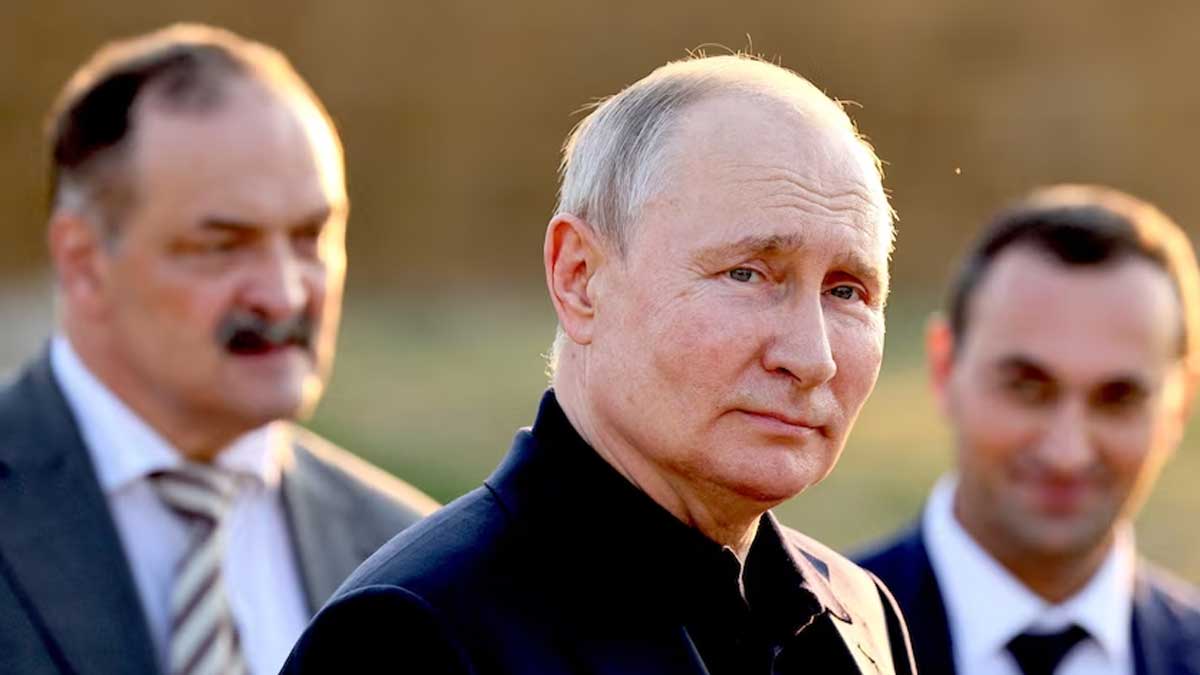
Russia's President Vladimir Putin may have placed himself at the pinnacle of a so-called "power vertical", but one weekend of mayhem could threaten to topple the whole thing.
In June, Putin's mercenary warlord Yevgeny Prigozhin launched a 36-hour mutiny that represented the greatest threat to the president's power in two decades.
After his Wagner soldiers marched within 500 kilometres of Moscow, Prigozhin agreed to a hastily arranged deal with his former ally.
But five weeks later, a clearer picture is emerging of Putin's demeanour during those first frenzied hours of the rebellion.
"Putin had time to take the decision to liquidate [the rebellion] and arrest the organisers," a European security official told the Washington Post this week.
"Then when it began to happen, there was paralysis on all levels. ... There was absolute dismay and confusion. For a long time, they did not know how to react."
The anonymous quotes are in line with a public assessment of the chaos made by US Central Intelligence Agency (CIA) chief William Burns.
"Russian decision makers which were adrift or appeared to be adrift for those 36 hours," he said.
"For a lot of Russians watching this, used to this image of Putin as the arbiter of order, the question was, does the emperor have no clothes? Or at least, why is it taking so long for him to get dressed?"
At the time of the rebellion, Prigozhin accused Russian army chiefs of starving his troops of ammunition and other supplies, and leaving them to die, during the ongoing invasion of Ukraine.
Ordering his men to advance further and further towards the heart of Russian power, was a show of force, but eventually the Wagner chief appeared to get cold feet.
He reportedly even "tried to call Putin, but the president didn't want to speak with him", according to Russian independent media outlet Meduza.
Despite a deal that was meant to see Prigozhin live in exile in Belarus, the Wagner leader appears to still have a role in his organisation and he has been photographed in St Petersburg.
On the madness he unleashed, Prigozhin is reportedly sheepish, explaining away his role in the rebellion as "a meltdown".
On the surface, Russia appears to have returned to normal life: Putin is still the president and Prigozhin is safe, for now.
But experts say that by displaying weakness, Putin has pulled back the curtain on his own myth.
The repercussions for his long-term power could be severe.
Putin's problematic 'power vertical'
Russia's current political system is often described as a "power vertical".
In this set-up, Putin — who is backed by the dominant United Russia party — gets the final say on everything.
In theory, the power vertical should have advantages during emergencies.
"You would think that in a state where power is centralised, he would be in a really good position to issue instructions to the regions to have a consistent policy across the whole country in times of crisis," said Jenny Mathers, a senior lecturer in international politics at Aberystwyth University, in Wales.
"But when instructions don't come from the top, it doesn't take long to see the problems underneath."
And, that's what happened on June 23 when Wagner forces were able to march, largely unchallenged, through several regional centres towards Moscow.
Putin has towered over the regime for more than two decades, but the narrow focus of Russia's power vertical means any form of change could destabilise it.
Dissidents typically face harsh — even deadly — consequences in Putin's Russia.
But not the Wagner forces, or its leader, Prigozhin, who remains alive, and, apparently, free to travel in and out of Russia from Belarus.
He even turned up at a summit of African leaders in St Petersburg last month.
Dr Mathers said the light touch Putin had used so far on Prigozhin and his Wagner mercenaries was "extraordinary".
"Russians protesting the war have been arrested for even holding blank pieces of paper, so the Wagner group has been treated remarkably gently," she said.
"But it reflects the fact private military companies, and the Wagner group in particular, are too valuable to the Russian state to pull the plug on them entirely."
The mutiny was not Putin's only indecisive moment
Just eight months into his presidency, Putin faced the biggest crisis of his fledgling political career.
In August 2000, the nuclear submarine Kursk was gliding near the Arctic Circle when one of the torpedoes on board exploded in its hatch.
Most of the crew died instantly, but 23 survivors sought refuge in a flooded compartment, waiting for a rescue mission that never arrived.
While Britain, Norway, and the United States were eager to help, Putin left the men on the sea floor for five days before finally accepting the offer.
"There was just silence from Russia ... at the time I remember it being said that Putin doesn't know how to respond to a crisis," Dr Mathers said.
The Kursk disaster and its handling was Putin's "first lie", according to lawyer Boris Kuznetsov, who represented some of the families of those who died.
"Early on — and the Kursk tragedy shows it — Putin prioritised state interests over the value of human life," he wrote in his book.
At the time, Putin was yet to build his power vertical. He was slammed by Russian media for his handling of the disaster, and screamed at by the victims' families at a town hall meeting.
"I think this latest paralysis around the Wagner mutiny is consistent with patterns of his behaviour that we've seen before. But one thing that has changed, is external perceptions of him," said Dr Mathers.
Over the last two decades, Putin has crushed dissent, brought Russian media under his control and shaped his public image with hyper-masculine, bare-chested photo opportunities.
"I think Putin does look weak, and for someone who is obsessed with looking strong and acting strong, and being a strong leader for a strong Russia, that is really damaging," Dr Mathers said.
"The whole Prigozhin episode was very humiliating for him ... So I think the appearances and perceptions of him have changed, certainly, externally, possibly internally as well."
'Post-Putin Russia is already here'
Tatiana Stanovaya, the founder of analysis firm R.Politik, argues the events on June 23 have changed everything in Russia.
In an article published by the Carnegie Endowment for International Peace last month, she wrote "Putin's much-hyped power vertical has disappeared" in the wake of the Wagner rebellion.
"Instead of a strong hand, there are dozens of mini-Prigozhins, and while they may be more predictable than the Wagner leader, they are no less dangerous.
"All of them know full well that a post-Putin Russia is already here — even as Putin remains in charge — and that it's time to take up arms and prepare for a battle for power."
While a power struggle appears inevitable whenever Putin's reign is over, Dr Mathers questions whether we're there yet.
"Whenever we see one of these things like the Wagner mutiny that appear to be a turning point, it always makes me wonder: were things in Russia maybe just always that chaotic and we just never noticed?
"But it's clear this has chipped away at Putin's persona of the strongman, the hard man, who is in charge of a power vertical.
"Things are clearly not as controlled as they appeared to be."

Stay tuned for the latest news on our radio stations