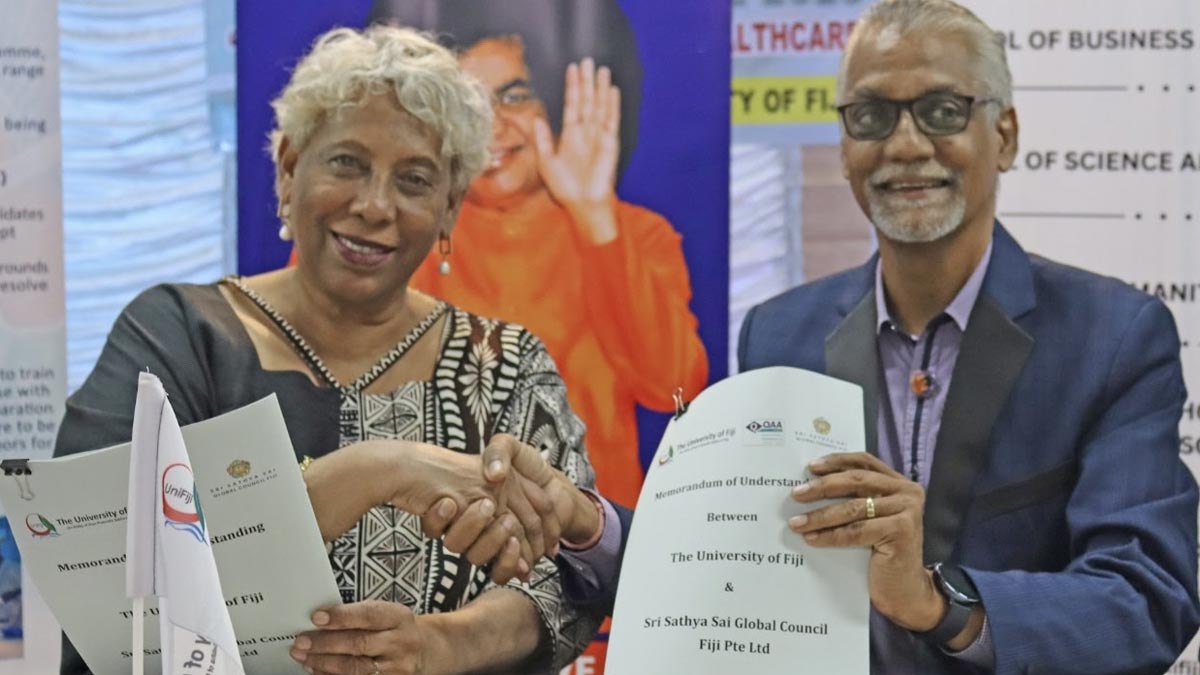
To enhance medical education and strengthen community health initiatives across Fiji and the Pacific, the University of Fiji signed a Memorandum of Understanding with Sri Sathya Sai Global Council Fiji (SSSGC).
The agreement, signed during the University’s International Health Conference, cements a growing partnership between academia and service that has already seen more than 17 University of Fiji students participate in the council’s outreach programmes.
UniFiji says it now sets a formal framework for broader cooperation from clinical placements abroad to free medical camps at home.
They say the MoU outlines a practical and values-based collaboration designed to empower the next generation of healthcare professionals through service and exposure to global best practices.
Under the agreement, SSSGC will support University of Fiji medical students and staff through:
• Annual scholarships for final-year MBBS students to undertake immersive clinical training in Australia, New Zealand, or other internationally recognized centres of excellence.
• Participation in SSSGC’s Annual Free Medical Clinics across Fiji, offering real-world medical experience in underserved communities.
• Professional development webinars and seminars, both online and in-person, led by internationally respected healthcare professionals.
• Tailored project-based collaborations designed to meet Fiji’s evolving healthcare priorities through joint planning and resource sharing.
University of Fiji Vice-Chancellor Professor Shaista Shameem described the MoU as more than a policy instrument but a platform for shared purpose.
She says they are pleased to be finalizing the MoU to further deepen their collaboration, opening new avenues for joint projects, community outreach, and shared growth.
Professor Shameem says this partnership reflects their commitment to developing medical professionals who are not only skilled but also driven by service and compassion.
She adds that this partnership is not just about academic opportunities, it's about instilling a deeper sense of purpose in their students.
The Vice-Chancellor says through hands-on service, they will learn that medicine is not only a science but also an act of compassion. Professor Shameem says their students will not only gain international exposure but also return with a greater sense of duty to serve locally.
She says this is how we build healthcare leaders who understand both the technical and human sides of medicine.
National President of SSSGC Fiji, Anil Kumar Amin, acknowledged the longstanding cooperation that has led to this formal agreement, saying that it is an absolute honour to witness the signing of this inaugural collaboration.
He says their organization is grounded in the values of love and service, and this partnership allows them to nurture the next generation of medical professionals while continuing their humanitarian work across Fiji.
Amin says by investing in the next generation of doctors and health professionals, they are investing in the future health of Fiji.
He adds these students will one day serve their communities, and we are proud to walk this journey with them.
He says this partnership exemplifies their commitment to action, and they don’t just believe in healthcare for all they act on it, alongside like-minded institutions such as the University of Fiji.
Zone 3 Countries Coordinator for SSSGC Kamal Naidu, who is based in Sydney, reflected on the long-term vision and impact of the partnership.
He says this MoU is not merely a formal agreement, it is a shared commitment to nation-building.
Naidu says from medical camps to clinical placements and professional development, their programs aim to equip students with both knowledge and compassion.
He also says together, we are building a sustainable and inclusive healthcare future for Fiji. UniFiji says with this MoU, it will advance its goal of providing value-based, high-quality training for medical and nursing professionals while ensuring that students are exposed to real-world challenges and solutions.
They say the agreement will remain in effect for an initial term of three years, with annual performance reviews and the option for a two-year extension.
They add that it also reflects a deep commitment from both institutions to empowering communities, expanding healthcare access, and shaping a resilient and responsive health workforce for the Pacific.
Stay tuned for the latest news on our radio stations