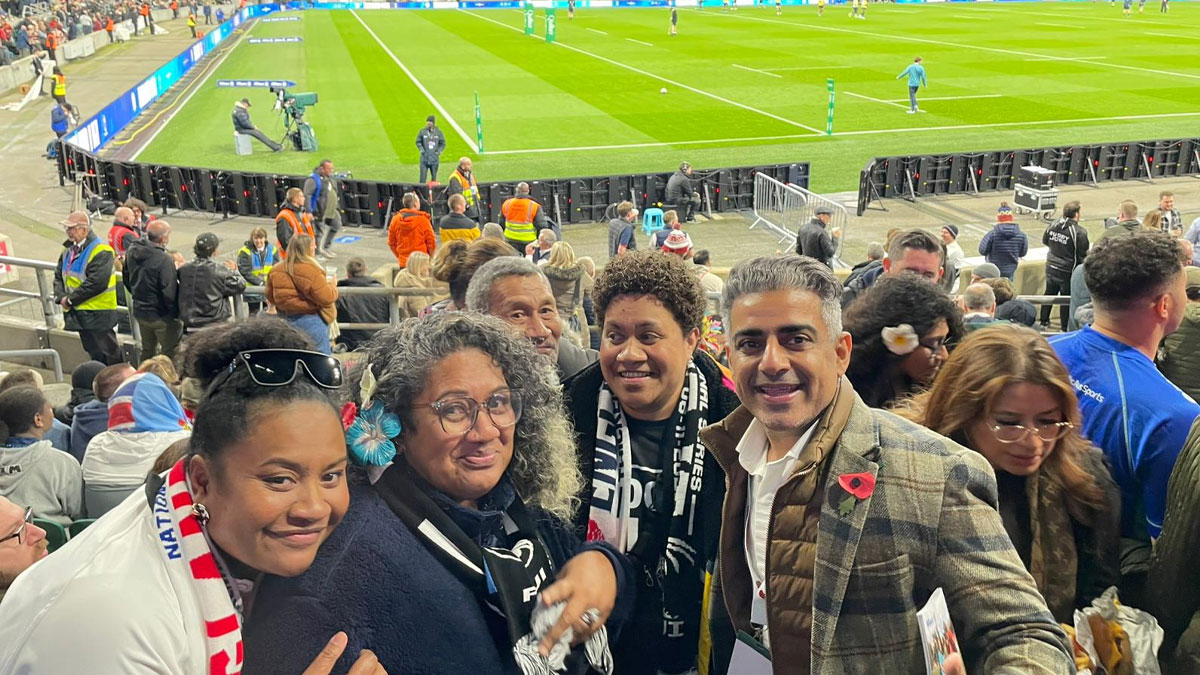
The power of sport to unite people cannot be understated, nor can its ability to showcase the best of a nation. Over the past few weeks, I’ve seen this firsthand through Fijian rugby, and it has inspired me to dream even bigger about Fiji’s potential on the global stage. In Labasa, I watched the Sukuna Bowl clash between Police and Army during a week that also marked the launch of the inaugural Rugby Nations Championship, where 12 of the world’s top teams will compete next year at Twickenham with Fiji among them. If their recent performance against England at Twickenham – which I was also lucky enough to attend – is any indication, Fiji is ready to be a force in this new era.
At Twickenham, I’ll never forget the 63rd minute when Kuruvoli crossed the line for what looked like a game-changing try. It was classic Fijian flair: Maqala bursting through the middle and passing to Kuruvoli to score. The scoreboard seemed ready to flicker to a potential 25–26 scoreline as Fiji closed the gap, despite two yellow cards during the game. For a moment, the stadium fell silent while the Fijian diaspora roared, daring to dream of an unforgettable upset. Then came the referee’s call: knock-on. Harsh, perhaps, for those of us who believe rugby should reward attacking brilliance. In that instant, the game swung back to England, who unleashed their depth by bringing on Lions-winning captain Itoje.
Before the match, I was honoured to attend the team’s Jersey Presentation ceremony, a humbling and deeply emotional evening. I witnessed the pride that flows through Fijian veins: pride in their country, their people, their vanua, and in each other. It was more than a ritual; it was a powerful affirmation of identity and unity. That moment will stay with me as a reminder that rugby for Fiji is not just a sport but a living expression of culture and community.
That disallowed try captures the essence of elite sport: the finest margins decide victory or defeat. Yet beyond the scoreline, Fiji proved something bigger. They belong at the very top. They had England wobbling and were again unlucky against France, dominating possession. Fiji stands on the cusp of more history-making moments.
This history is, in many ways, a national story of resilience and ambition. Every player carries the weight of countless sacrifices: families giving up hours to nurture dreams, volunteers working tirelessly to keep grassroots alive, and fans roaring from the sidelines. It begins with young boys imagining themselves as the next Serevi or Caucaunibuca and stretches from the sand dunes of Sigatoka, the beating heart of Fijian rugby, to the Deans Trophy, to the 7s Olympic Gold medal win, and the rise of the Drua. Together, these moments have built an unshakable legacy: Fiji’s rise to the global stage.
In Labasa, I saw two of Fiji’s key institutions, the Police and the Army, come together and use rugby as a platform to celebrate Fijian excellence not only in rugby but also in other sports such as football, tug-of-war, and boxing. The original vision behind the Sukuna Bowl, conceived by Ratu Sir Lala Sukuna, was to channel the rivalry between these two institutions into something constructive. Today, it has grown into a platform for so much more.
Building on this, Fiji’s upcoming fixtures in the UK against Wales and Scotland offer a similar opportunity but on a global stage. These matches are not just about rugby; they are a showcase for everything Fiji has to offer: tourism, business, arts, and education. When Fiji played England, the community hosted a trade event alongside the match, with the UK-sponsored International Trade Centre showcasing Fijian businesses and art - from cocoa growers to skincare producers to sauce makers - opening new avenues for development and prosperity. Also present were three artists who had come to the UK on an exchange programme through the Fiji Society to share their specialist skills.
This is a brilliant example of how sport can open doors beyond the field. Next year’s fixtures should be further opportunities to unite Fiji’s talent - athletes, entrepreneurs, artists - and show the world what this nation can offer, perhaps even combining these moments with the increasingly popular Bula Festival in the UK where Fijians celebrate their vibrant culture. And maybe, just maybe, Fiji’s rise can pave the way for future internationals to be hosted here at home or make the case for visiting teams, including the Lions, to stop off in Fiji and test themselves against the best.
Who would have thought that a young boy in 1823, over 10,000 miles away in the town of Rugby, would inspire countless similar young boys to pick up the ball and run, this time in fields as far-flung as Kadavu, Sigatoka, and Labasa? The power of rugby to inspire, innovate, and build resilience can also unlock the full spectrum of Fiji’s talent on the global stage. I can’t wait to join in and support this journey.

Kanbar Hossein-Bor is a senior British diplomat and international lawyer, currently serving as the United Kingdom’s High Commissioner to Fiji.
He previously led the UK Foreign, Commonwealth & Development Office’s Democratic Governance Department and served as the UK’s Media Freedom Co- ordinator. In this role, he launched the UK Government’s flagship global campaign on media freedom, co-founding the Media Freedom Coalition—now comprising over 50 countries—and establishing a landmark international fund in partnership with the United Nations. He also chaired the Freedom Online Coalition’s Taskforce on Internet Shutdowns, galvanizing international action on digital rights.
Kanbar has held senior diplomatic and legal roles in a range of complex environments. He served as Deputy High Commissioner to Bangladesh, led the UK’s international law team in The Hague as Agent to the International Court of Justice, headed the human rights team in Iraq, and was deployed as Acting Head of Mission in Liberia during the Ebola crisis.
Before joining the Foreign Office, Kanbar practiced constitutional and criminal law as a barrister and is a Lord Denning Scholar of Lincoln’s Inn. He holds an LLM in international law from Cambridge University and is a Yale World Fellow (2016).
A passionate advocate for inclusion and public service, Kanbar regularly speaks at schools and public forums in the UK and abroad about his journey as a child refugee and the importance of diversity in leadership.
He is also a devoted Liverpool FC supporter and enjoys padel, football, rugby, and watching MMA.
For more Yellow Bucket opinion pieces click: HERE
Opinion Note
Long time fijivillage users may remember the Yellow Bucket opinion column that ran in the years leading up to the 2006 coup. Well following the repeal of the MIDA Act we are delighted to announce that YB is back!
The Yellow Bucket is something of a Communications Fiji Ltd institution…. Yes it exists…. A real Yellow Bucket that the CFL team and visitors gather around after work to drink grog and discuss the day. Legend has it that every Fiji Prime Minister has at some stage enjoyed a bilo from the bucket.
The YB column ran from 2003 to early 2007 when it was shut down under extreme pressure from the military government. Later the MIDA Act specifically forbade any use of nom de plums or pseudonyms requiring every published article to have a named author.
So why the pseudonym. The YB column was and will continue to be a product of group thinking and discussion, so it would be impossible and a little unfair to attribute it to a single author.
It will continue to provide fact-based opinion offering context to the complex and constantly unfolding story, that is our home Fiji. We stress, FACT BASED…. No rush to judgement here ….. Our aim will be to run weekly but that could change depending on the situation.

Stay tuned for the latest news on our radio stations