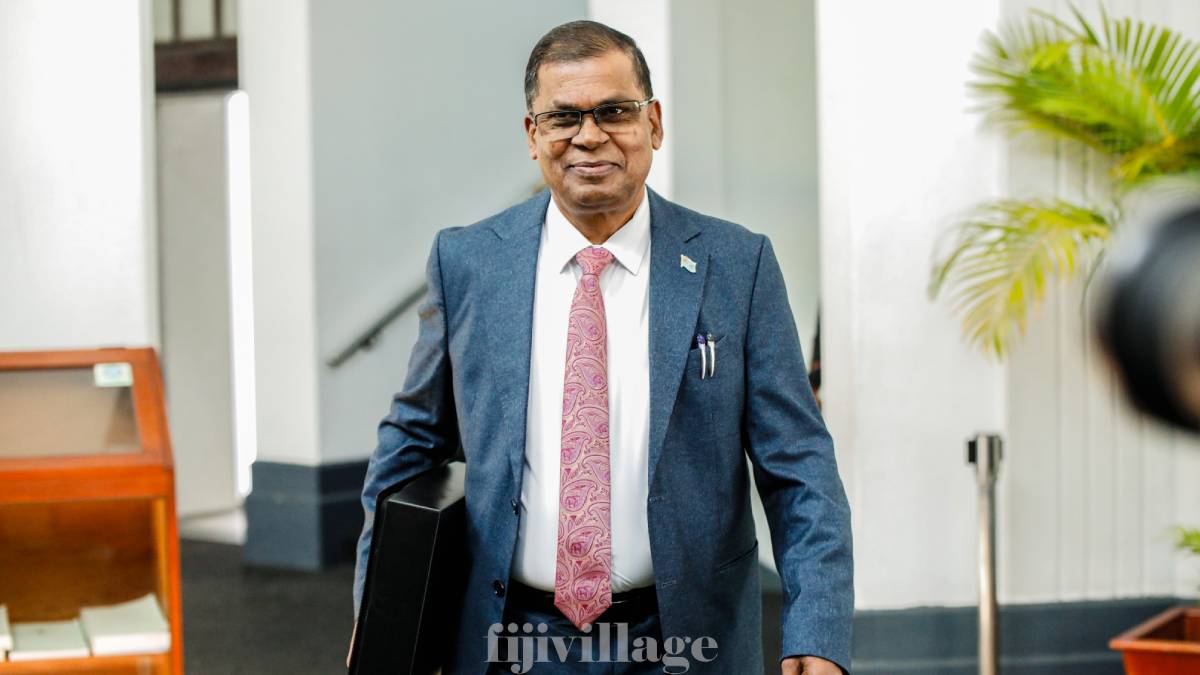
Deputy Prime Minister and Minister for Finance Professor Prasad says to further support affordability, the government has reduced customs duties on several food items, many of which attract low duties of zero to 5 percent.
He says this reduction in indirect taxes must be passed on to the people, and he reiterates that they will be strengthening compliance and enforcement measures to ensure that people benefit directly from these reforms.
Professor Prasad says the classification of personal imports has been amended to clearly distinguish between online purchases and those received as gifts and donations.
He adds under this revised policy, all items received through gifts and donations below $500 will be duty-free and VAT-free.
The Deputy Prime Minister says the government remains firmly committed to tax stability, fiscal responsibility, and putting more money back into the pockets of ordinary Fijians.
He says there are no increases in taxes in this Budget, and they have focused their efforts on targeted relief, incentivising investment, and promoting economic activity in key sectors that support inclusive and sustainable growth.
Professor Prasad says the most significant change in this Budget is the reduction of the VAT rate from 15 percent to 12.5 percent, a bold but deliberate move to ease the cost of living for every Fijian household.
He says this is complemented by the continuation of zero-rated VAT on 22 essential items including medicines, ensuring that low-income families are protected from inflationary pressures.
Professor Prasad says in line with our broader economic transformation agenda, they are also introducing and extending targeted tax incentives to incentivise growth, innovation, and social impact.
He says a 150 percent tax deduction will now apply for donations to Accredited Start-Up Support Programs, fostering entrepreneurship and innovation.
The Minister says under the Employment Taxation Scheme, the 300 percent tax deduction for wages or salaries paid for work placements, apprenticeships, and part-time employment is extended until 31st December, 2026.
He adds the 400 percent tax deduction for hiring persons with disabilities will also be extended until the same period, and these incentives support both workforce participation and social inclusion.
Professor Prasad says for climate transition, they are expanding tax relief for green investments and the income derived from new renewable energy and co-generation projects will now be tax-exempt for 10 years, up from the current 5 years—providing stronger incentives for clean energy adoption.
He adds the Tax-Free Region (TFR) incentive is also being extended to cover the Wainadoi region for waste management, recycling, and renewable energy businesses—sectors that are central to our circular economy strategy.
The Finance Minister says they are also incentivising donations, and a 100 percent tax deduction will now apply to donations made to health centres, nursing stations, aged care homes, orphanages, and drug rehabilitation facilities—supporting vital community institutions that care for our most vulnerable.
Professor Prasad says in the tourism sector, a new 25 percent investment allowance will be introduced for businesses undertaking capital investments in tour and sightseeing operations, with a minimum qualifying threshold of $100,000.
He says this will help diversify tourism offerings and deepen the value chain for our visitor economy.
Professor Prasad says to improve tax administration, they are introducing the VAT Monitoring System (VMS) for all businesses with an annual turnover of $50,000 or more.
He says this will be implemented in phases and will come into effect on 1st January 2026.
Professor Prasad says this system will modernise VAT compliance and improve revenue transparency while reducing tax evasion.
He adds two new VAT refund initiatives will also support our social and environmental objectives.
He says VAT refunds will be available for capital investments in residential solar projects, helping households transition to clean energy.
He further says households that rebuild or repair homes damaged by termites will now be eligible for VAT refunds on construction costs—providing critical relief for affected families.
The Deputy Prime Minister says to support our agriculture sector and improve farming efficiency, mechanical harvester services supplied by registered cooperatives will now be zero-rated for VAT, reducing the cost burden on smallholder farmers and enabling faster land preparation and harvesting.
He adds to support our Fijian diaspora, they will make changes to the Income Tax Act to allow our citizens residing overseas to reorganise and protect their Fiji-based assets through the use of properly structured resident Family Trusts.
He further adds this initiative recognises the deep-rooted connection many diaspora families maintain with Fiji and aims to support intergenerational wealth preservation while ensuring such assets remain invested within our economy.
Professor Prasad says a framework will be developed and rolled out in the coming months to accompany the legislative amendments and support the transparent and responsible use of this concession.
The Minister says they will also reduce the acquisition of Fiji Citizenship and passport fees from the current $3,450 to $1,500 for our diaspora who wish to acquire their Fijian citizenship and return to Fiji to live and invest effective from the 1st of August.
He says this is a pro-people, pro-growth, and pro-investment tax framework, and it rewards innovation, supports job creation, lowers the cost of living, and strengthens the social contract between the state and its citizens.
Click here for Budget 2025-2026 stories, documents and details

Stay tuned for the latest news on our radio stations