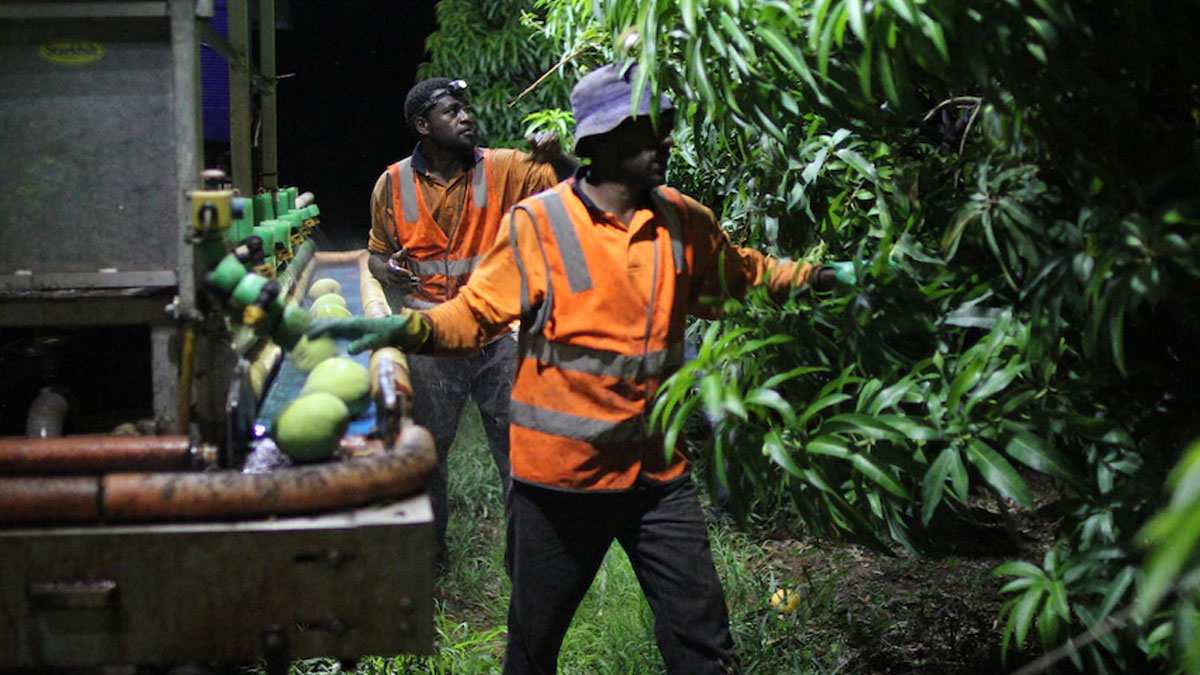
Wages Daniel Yakapus earned picking fruit in Australia became essential when his family's lives in Vanuatu were thrown into chaos by two cyclones earlier this year.
Mr Yakapus picks table grapes in Victoria's north-west through the federal government-run Pacific Australia Labour Mobility (PALM) scheme, which was introduced in 2012 to fill labour gaps in the agricultural industry.
He said he came to Australia for one simple reason.
"Do a little bit of work, get some money, send it back to my country, help my family," he said.
"They are slowly recovering, but the most income that they [have] to get their food or to build their house, they get from me."
Mr Yakapus is one of almost 40,000 Pacific and Timore Leste PALM workers in regional Australia, who are employed on farms and other industries including in nursing homes and meat works.
But there are significant changes on the horizon for the scheme, which Mr Yakapus hopes will help him send more money home and make his farm work stint more enjoyable.
Reforms as worker scheme expands
Last week the federal government released details of its previously announced PALM scheme reforms, which are part of a plan to significantly expand the program.
When Labor was elected in May 2022 there were about 24,400 Pacific workers in the country, and the government's 12-month target of 35,000 workers was reached within seven months — up 62 per cent from when they took office.
With a record number of Pacific workers in the country, it is likely the next time you buy grapes, oranges or a steak from the supermarket, a worker on the scheme helped get the food to your plate.
A key component of the reforms is to ensure that casual employees, who under their visa conditions can only work for employers approved by the federal government, are paid a minimum of 30 hours a week.
Previously employers were able to average out the 30-hour-a-week minimum payment over a long period, normally nine months.
The minimum-hours change will come into effect from July next year.
The farming sector, which takes about 70 per cent of the workers, as well as the federal opposition and Australian Fresh Produce Alliance have opposed the changes, arguing it would increase the program's costs, and make it unworkable.
Unions have labelled their response as "hysteria".
Another reform welcomed by workers aims for greater transparency around workers' deductions.
It will include a minimum net pay guarantee after tax and deductions of $200, plus changes to make sure workers understand the deductions which are usually for accommodation, transport and paying back flights.
Mr Yakapus said employer deductions were confusing, and he looked forward to a consistent income.
"Sometimes we don't have enough work to do. Maybe we'll work for three days or four days," he said.
"Once the payment comes in, then the boss gets all the money from the deductions."
He said when that happened his take-home pay was significantly less, which affected both him and his family at home.
Reducing worker exploitation
Uniting Church senior social justice advocate Mark Zirnsak said the PALM workers, who often came from low socio-economic backgrounds, were very reliant on their job and bonded to their Australian employers.
The workers are not eligible for Australian welfare support or payments, and can't find other work under their visa conditions.
Dr Zirnsak said he knew of a group of PALM workers who had to rely on food charity after going seven weeks without paid work.
"Those situations leave workers in really desperate situations and their families back in the Pacific who were depending on them to send money home," he said.
Dr Zirnsak said the reforms would also bring Australia into line with farm worker schemes in New Zealand and the United Kingdom.
Other changes he supports include giving workers seven days' notice of termination. Currently, workers can find themselves out of work with no notice, which means they may lose their accommodation, which is often provided by the employer.
Dr Zirnsak said some changes would benefit employers, such as the possibility to claim a travel cost reimbursement from the government, as well as a more streamlined approval process for worker accommodation.
More flexibility needed
New South Wales-based Pacific welfare worker Valencia Packete has seen many contracts stipulating a minimum of 30 hours of work averaged out over a nine-month period, but knows in reality that doesn't always happen.
"I understand in the horticulture industry, sometimes, [that] seasons don't account for that 30 hours," she said.
"I have spoken to many workers who are crying out for help."
Ms Packete said one way to ensure workers were getting enough money could be to allow more flexibility for PALM participants to work for different employers.
Currently under their visa conditions Pacific workers are bonded to their employer and are unable to switch jobs if they don't get enough hours or the work is unsuitable.
The workers can only change employers with the approval of their employer and the Department of Employment and Workplace Relations.
In the absence of this, there have been cases of workers absconding and breaching their visa conditions after alleged pay and condition problems.
"There has to be a way where the contractors can shift the workers to another farm," Ms Packete said.
Pacific Island Council of South Australia chair Tukini Tavui said Pacific workers on nine-month short-term visas were the most vulnerable to working hour variability.
While he acknowledged that the minimum hours change would be "difficult and almost impossible for some of those small farmers" he hoped they would not abandon the program.
He said key changes included better portability for workers to move from one employer to another, improved flexibility to move from the short-term to the long-term visas scheme, and clarity around deductions and pay.
"That's been one of the big contributors to some of the concerns and challenges with the program," he said.
Weather disrupts work hours
Tania Chapman, who manages farming operations at Nutrano, said the obligation for businesses like hers to pay workers 30 hours a week, "irrespective of whether they work or not" will put massive pressure on her business.
She said the citrus farm in north-west Victoria was often interrupted by the weather during the winter harvest season, which could see an "average four rain days every week".
Ms Chapman said if growers leave the PALM scheme in large numbers because of cost pressure of minimum working hours it would be a "double whammy" for relations between Pacific Island workers and Australian farmers.
"These communities, these islands, these countries, they rely so heavily on us," she said.
Meanwhile in Western Australia, Fruitico Group chief executive Roger Fahl said while he understood the fairness of introducing minimum working hours, in practice the change was hard to swallow for his business.
The table grape exporter, who is an approved employer under the scheme, employs about 250 workers on farms in the state's south west and far north.
"We're out in mother nature, as most growers are, and she doesn't always play by the rules," he said.
A Department of Employment and Workplace Relations spokesperson said there would be a "staged implementation" of the new PALM guidelines with "planned and unscheduled visits" to monitor changes.
"The department consulted extensively over 18 months on potential changes to the PALM settings that include industry, approved employers, participating countries, unions, civil society groups and other stakeholders."
Cultural understanding needed
Dr Zirnsak said improving cultural understanding between employers and workers would also be addressed within the new guidelines.
"[Employers] need to have some knowledge of Pacific Island cultures and treat workers in a respectful way, and that's going to increase worker productivity," he said.
Picker Mr Yakapus said employers understanding more about Islander culture would improve the program.
"One of the most important things about Islanders is they have more respect with each other," he said.
"When we say something bad to someone, we have to apologise to him before we continue the day, or we continue to work."
Mr Yakapus while there were challenges within the worker program, he was happy working to support his family "to buy food and to rebuild the house for them to sleep [in]".
Story By: ABC Rural / By Emma Field, Eliza Berlage, Emile Pavlich, and Ellie Honeybone
Original Story link: https://www.abc.net.au/news/rural/2023-06-19/pacific-australia-labour-mobility-palm-scheme-changes-welcomed/102477350

Stay tuned for the latest news on our radio stations