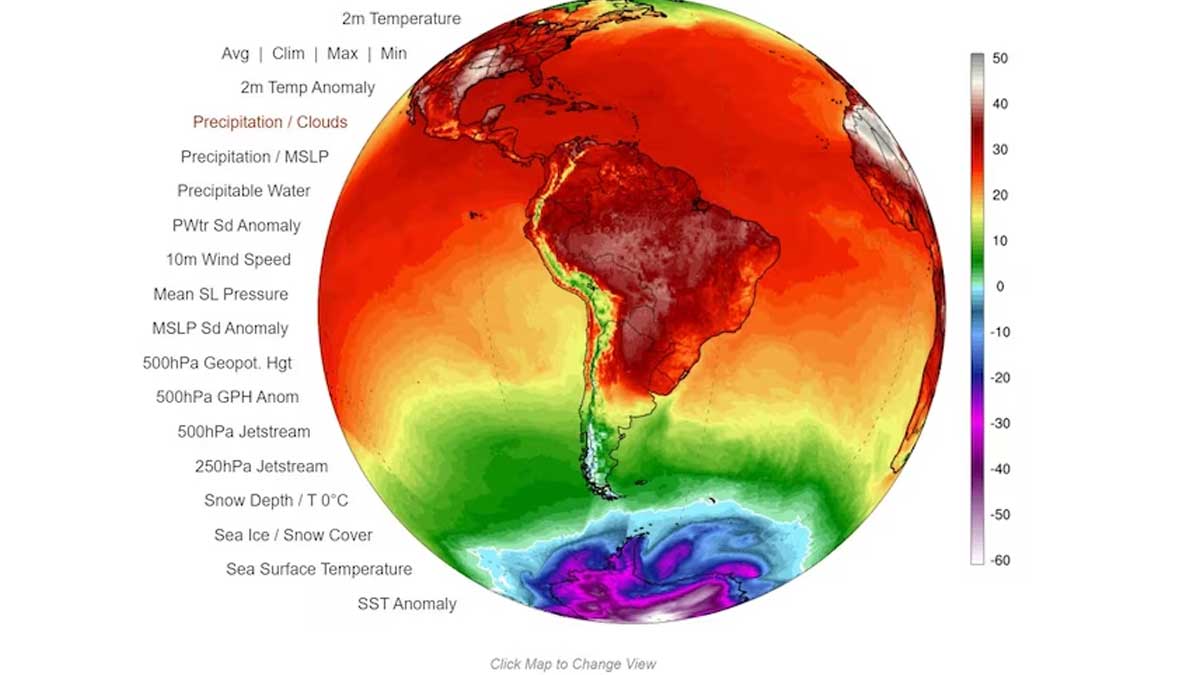
Climate scientists have been left "flabbergasted" as temperatures in parts of South America near 40 degrees Celsius in the middle of what is supposed to be its winter.
Data from Chile's national meteorological agency, Dirección Meteorológica de Chile, shows several weather stations in the country reached temperatures above 35C on August 1.
This is between 10C and 20C above what is normal for this time of year in parts of Chile and Argentina, according to data from the European Centre for Medium Range Weather Forecasts (ECMWF).
In the Coquimbo region, the mountain town of Vicuna reached a top of 37C, the Liceo Samuel Román Rojas weather station peaked at 35.4C and Monte Patricia reached 31.5C.
Climatologist and weather historian Maximiliano Herrera went so far as to call it one of the most "extreme weather events the world has ever seen".
"For its duration, area, and intensity, it's probably the worst winter heatwave in the Southern Hemisphere," he said.
He said temperatures in South America earlier this week had even rivalled the prolonged heat experienced in Europe during July, despite being the middle of winter.
"South America is living one of the most extreme events the world has ever seen, unbelievable temperatures up to 38.9C in the Chilean Andine areas in mid-winter," Mr Herrera wrote on social media.
"[This is] much more than what southern Europe just had in mid-summer at the same elevation."
Many parts of Argentina also reached temperatures of 30C to 35C, and Brazil saw widespread temperatures above 35C and 38C on both Tuesday and Wednesday, according to data from their respective meteorological agencies.
Buenos Aires set a daily record for the start of August with its high of 30.1C — more than 5 degrees above the previous daily record, and 12C warmer than its August average, according to a spokesperson for Argentina's National Meteorological Service.
'Flabbergasted' by temperatures University of New South Wales climate scientist Sarah Perkins-Kirkpatrick said that, even as a climate scientist who specialised in heat extremes, the temperature observations were hard to believe.
"I'm flabbergasted by these temperatures," Dr Perkins-Kirkpatrick said.
She said if those temperatures were to occur in New South Wales, which sits at a similar latitude, it would be "extraordinary".
"It's reported that Buenos Aires has had the hottest start to August on record and has shattered its previous record by over 5 degrees. That margin is phenomenal," Dr Perkins-Kirkpatrick said.
"This is happening during the austral winter. To put it into context, it's like Sydney experiencing a 30-degree day this time of year — something that is beyond extraordinary."
Several other climate scientists have also expressed their disbelief at the temperatures, including Andrew Watkins, a climatologist from Australia's Bureau of Meteorology, who wrote on social media that the figures were "mind-boggling".
Pascal Boureau, a former forecaster at Météo-France, wrote that it was "unheard of".
Extreme heat in Northern Hemisphere
Parts of Italy reached temperatures up to 48C in late July, and China more than 50C.
On July 6, Algeria recorded its all-time hottest minimum temperature of 39.6C, as well as several maximum temperature records. Much of the focus of heat in recent weeks has been on the Northern Hemisphere, which is sweltering through prolonged and intense heatwaves that have fuelled wildfires across three continents and shattered temperature records.
The unrelenting heat helped secure July 2023 as Earth's hottest month on record by global average temperature, according to the World Meteorological Organization.
New analysis by not-for-profit research group Climate Central found the exceptional heat of July would have been unlikely if not for climate change.
It found that the July temperatures in 200 countries were made at least three times more likely with climate change.
This impacted more than 6.5 billion people, or 81 per cent of the global population, according to the analysis.
What's causing South America's heat? Dr Perkins-Kirkpatrick said the South American heat extremes were also likely to bear the fingerprints of climate change.
"There are likely multiple causes to these temperatures — record warm sea surface temperatures in the Atlantic, the developing El Niño in the Pacific, a heat dome that was recently over the region combined with foehn winds, and anthropogenic climate change," she said.
"Indeed, climate change is probably giving the event a double-whammy, through heating the atmosphere and the ocean."
Foehn winds are warm and dry, gusty winds that periodically descend down the slopes of mountains and ranges.
Dr Perkins-Kirkpatrick said the temperatures were "equally" as concerning as the heat extremes being experienced in the Northern Hemisphere.
"While they are not as hot in absolute terms as the Northern Hemisphere, they are totally off the charts so early in August. It's bonkers," she said.
In a social media post, MetSul Meteorologica noted Buenos Aires had experienced temperatures of up to 34C in August before, due to "low-level jets with very warm air", which occasionally brought summer-like temperatures.
Data from Chile's national meteorological service shows the temperatures above 30C have now eased across Chile, with Argentina reporting an easing of conditions across southern parts of the country too, including the capital, Buenos Aires.
But for central and north Argentina and Brazil, the warmer temperatures are likely to persist for several more days, according to medium-range forecasts from ECMWF.
Story by Tyne Logan
Original story link https://www.abc.net.au/news/2023-08-04/south-america-extreme-heat-mid-winter-climate-change-scientists/102678662

Stay tuned for the latest news on our radio stations