Women in the trucking industry are encouraging more female truckies to join the workforce, amid fears of a national shortage of drivers.
Despite many women holding a heavy vehicle licence, female truck drivers say some are being turned away due to a lack of experience.
To bridge the licence-to-employment gap, advocacy group Women in Trucking Australia has secured Commonwealth funding to begin the largest recruitment of female heavy vehicle drivers in Australia's history.
The recruitment pilot, called Foot in the Door, will launch nationally next month in an attempt to get more women in the driver's seat.
Lyndal Denny, CEO of Women in Trucking Australia, says after women have paid for their own heavy vehicle licences they struggle to secure employment.
"[Women] wander round in a wasteland on their own trying to find work, and are asked constantly to come back when they have three years' experience," Ms Denny says.
"The only way to get experience is on the job."
Ms Denny believes a gender bias continues to be a major defining barrier for women seeking a career in trucking.
"It's a male-dominated sector, and I guess [it's] that unconscious bias, where we pick like for like, which means, the men will normally get a run before us girls do," she says.
"Men also tend to oversell their skills and women are the exact opposite."
How will the program work?
Foot in the Door will be one of 132 projects funded by the Australian government's $33 million Heavy Vehicle Safety Initiative and will connect inexperienced female heavy vehicle drivers with employers in their local area.
Ms Denny says the recruitment drive will establish those missing relationships between heavy vehicle drivers and employers to encourage on-the-job training.
"Very few people are training drivers from the ground up, so we just need to change that — a bit of a cultural shift and get the industry to look again," Ms Denny says.
Ms Denny says the project will assess women's skills and help them to break into the workforce.
"Attitude is critical when you're driving a heavy vehicle, so you can teach anybody to drive a truck. But you cannot teach someone to have a good attitude."
Initially, the Foot in the Door pilot will be for those who already have their trucking licence.
But Ms Denny hopes that, in time, it will be offered to those who don't yet have a heavy vehicle licence, and those seeking employment.
"We have had the department approach us, wanting to work with us to get unemployed people up into trucks," she says.
"We said no for this first iteration.
"But those unemployed people are welcome to approach us and we would be delighted to work with them in the second iteration later on in the year, and get them up into heavy vehicles as well."
Not just a gap from licence to employment
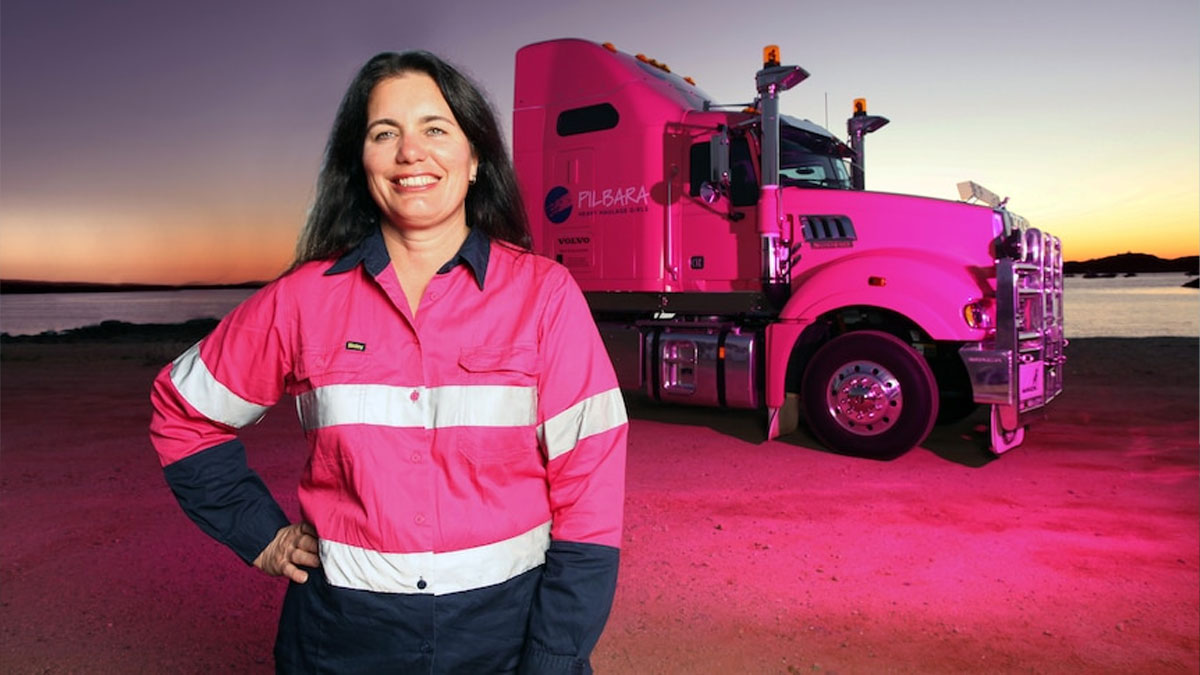
West Australian truck driver Heather Jones owns Pilbara Heavy Haulage Girls — a company offering training to women who want to drive trucks.
"We're [women] 51 per cent of the population and only 2.5 per cent of the transport industry in road driving."
She says there was not only a gap from licence to employment, but also in the skills being taught when acquiring those trucking licences.
"It is really difficult because when you get your licence, you're taught how to drive a truck forwards, backwards, connect, disconnect, and really basic stuff," Ms Jones said.
"You're not taught about the load or any of the trailers behind, and each different occupation required different trailers. General freight requires separate training.
"So that's the shortfall between getting your licence and actually knowing what you're doing."
Ms Jones believes new truck drivers are jumping into trucks unprepared, and hiring outside of Australia would not solve the trucking labour shortage.
"When you get your licence, you're not job ready. And I think that we've been failing newly licensed drivers — male and female — for a very long time," she says.
"Australia has a serious situation at the moment — we don't have enough truck drivers. The answer isn't bringing overseas drivers in, it might be a short stopgap measure.
"We have hundreds and hundreds of people who want to come and do our training.
"So we do know that, in Australia, we do have enough truck drivers to fill the seats. It's just finding them and training them so we can put them in seats and out on the highways."
Young truckies
South Australian fuel tanker driver Casuarina Smith believes encouraging young people into the industry is the key to tackling the labour shortage.
Ms Smith has almost 14,000 followers on Instagram — where she shares what it's like to work in trucking.
"My goal is to try to encourage others to get in the industry and have a bit of a behind-the-scenes view of what it's like day to day as a truck driver," she says.
"Hopefully through this, I can then get into schools to start talking to kids about truck safety and awareness.
"Then that might inspire them to realise that there are actually career options in this industry as well."
Ms Smith also champions the need for more apprenticeship-type training.
"A young kid can start off like any apprentice, where they learn basics about [being] around the yard, how to load trucks or cleaning trucks and then start as a passenger," she says.
In 2022, both Queensland and Tasmania established a heavy vehicle driving apprenticeship.
The apprenticeships, according to the Australian Industry standard, are in response to the call to address driver shortages across Australia.
At the moment, South Australia, Victoria, New South Wales, Australian Capital Territory, Northern Territory, and Western Australia are in the proposal or consultation phases of establishing a heavy vehicle licence apprenticeship.
Original link https://www.abc.net.au/news/rural/2023-03-27/women-in-trucking-push-for-more-female-truckies/102093948
Story by Dimitria Panagiotaros and Angela Coe

Stay tuned for the latest news on our radio stations