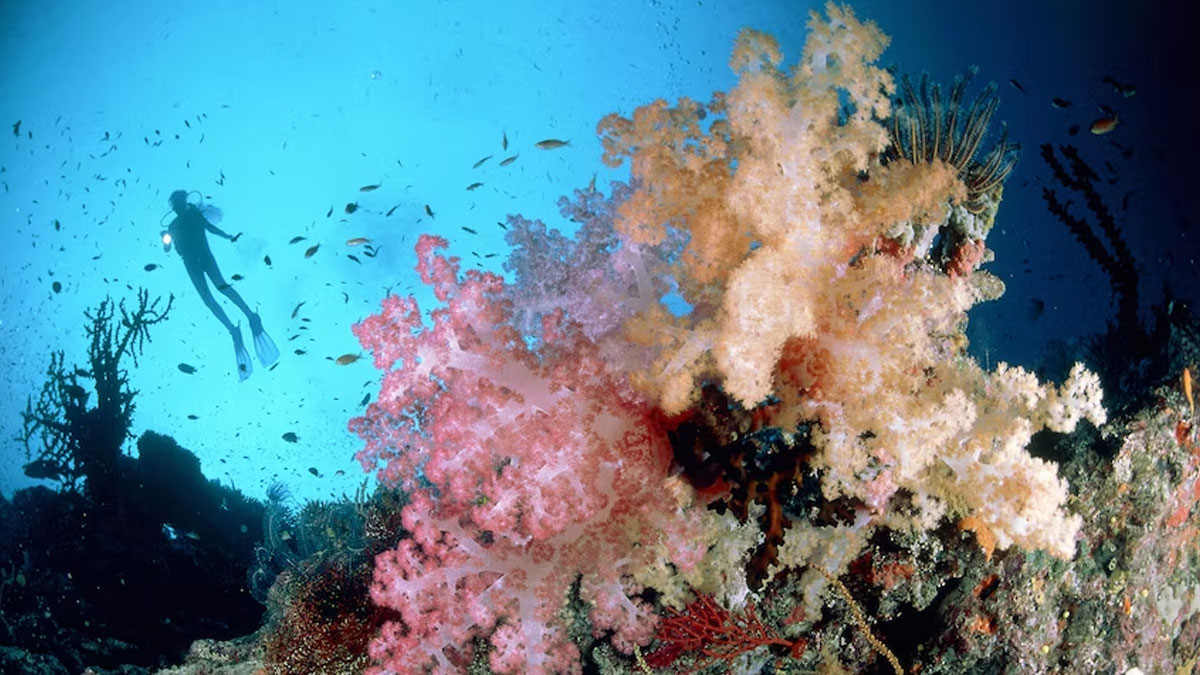
For generations, the people of Fiji have built their lives around the country's rich coral reef ecosystems.
The ocean provides sustenance, while the dazzling marine life brings tourists from around the world.
But climate change is threatening this way of life.
Sea level rise is forcing coastal villages to relocate, with many more in peril.
More frequent natural disasters have taken lives and destroyed houses, crops and infrastructure.
But there's another effect of climate change that isn't as easy to see — an insidious rising danger for the people of Fiji: ocean acidification
"When it hits, it's going to be catastrophic," says Katy Soapi, coordinator of the Pacific Community Centre for Ocean Science at the science and development organisation SPC.
Worse still, Dr Soapi says Fiji and the broader Pacific region aren't watching the emerging threat closely enough.
"We are definitely flying blind," she says.
Many Pacific Island nations have historically lacked the resources to monitor the scale of the problem in their own waters.
But now Dr Soapi is helping to establish a network of scientists that will use novel methods to turn this around.
A more acidic ocean
Dr Soapi is aboard a small dive boat, scanning the choppy waves at the edge of the harbour of Suva, Fiji's capital.
She's here with a small team to check on a pair of devices that she hopes will be the foundation of a Pacific-wide network to monitor rising ocean acidification.
It's overcast but there are still occasional flashes of neon blue and glimpses of rich coral reefs through the clear water.
She's looking for a submerged yellow tag that marks the location of the devices.
When carbon dioxide dissolves in water, it reacts to form carbonic acid.
"The increased presence of carbonic acid leads to increased acidity of the ocean," Dr Soapi says.
It's estimated oceans absorb somewhere between a quarter and a third of the millions of tonnes of CO2 human activities emit.
As oceans turn more acidic, it becomes more difficult for marine organisms, such as coral and some plankton, to form their protective shells and skeletons, and existing shells may begin to dissolve.
"The increase in acidity of the ocean means these organisms are vulnerable to more stress, more predation," Dr Soapi says.
Since pre-industrial times, the average pH level of the world's oceans has decreased from 8.2 to 8.1 (a lower pH means they're more acidic).
That may not sound like much, but it actually means the world's oceans are on average about 25 per cent more acidic now.
That's because the pH scale is logarithmic, so if the value moves one full point down (e.g. from 8.0 to 7.0) that represents a 10-fold change in acidity.
There are grim predictions that by the end of this century, at current CO2 emission rates, the average pH of our seas will have dropped to as low as 7.7.
This would mean a more acidic ocean than the Earth has likely seen for millions of years.
And it's such a rapid change that marine life would have little time to adapt.
"For us in the Pacific, I think this means basically our food sources," Dr Soapi says.
But despite the scale of the threat, monitoring of ocean acidity in the Pacific has been patchy, especially around Pacific Island nations.
Dr Soapi says having this local data is vital, because oceans don't experience acidification at the same rate in each region or microhabitat.
"We really don't have a lot of data for the region," Dr Soapi says.
"Without data, it's very, very difficult to convince people that this is a problem."
A new network in a new way
To help fill these gaps in acidity monitoring, Dr Soapi and her team are building a new network of ocean scientists.
Her centre leads a Suva-based regional training hub called the Pacific Islands Ocean Acidification Centre (PIOAC).
Since 2021, PIOAC has been training dozens of ocean scientists from Pacific nations and providing them with equipment to keep a closer eye on the sea.
"All these young scientists want to do the work," Dr Soapi says.
"But [they] have a lot of the challenges of being small-island, developing-state scientists with very limited resources."
Training scientists to use this equipment means knowing it inside out.
This is why Dr Soapi has deployed a pair of trial devices on the edge of Suva's harbour, and is retrieving them today.
The small inexpensive kits can provide baseline data over long periods — without scientists having to manually test water samples each day.
One of the members of this growing monitoring network, Azaria Pickering, is taking the lead on this trial site. She is aboard with Dr Soapi to extract the valuable data stored on these devices.
While Ms Pickering fires up a laptop on the dive boat, Dr Soapi pulls on a snorkel and mask and dives into the sea to search for the devices.
Soon, she calls out across the waves.
Having found the bright yellow marker, she triumphantly lifts a monitoring device out of the water.
She splashes back to the boat, cleans algae off the device and hands it to Ms Pickering to download the recorded pH and temperature data.
But one of the devices throws up an error.
Its monitoring data has been corrupted and lost.
This result is disappointing for the scientists on board, but not unexpected.
The sea is a harsh environment for electronic devices and sometimes marine creatures will chew on the hardware.
"For a previous deployment, when we went back, a piece of the whole equipment was missing," Dr Soapi says with a wry smile.
Dr Soapi packs this device away for a closer inspection later and prepares a replacement.
"One of the key reasons we are doing the monitoring here is exactly for this [type of data corruption]," she says.
"We could actually use the learnings here to support and help member countries."
Why previous monitoring faltered
These sea-eaten and fish-chomped devices illustrate the challenge of long-term monitoring in the sea.
Organisations like Australia's CSIRO and NOAA in the US have some long-running acidity monitoring stations, but these are mostly located in their own waters.
They also send research vessels crisscrossing through the region taking samples along the way.
But developing the capability for Pacific Island nations to do their own acidity monitoring has proved expensive and challenging.
Previous attempts often saw foreign scientists hand over new equipment with limited training, then leave, Dr Soapi says.
"The scientists that received the equipment had no ongoing support after that.
"The equipment was either just sitting in their offices or the equipment broke down."
She says Pacific scientists often didn't feel they could talk openly about the technical issues that arose.
To avoid this situation, Dr Soapi has encouraged PIOAC's training program to incorporate the Pacific concept of "talanoa."
The traditional Pacific custom is an informal setting for discussion that often uses storytelling to build empathy, share concerns or resolve disputes.
"It's where everybody comes together to share, discuss, learn from each other," Dr Soapi says.
This cultural practice creates a safe place to talk openly about what's working — and what's not.
"Nobody is correct. Nobody is wrong. It's a space and a place for everybody to participate."
Along with embracing talanoa, Dr Soapi marries science with traditional knowledge systems, and links customary ideas of ocean stewardship with the cause of marine conservation in an age of climate change.
"We have a lot of traditional knowledge and it is the dominant form of knowledge in a lot of our communities," she says.
"The Pacific still has some of the healthiest marine areas. This is no surprise because a lot of our areas are managed through traditional knowledge."
Uncharted waters
After replacing the faulty device with a spare, the team motors back to Suva. Dr Soapi shares her hopes for the future.
The task ahead seems daunting, but she says the first step towards finding solutions is having an accurate understanding of the size and shape of the problem — and that means a detailed, up-to-date map of acidity around the Pacific.
"We can only tell whether things are changing, whether there's a trend … if we actually have the long term monitoring," says Dr Soapi.
"We don't know which are the risk areas that are vulnerable."
The new network has already sent monitoring devices to ocean scientists in nine Pacific countries, and has trained scientists in each to run regular data collection.
Dr Soapi says gathering this information now will ultimately allow policy makers to make "informed decisions" about the growing acidification threat.
While combating carbon emissions remains the ideal path towards meaningful change, the training workshops also provide advice on adaptation and mitigation for each nation's scientists to present to local governments.
Some researchers have proposed meadows of seagrass could reduce local ocean acidity, while others suggest regenerative marine aquaculture practices could play a role, simultaneously improving food security.
"The ocean is on everyone's agenda in the Pacific," Dr Soapi says.
"The time to act is now.
"I think it's everyone's business to ensure that the ocean remains healthy, protected.
"Its health is so important."
Story By: ABC Science / By Carl Smith for Pacific Scientific
Original story link: https://www.abc.net.au/news/science/2023-09-12/ocean-acidification-pacific-marine-environment-climate-change/102630998

Stay tuned for the latest news on our radio stations