Fijivillage
10 February, 2026, 6:25 pm
Central - 27°C Rain
10 February, 2026, 6:25 pm Central - 27°C Rain

Expert warns Fiji could become a semi-narco state
Based on second half of last year, 48% of new HIV cases were through injecting drugs while 43% from sexual transmission

Expert warns Fiji could become a semi-narco state

Based on second half of last year, 48% of new HIV cases were through injecting drugs while 43% from sexual transmission

By Vijay Narayan
09/07/2025

As Fiji grapples with a growing HIV outbreak driven by a methamphetamine crisis, an expert warns the country could become a semi-narco state.

The expert in transnational crime also explains to Radio New Zealand on how drug trafficking through Fiji has changed in the past several years to depend more on local syndicates, and the effect this is having on Fiji's drug use and resulting HIV rates.

José Sousa-Santos, lead and convenor of the Pacific Regional Security Hub at the University of Canterbury, says drugs came through the Pacific Islands to New Zealand and Australia, which, despite being small markets, had some of the highest prices, due to tight control of the market.

But he says when local traffickers were paid in drugs instead of cash, they needed a local market to sell to.

He says it's not the larger cartels that are looking at getting the local populations addicted, it's the smaller regional syndicates, the national syndicates, which can now really profit from these local markets.

Santos says this creates 'foot soldiers' who help move drugs through.

He says it leads us to see the roadmap toward Fiji in the future - if this is not addressed urgently - becoming a semi narco state ... where the syndicates and the cartels have undue and strong influence over the state itself and where the government will struggle to maintain law enforcement.

UNAIDS Pacific advisor, Renata Ram has been working for UNAIDS since 2017, and says the landscape had changed in that time.

She says the HIV epidemic was largely driven by sexual transmission, however in early 2019 they started hearing sporadic cases of injecting drug use and domestic drug use, due to all this drug trafficking that was happening through Fiji.

Ram says one practice that had received a lot of attention and blame for spreading the virus is called 'bluetoothing", where after one person gets a hit, they withdraw their blood and share it with other people.

It comes with a high risk of contracting various blood-borne diseases, including HIV.

But Ram says this had been overblown.

She says there's been a lot of sensationalisation around bluetoothing, but it's not the main way people who use drugs actually consume their drugs, it's a very small percentage of people who actually do this.

She says sharing needles is the main cause.

Based on the statistics for the second half of last year, 48 percent of the people had contracted HIV through injecting drugs, compared to about 43 percent from sexual transmission.

There were also 32 cases last year of mother-to-child transmission.

The report say it is clear that behind the HIV crisis is a drug crisis.

Ram adds testing of HIV around the Pacific Islands is poor, so they don't have a clear picture of the scale of the problem, but several countries including Solomon Islands, Vanuatu and Tonga have reported an increasing number of cases.

Fiji had 1583 new cases last year.

It is a 281 percent increase from 2023.
Click here for stories on the Drugs Situation in Fiji

FEATURE NEWS
PM yet to meet Saukuru, whistleblower asks how Rokoika & Vakalalabure Lawyers were allowed to have office
Prime Minister, Sitiveni Rabuka has not confirmed when he will meet Minister for Sports, Jese Saukuru regarding the business class travel by Saukuru's...
1 hour ago
LATEST NEWS
Four FNU students set sail on fully funded maritime scholarships
A sense of renewed opportunity filled the Fiji National University’s Nasinu Campus today as four students were awarded fully funded maritime ...
1 hour ago

UniFiji backs National Referendum Bill but flags two unconstitutional clauses
The University of Fiji has stated that the National Referendum Bill is firmly based on Section 160 (3–6) of Fiji’s 2013 Constitution, with most ...
1 hour ago

ODPP confirms Bainimarama, Sayed-Khaiyum and Qiliho 2023 alleged sedition file under review
The Office of the Director of Public Prosecutions has today confirmed that Police have returned the file of former Prime Minister Voreqe ...
1 hour ago

Shazran Lateef to stand trial in July for alleged meth and marijuana possession
The trial of former Suva lawyer, Shazran Abdul Lateef who was allegedly found with methamphetamine and marijuana in Rewa Street, Suva in 2021, will ...
2 hours ago

Severe Thunderstorm Warning in force for Viti Levu
A Severe Thunderstorm Warning for heavy rain is now in force for the north-western half and interior of Viti Levu, from Nadi through to Rakiraki, ...
2 hours ago


Stay tuned for the latest news on our radio stations

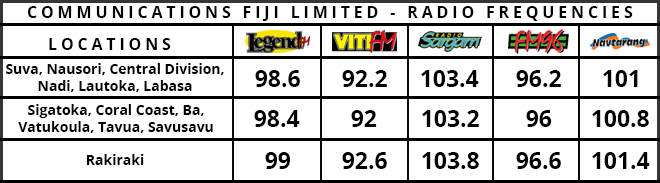
CFL radio frequencies
IN DEPTH
Minister ready to repay business class air fare for wife as concerns grow about Sports Council deals
I was invited to travel to New Zealand by the Fiji Sports Council for a grassroots 7s tournament in 2024, I travelled business class but it was ...
4 days ago

Barbara Malimali, former Attorney General Graham Leung and lawyers Wylie Clarke and Laurel Vaurasi's counsels made submissions for leave to apply for judicial review of the Commission of Inquiry into Malimali's appointment as FICAC Commissioner
The application for leave for the judicial review has been made by former FICAC Commissioner Barbara Malimali, former Attorney General Graham Leung ...
4 days ago

Malimali’s legal battle against President, PM and AG
Another legal battle starts today as sacked FICAC Commissioner, Barbara Malimali takes her matter to court against the President, Prime Minister and ...
5 days ago

TOP