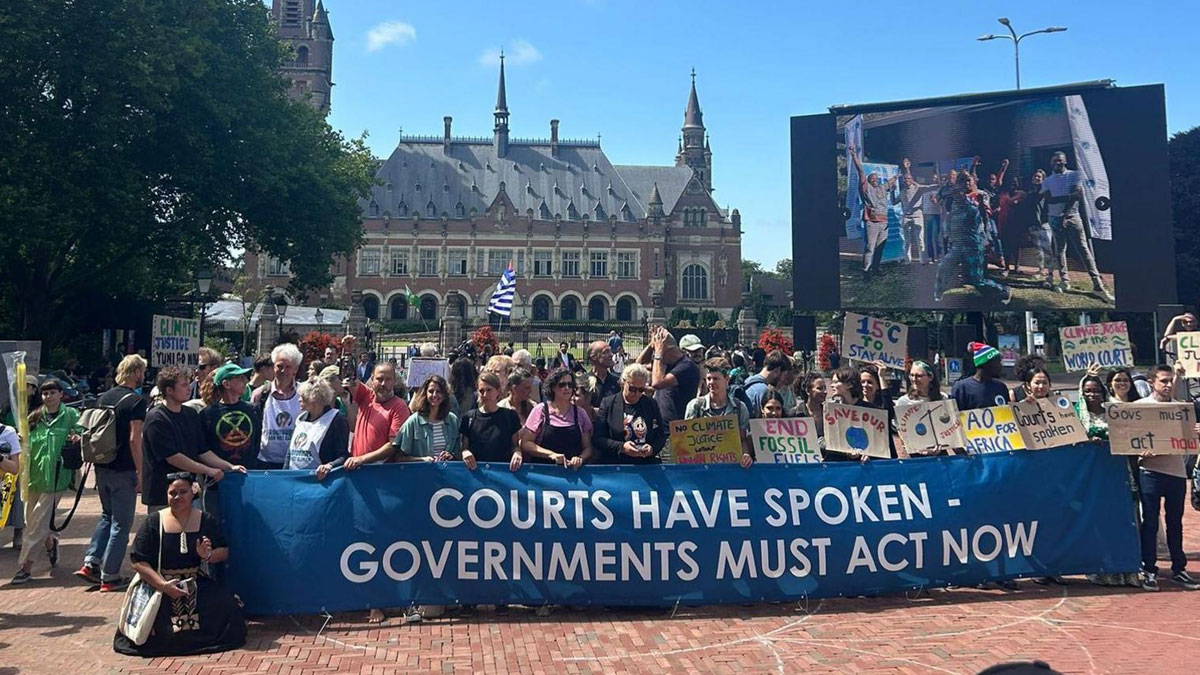
The International Court of Justice has delivered its historic first advisory opinion on the obligations of States in relation to climate change.
The top United Nations court has cleared the way for countries to sue each other over climate change, including the greenhouse gas emissions.
The landmark ruling was read in a public sitting at the Peace Palace in The Hague, by Judge Iwasawa Yuji, President of the Court.
Judge Yuji says that if countries don’t develop the most ambitious possible plans to tackle climate change this would constitute a breach of their promises in the Paris Agreement.
He says that broader international law applies, which means that countries which are not signed up to the Paris Agreement - or want to leave, like the United States - are still required to protect the environment, including the climate system.
Judge Yugi says the consequences of climate change are severe and far-reaching, affecting both natural ecosystems and human populations.
In the ruling it was stated that States parties to the Paris Agreement have an obligation to prepare, communicate and maintain successive and progressive nationally determined contributions which, inter alia, when taken together, are capable of achieving the temperature goal of limiting global warming to 1.5°C above pre-industrial levels.
It also highlights that parties to the Paris Agreement have obligations of adaptation and co-operation, including through technology and financial transfers, which must be performed in good faith.
Customary international law sets forth obligations for States to ensure the protection of the climate system and other parts of the environment from anthropogenic greenhouse gas emissions.
These obligations include that States have a duty to prevent significant harm to the environment by acting with due diligence and to use all means at their disposal to prevent activities carried out within their jurisdiction or control from causing significant harm to the climate system and other parts of the environment, in accordance with their common but differentiated responsibilities and respective capabilities. Also to co-operate with each other in good faith to prevent significant harm to the climate system and other parts of the environment, which requires sustained and continuous forms of co-operation by States when taking measures to prevent such harm.
The Court responds to questions put by the General Assembly that breach by a State of any obligations identified in response to question (a) constitutes an internationally wrongful act, entailing the responsibility of that State.
The responsible State is under a continuing duty to perform the obligation breached.
The legal consequences resulting from the commission of an internationally wrongful act may include the obligations of: (a) cessation of the wrongful actions or omissions, if they are continuing; (b) providing assurances and guarantees of non-repetition of wrongful actions or omissions, if circumstances so require; and (c) full reparation to injured States in the form of restitution, compensation, and satisfaction, provided that the general conditions of the law of State responsibility are met, including that a sufficiently direct and certain causal nexus can be shown between the wrongful act and injury.
Meanwhile, in December last year, Fiji presented its submission to the International Court of Justice Advisory Opinion proceedings on the obligation of States with regards to climate change in The Hague.
The Fiji delegation was led by the then Attorney General, Graham Leung and supported by Fiji’s Permanent Representative to the United National Office and Other International Organizations in Geneva, Ambassador Luke Daunivalu.
Graham Leung also provided the legal arguments and submissions focused on three critical areas - the existential threat of climate change; the legal obligations of the States with respect to climate change; and the legal consequences of failing to uphold those obligations.
Source: BBC

Stay tuned for the latest news on our radio stations