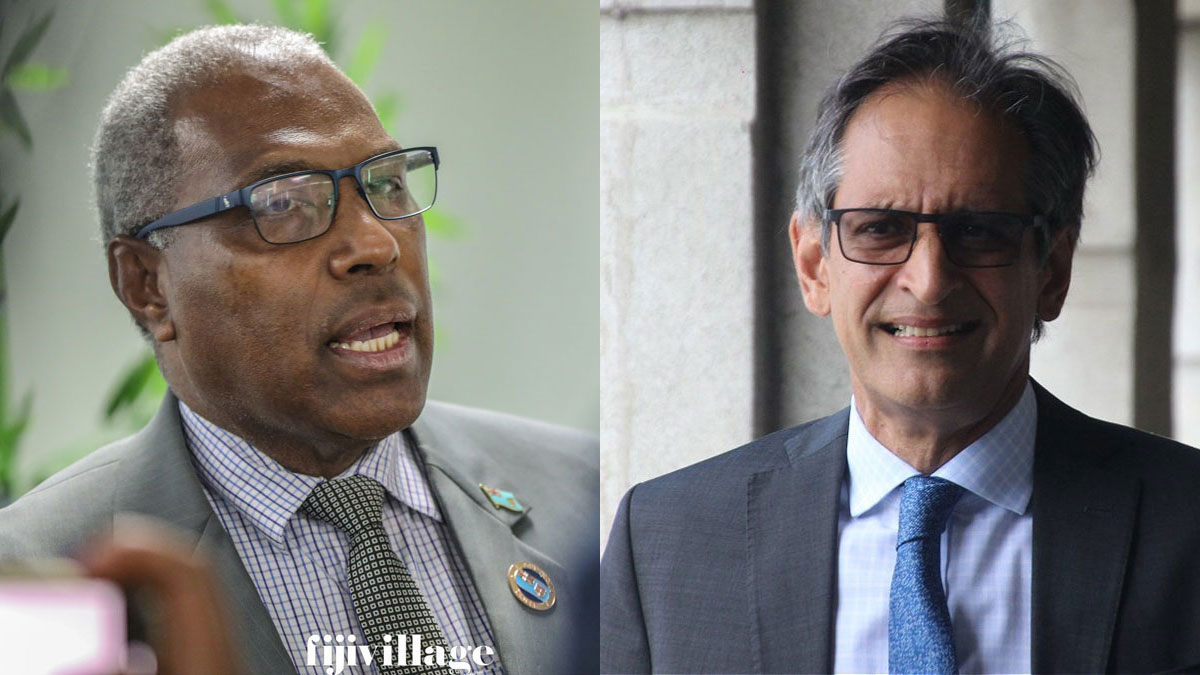
Acting Attorney General, Siromi Turaga encourages that submissions be made to the Parliamentary Committee dealing with the National Referendum Bill 2025 as the appropriate forum so that the views of concerned persons and ordinary Fijians may be taken into consideration as they strive to enact a law to regulate the conduct of national referendums in a way that is responsive, effective and suitable to the context of Fiji.
Turaga says there are some recent posts on social media that are generating unnecessary alarm with respect to the Referendum Bill by alluding that its provisions breach free speech pursuant to the Constitution or that it is a product borne of ulterior motives or is dissimilar to laws on referendums that can be found elsewhere.
Turaga says Clauses 22 and 23 of the Bill impose certain prohibitions on the use of badges, symbols or other emblems, as well as canvassing, respectively, in connection with a referendum that are in line with international best practices to avoid undue influencing of votes or interference with political autonomy.
He adds equivalent or similar provisions exist under section 145 of the Electoral Act 2014.
The Acting Attorney General says in addition, Singapore has similar provisions under sections 40 and 42 of the Singapore National Referendum Ordinance 1961 and Australia under sections 122 and 133 of the Referendum (Machinery Provisions) Act 1984 of Australia also have similar provisions.
Turaga says Section 17 of the Constitution provides the right to freedom of speech, expression and publication, and also provides that to the extent that it is necessary, a law may limit, or may authorise the limitation of such rights for reasons including in the interests of national security, public safety, public order, public morality, public health or the orderly conduct of elections.
He adds that Section 7(3) of the Constitution which provides guidance on the interpretation of the Constitutional Bill of Rights provides that a law that limits a right or freedom is not invalid solely because the law exceeds the limits imposed therein if the law is reasonably capable of a more restricted interpretation that does not exceed those limits, and in that case, must be construed with the more restricted interpretation.
The Acting Attorney General says purported interpretations aside, the Bill that is the subject of much commentary has yet to be enacted and, true to the spirit of democracy and a living breathing Parliament, is currently before the Parliamentary Standing Committee on Justice, Law and Human Rights to which submissions can be made accordingly.
Meanwhile prominent Suva lawyer, Richard Naidu has said that some of the provisions in the National Referendum Bill are a mess, and they seem to have been “cut and pasted” from somewhere else without thinking.
Naidu says in a post that Section 22 makes little sense, and it’s wide enough to allow someone to be prosecuted for publishing a newspaper ad saying “I support the 2013 Constitution, please vote against changing it in the referendum.”
He says Section 23(1) does not seem to stop you from campaigning for one side or other in the referendum.
Naidu says it seems to stop you from persuading someone to vote or not vote in the referendum.
He says that does not make any sense either.
The lawyer says Section 23(2), however, seems to stop you from visiting someone’s home for “any purpose in connection” with the referendum, which could include saying “vote to keep the 2013 Constitution” (or not to).
Naidu says they breach basic free speech provisions in the Constitution, and they need to be fixed.
He adds the Government’s published response to Dialogue Fiji’s concerns about the Bill was hardly encouraging.
Naidu says they do not want anyone to do media or talkback on the Bill without consulting the Attorney General’s Office.
He says this is to “avoid miscommunication and public confusion”, and their drafting seems to have created a lot of that already.