Fiji and Australia’s business relationship must move from dialogue to projects, investment and long-lasting economic transformation as the two countries navigate a rapidly shifting global landscape.
This was the strong message from Deputy Prime Minister and
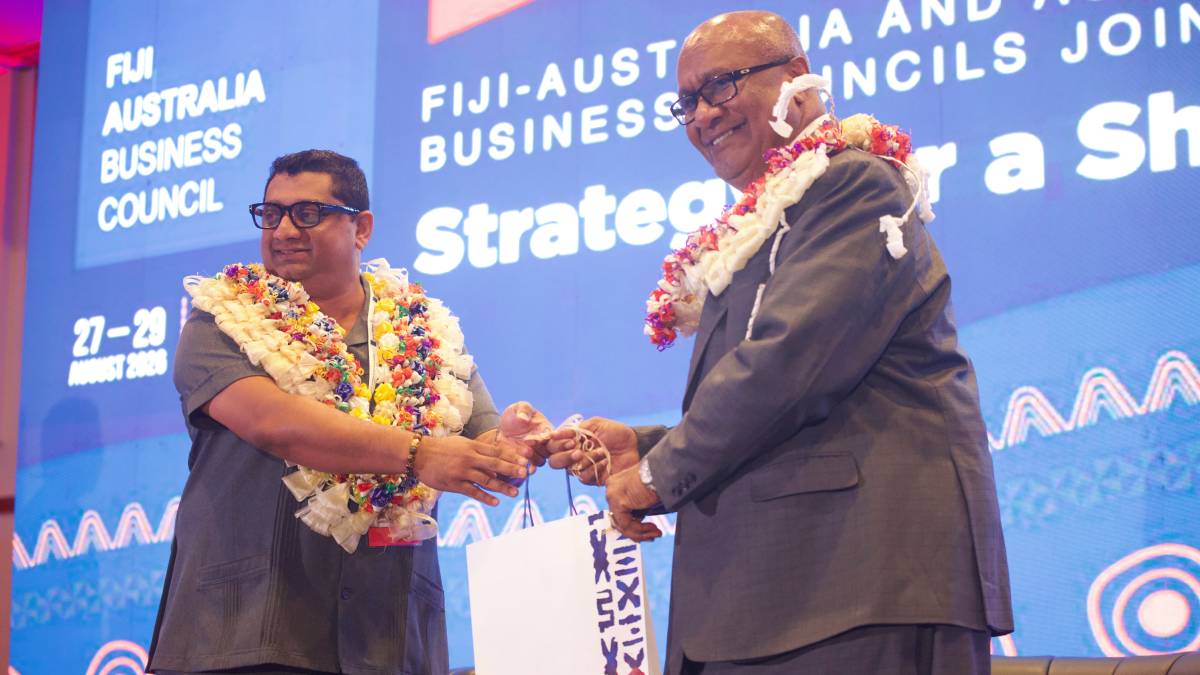
Minister for Industries, Commerce and Business Development, Manoa Kamikamica at the opening dinner of the Australia-Fiji and Fiji-Australia Business Council Joint Forum 2026 at the Grand Pacific Hotel in Suva.
Kamikamica says the theme of this year’s forum, Strategy for a Shifting Landscape, is particularly timely as geopolitical competition increases, global supply chains remain vulnerable, technology transforms economies and climate change continues to affect security and development.
He says Fiji’s response to these changes must not be driven by uncertainty, but guided by principle.
The Deputy Prime Minister says the signing of the Vuvale Union Treaty and the Ocean of Peace Alliance on 6th July 2026 marks a new chapter in the Fiji-Australia relationship.
He says the meaning of Vuvale is important because it means family.
He stresses that the relationship between Fiji and Australia extends well beyond governments and political cycles, and is sustained by families, communities, businesses, workers, investors and people-to-people connections.
INSERT: Kamikamica on partnership 27th Aug
Kamikamica says Fiji welcomes partnerships with Australia, New Zealand, the United States, Japan, China, the European Union and other partners, provided those partnerships respect Fiji’s sovereignty, support Pacific regionalism and contribute to long-term capability and resilience.
He stresses that Fiji does not seek partnerships based on dependency, but partnerships based on mutual benefit, mutual respect and shared responsibility.
He says the next step is to translate the strong political and people-to-people relationship between Fiji and Australia into greater economic opportunity.
The Deputy Prime Minister identifies stronger two-way trade, greater investment, regional headquarters and business services, digital and technology partnerships, renewable energy, climate-resilient infrastructure, agriculture and agro-processing, fisheries and the blue economy, logistics, maritime services, skills development and workforce mobility as areas of opportunity.
He emphasises that our objective should not be simply more investment; it should be better investment.
He adds that investment should create jobs, build local capability, transfer knowledge, strengthen supply chains, add value locally and remain sustainable over the long term.
Kamikamica says Fiji’s economy has demonstrated resilience, but the country must move from recovery towards stronger, more sustainable productivity-led growth.
He says the private sector must be at the centre of Fiji’s growth strategy, explaining that government’s role is simply to create conditions for investment, while businesses’ role is to invest, innovate, create employment and expand markets.
He acknowledges that improving the business environment remains a work in progress, saying businesses need certainty, efficient public services, reliable infrastructure, access to finance, skills and markets, as well as confidence that government will continue improving the regulatory environment.
Kamikamica also highlights digital transformation and public sector reform, encouraging businesses to examine Fiji’s National Digital Strategy.
He also calls for greater economic opportunities outside Fiji’s main urban centres, saying that Fiji’s villages, islands and maritime communities have enormous potential in agriculture, aquaculture, tourism, renewable energy, cultural industries and the blue economy, but need stronger connections to markets.
He encourages the Fiji-Australia business community to partner with rural producers, invest in agro-processing and maritime logistics, and create greater opportunities for women and young entrepreneurs.
Kamikamica says the future of the Fiji-Australia economic relationship will also depend heavily on skills, mobility and people-to-people connections.
He says businesses should be part of discussions around skills development because industry knows the skills it needs, while government can create the policy environment and Australia can provide opportunities for training, experience and knowledge exchange.
Meanwhile, Fiji-Australia Business Council President Himen Chandra says 2026 marks 40 years of the bilateral business council relationship.
Chandra says the Fiji-Australia Business Council (FABC) and the Australia-Fiji Business Council (AFBC) were formed in April 1986 and have remained steadfast through periods of political and economic challenge over the past four decades.
He highlights the role of FABC during the political crises of 1987 and 2000, the strengthening of private sector engagement in the 1990s and 2000s, the broader focus on investment, tourism, trade and policy in the 2010s, and the disruption caused by COVID-19.
He says the Joint Business Forum returned in 2022 following the pandemic, attracting 136 delegates, while FABC recorded 155 members at its 2024 Annual General Meeting.
Chandra says FABC now has a record 171 registered members and more than 200 delegates are participating in this year’s Joint Forum.
He says FABC is entering its fifth decade with a stronger focus on trade, investment, export development, SME growth, innovation and community impact.
He also highlights FABC’s work supporting community initiatives, including a planned $50,000 contribution towards community projects in 2024 and an agreement with the Market Development Facility for an Agri-Food Manufacturing SME Export Accelerator Programme aimed at helping Fijian businesses become export-ready and access the Australian market.
He says FABC also supported a medical cleaning upgrade in Raiwaqa as part of its community engagement.
Chandra says the objective now is to make the Fiji-Australia business relationship bigger and better.
The Joint Forum is being held under the theme Strategy for a Shifting Landscape, with discussions focused on how businesses can respond to changing economic, geopolitical, technological and climate conditions while strengthening the Fiji-Australia partnership.
The forum is being held at the Grand Pacific Hotel and will conclude on Saturday.