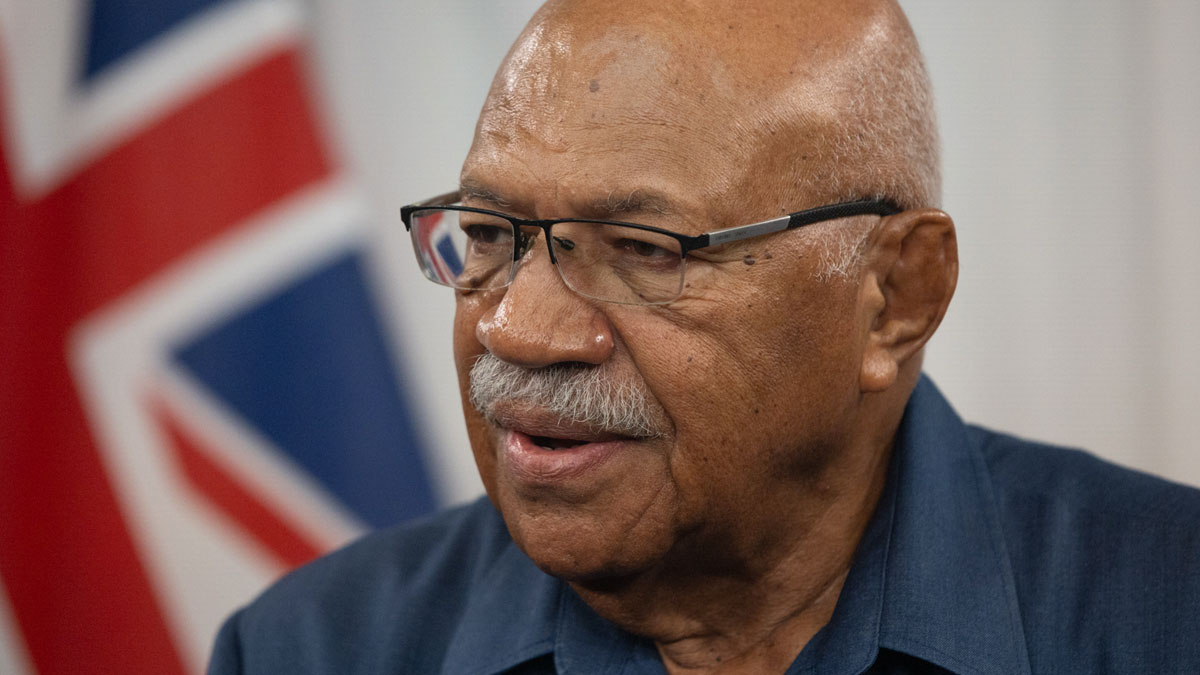
Rabuka stresses that the government cannot interfere into any investigations and the court processes after investigations as they are independent functions.
He says if the US has grounds on some of their citizens who are involved and they would want them extradited, Fiji has extradition agreements with the US and we will oblige.
The 2025 Trafficking In Persons Report states that foreign nationals, including from the Republic of Korea and the United States, who are members of a foreign-based religious organisation, the Grace Road Group, experience conditions indicative of human trafficking, including in businesses owned and operated by the organisation in the agriculture, retail, construction, and service industries.
The report says victims associated with the organisation report being forced to work excessive hours with no rest days, physical violence, passport confiscation, and unpaid wages.
The United States remains deeply concerned about indicators of trans-national organised crime and human trafficking in Fiji associated with the Grace Road Group as outlined in the latest report as well as other suspected trafficking in persons issues in Fiji.
A US Embassy spokesperson has told fijivillage News that they are working closely with the Government of Fiji to encourage decisive action to address the recommendations outlined in the report and avoid an automatic downgrade to Tier 3 in 2026 which could result in the suspension of certain assistance programs.
The spokesperson says the United States and Fiji continue to work together on a wide range of programs that will enhance the prosperity of both countries including the recently announced Millennium Challenge Corporation Compact Program.
The 2025 Trafficking In Persons Report places the Government of Fiji on the Tier 2 Watch List for the second consecutive year.
According to this year's report, the Government of Fiji does not fully meet the minimum standards for the elimination of trafficking.
It says despite making significant efforts to do so, the government did not demonstrate overall increasing efforts compared with the previous reporting period.
Therefore, Fiji remains on Tier 2 Watch List for the second consecutive year.
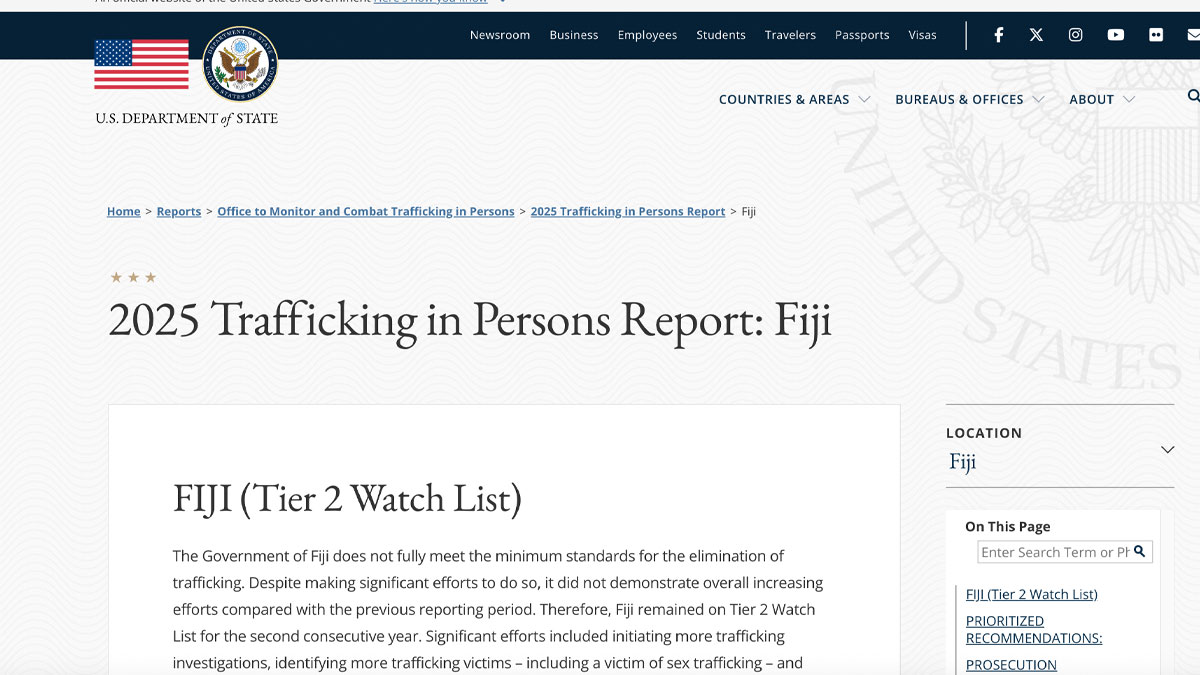
The United States remains deeply concerned about indicators of trans-national organised crime and human trafficking in Fiji associated with the Grace Road Group as outlined in the 2025 US Trafficking In Persons Report as well as other suspected trafficking in persons issues in Fiji.
A US Embassy spokesperson has told fijivillage News that they are working closely with the Government of Fiji to encourage decisive action to address the recommendations outlined in the report and avoid an automatic downgrade to Tier 3 in 2026 which could result in the suspension of certain assistance programs.
The spokesperson says the United States and Fiji continue to work together on a wide range of programs that will enhance the prosperity of both countries including the recently announced Millennium Challenge Corporation Compact Program.
The 2025 Trafficking In Persons Report places the Government of Fiji on the Tier 2 Watch List for the second consecutive year.
According to this year's report, the Government of Fiji does not fully meet the minimum standards for the elimination of trafficking.
It says despite making significant efforts to do so, the government did not demonstrate overall increasing efforts compared with the previous reporting period.
Therefore, Fiji remains on Tier 2 Watch List for the second consecutive year.
The significant efforts included initiating more trafficking investigations, identifying more trafficking victims – including a victim of sex trafficking – and referring trafficking victims to services.
The report highlights that in partnership with civil society, the government completed the development of victim identification Standard Operating Procedures, began developing a centralized trafficking case management system, and updated the anti-trafficking National Action Plan.
However, the government did not initiate any new trafficking prosecutions and, for the second consecutive year, did not convict any traffickers.
The US report states that despite many years of widespread reporting of trafficking indicators within a religious organisation that operated numerous businesses in various sectors, authorities did not take sufficient action to hold suspected traffickers accountable or identify and assist potential victims.
It says official complicity and corruption undermined anti-trafficking efforts and allowed traffickers to operate with impunity.
The recommendations for Fiji include approving and implementing formal Standard Operating Procedures for victim identification and referral to care and train stakeholders on their use, and proactively identifying trafficking victims by screening for trafficking indicators among vulnerable populations – including individuals in commercial sex, Chinese national workers, child labourers, and migrant workers – including at initial visa application and recruitment.
Other recommendations include increasing efforts to investigate and prosecute trafficking crimes, including those involving complicit officials and individuals facilitating child sex trafficking on private yachts and in hotels, and seeking adequate penalties for convicted traffickers, which should involve significant prison terms.
The report also recommends that the Fiji Government should finalise and implement the 2026 National Action Plan and dedicate resources to its implementation, institutionalize and expand comprehensive anti-trafficking training for front-line officials, including in the basic recruit training, at local police stations, and for officers assigned to the Fiji Police Force’s Human Trafficking Unit, on the indicators of trafficking, victim-centered and trauma-informed trafficking investigations, available victim protection services, and investigative techniques, amend trafficking-related provisions of the 2009 Crimes Act to criminalise all forms of trafficking, enable identified foreign victims to work and earn income while assisting with investigations, provide a legal alternative to victims’ removal to countries where they may face retribution or hardship, and continue to increase efforts to work with civil society, the private sector, and religious and community leaders to develop public awareness campaigns, including in iTaukei and Hindi, to raise awareness on all forms of human trafficking and the anti-trafficking laws, particularly among employers, foreign tourists, residents in outer island communities, and vulnerable populations, including individuals in commercial sex, persons displaced by natural disasters, foreign migrant workers, and female victims of violence.
They recommend increasing the availability and quality of protection services – including completing renovation of the Fiji Immigration Department’s safehouses and providing short-term shelter, long-term housing, counseling, and medical care for all trafficking victims, including by collaborating with civil society service providers, train prosecutors and judicial officials on the application of trafficking laws, elements of trafficking, investigative techniques, evidence collection specific to trafficking cases, and alternatives to victim testimony, and improving collaboration and communication between police and prosecutors, including by assigning a prosecutor to work directly with the police and Immigration Department on trafficking cases.
The recommendations include increasing oversight of working conditions for foreign construction workers and increasing investigation of labour violations involving children and migrant workers for forced labour.
Meanwhile Prime Minister, Sitiveni Rabuka has said that the Fiji Government’s fight against human trafficking and people smuggling has been further strengthened through a series of initiatives designed to further strengthen security at our borders and enhance our law enforcement capabilities.
Rabuka says following Parliament’s successful passage this month of Bill No. 44 of 2025, an Act to Repeal the Registration of Skilled Professionals Act 2016, the Coalition Government has this week secured Cabinet’s endorsement of two additional measures which include the allocation of $0.5 million to support Fiji’s response to trafficking in persons; and the implementation of the Advance Passenger Information (API) and Passenger Name Record (PNR) systems as part of our national security and border modernisation strategy.
He says in close partnership with civil society organisations, the government has completed a Standard Operating Procedure for victim identification, established a centralised case management system, and updated the National Action Plan on Anti-Trafficking to guide the whole-of-government actions.
Rabuka says an inter-ministerial taskforce—comprising the Ministries of Justice, Policing, Immigration, Finance, and led by the Office of the Prime Minister continues to provide strategic direction and oversight of these national efforts.
He confirms that joint investigations by Immigration, Customs, and Police into a series of related cases are now nearing completion, and enhancing prosecution and conviction rates remains high on the priority list.
We have also sought comments from Police regarding the Grace Road investigations. They are yet to respond.

Stay tuned for the latest news on our radio stations