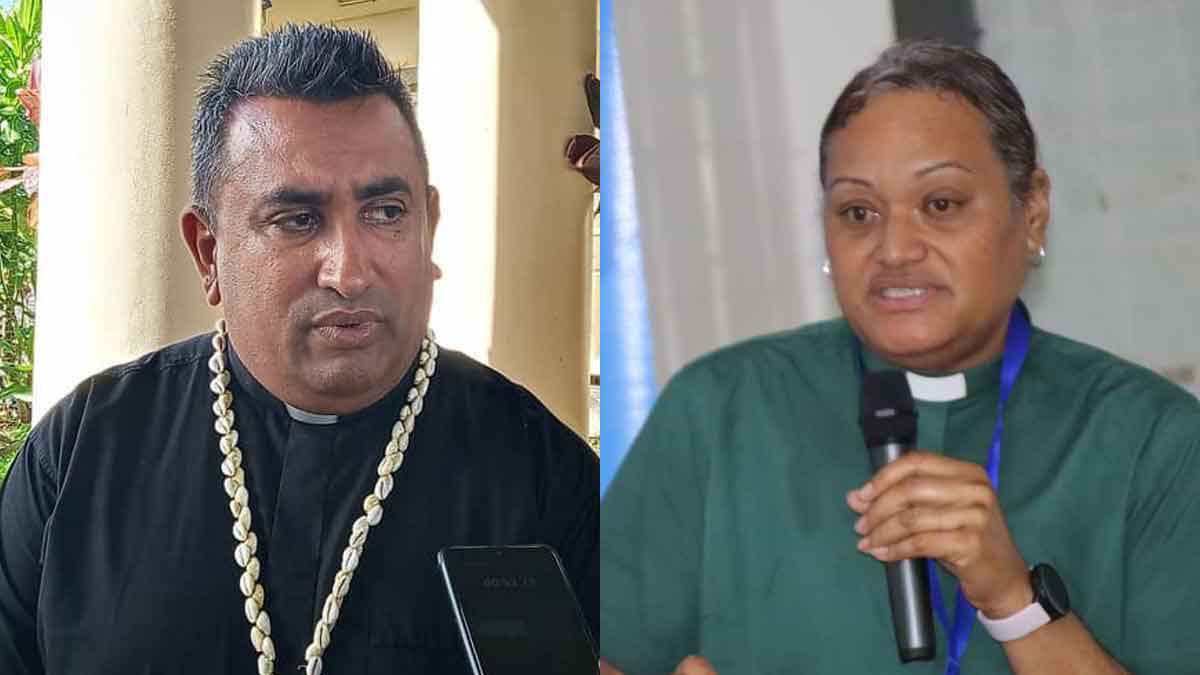
The Pacific Conference of Churches and the Fiji Council of Churches have written to the Director of Environment to endorse the collective submission objecting to the proposed The Next Generation Fiji's proposed Energy from Waste Facility, Port Development, and Associated Industrial Precinct at Vuda Point.
Pacific Conference of Churches General Secretary, Reverend James Bhagwan and Fiji Council of Churches General Secretary, Reverend Sepiuta Hala'api'api say they do so as churches called to bear witness to the God who creates, sustains, and redeems all life.
They say the land is not ours to destroy, the sea is not ours to poison, the mangroves, reefs, rivers, air, and shores are not empty spaces for unchecked industrial ambition, they belong first to
God, and we are entrusted to live within creation as servants, not masters, as guardians, not consumers.
The Pacific Conference of Churches and Fiji Council of Churches believe the concerns raised in the collective submission are grave and cannot be dismissed lightly as they involve not only technical
matters, but moral ones: the protection of creation, the wellbeing of communities, the rights of customary holders, the integrity of consultation and consent, and the duty of the State to act with
precaution and justice.
The collective submission which is also signed off by Reverend Bhagwan says Fiji does face real waste-management and energy challenges.
They say the objection is not to development in principle, but to approving a project of this scale without meeting the highest legal, ecological, social, and moral threshold.
It says this is a high-risk proposal in the wrong kind of place.
The submission argues that even the Environmental Impact Assessment acknowledges serious risks to mangroves, marine ecosystems, air quality, traffic, livelihoods, amenity, customary marine use, and community wellbeing.
It describes the proposal as a major industrial development in a sensitive coastal and cultural landscape, in a prime tourism area.
They add that consultation is not the same as consent.
One of the strongest points is that the process does not yet show Free, Prior and Informed Consent.
The collective submission says affected communities were not meaningfully empowered to decide, and raises concern that only 27 percent of the proposed development area is owned by the proponent, with 73 percent still to be acquired.
They say the promised benefits read more like promotional claims than decision-grade evidence.
It says it points to sweeping claims about jobs, energy security, hospitals, schools, medical tourism, and national transformation, while noting contradictions such as references to landfill elimination by Q1 2026 even though operations are indicated elsewhere as starting in 2029.
The submission argues that comparing the project to worse alternatives is not enough.
It says direct emissions, long-term combustion infrastructure, waste lock-in, shipping, ash handling, and hazard exposure all need serious scrutiny, and that offsets or “net” framing cannot simply erase real emissions.
The submission also challenges simplified claims that there are effectively no toxic emissions.
It notes that the EIA models pollutants including NOx, SO₂, CO, hydrochloric acid, particulate matter, metals, dioxins and furans, and also raises unresolved questions about hazardous ash and long-term monitoring and enforcement.
The document says the impacts are not abstract.
They include possible displacement, harm to livelihoods, effects on fishers and tourism, visual and noise impacts, traffic increases, and pressure on access, safety, and the character of the coast.
It notes the EIA indicates up to 30 affected households and around 90 waste trucks a day during operation.
It adds the submission grounds its objection in Fiji’s Constitution, the Environment Management Act 2005, the Climate Change Act 2021, the waste hierarchy, and Fiji’s biodiversity and human-rights obligations.
The collective submission says the central claim is that the approval threshold has not yet been met.