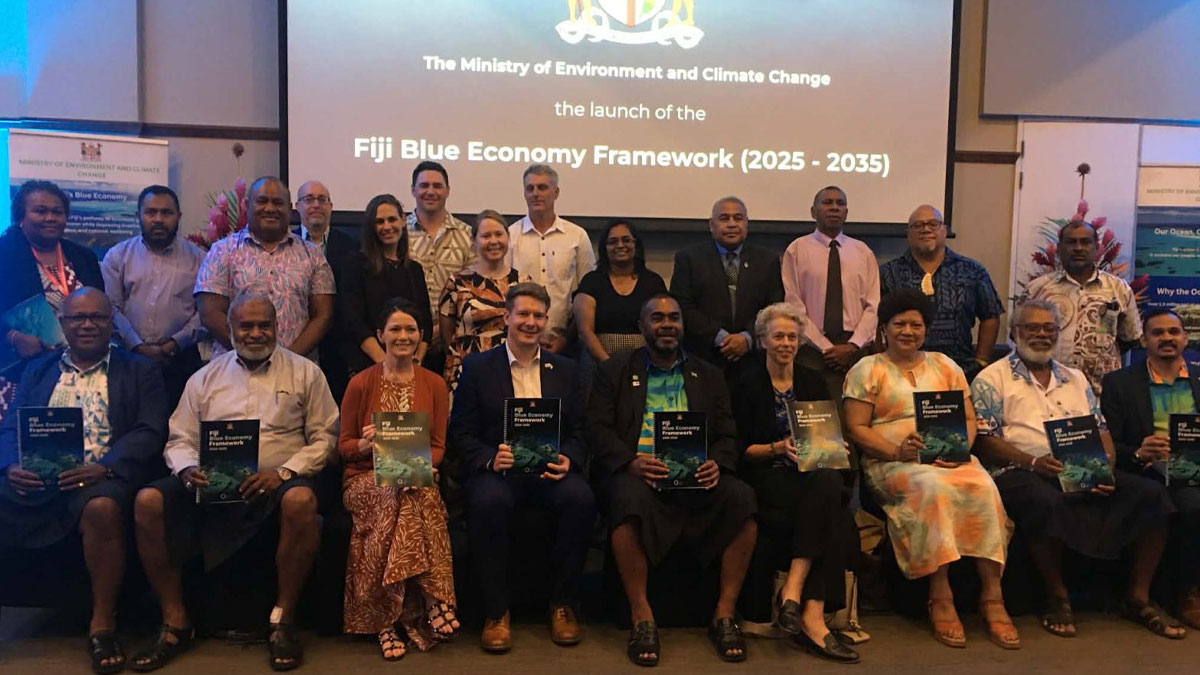
The Cabinet has endorsed the Fiji Blue Economy Framework 2025 to 2035, setting a national policy direction for sustainable, inclusive, and climate-resilient development of Fiji’s ocean-based economy.
While officiating at the launch, outgoing Minister for Environment and Climate Change Mosese Bulitavu says the Framework provides a clear national direction for Fiji’s ocean development.
He says it lays a strong foundation for growing the ocean economy while protecting the marine environment and delivering long-term benefits for communities and future generations.
Bulitavu says the sea feeds our people, sustains communities, connects islands, and protects Fiji’s shores.
He adds that nearly nine out of every ten Fijians live along the coast, with thousands of livelihoods depending directly on healthy marine ecosystems.
The Minister says when the ocean thrives, Fiji thrives.
He says coastal and marine ecosystems — including coral reefs, mangroves, and seagrass — support fisheries, tourism, shoreline protection, and rural livelihoods, especially in the outer islands and maritime provinces.
Founder and Chairman of the Waitt Institute, Ted Waitt, highlighted the importance of long-term ocean protection for sustainable economic growth.
He says the success of the Blue Economy depends on protecting ocean resources so they can continue supporting livelihoods and food security.
Waitt adds that healthy oceans are like a bank account that pays dividends over time.
The Framework provides a coordinated national approach to developing Fiji’s Blue Economy, recognising the ocean as a key driver of economic growth, food security, livelihoods, and cultural identity.
It sets strategic direction across priority sectors, including fisheries, aquaculture, ocean tourism, maritime transport, renewable ocean energy, and marine conservation.
As a Big Ocean State, Fiji’s ocean territory covers more than 1.3 million square kilometres, with most of the population living along coastal areas and relying on ocean resources.
The Framework also responds to growing threats such as climate change, ocean warming, coral bleaching, declining fish stocks, and extreme weather events.
It was developed through an inclusive consultation process involving government agencies, civil society, customary resource owners, the private sector, academia, youth groups, and development partners.
The Framework outlines national principles and strategic priorities, allowing flexibility for ministries and sectors to develop projects that meet local needs while aligning with national Blue Economy goals.
Navi