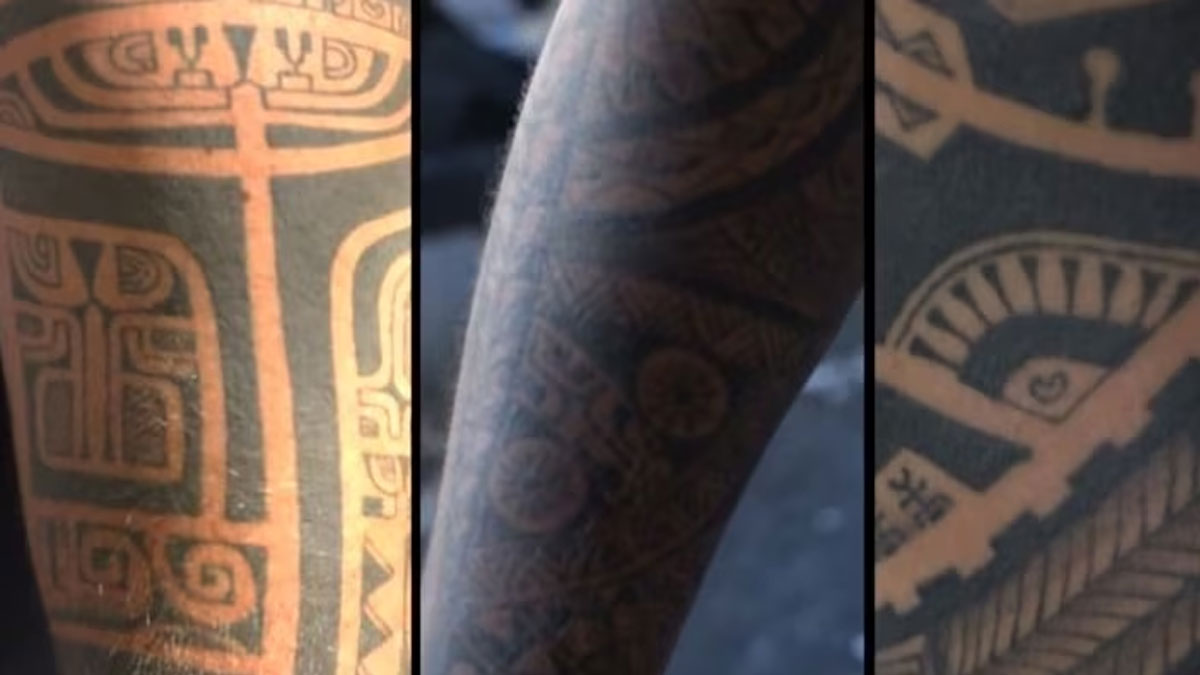
The ancient practice of tatau, or tattooing, has been at the heart of Pacific societies for more than 2,000 years.
With the body a canvas for breathtaking craftsmanship, the tatau is etched into stretched skin using needle-sharp animal bones.
Each tatau is different and personal with motifs that symbolise one's identity, heritage, and responsibilities as well as social rank, geography and genealogy.
Tahiti's tatau revival In Tahiti in French Polynesia, tatau survived early attempts to prohibit tattooing by missionaries who believed it was sinful to break and mark the skin.
Then from 1986 to 2001, traditional tattooing was banned due to health and hygiene concerns.
"For the Tahitian tatau, ta means to mark, and tau is the time. So for me, tatau is the mark of our link with the past, with our ancestors," tattoo artist Patu Mamatui Tamata said.
Although it was forbidden for a long time, Mr Tamata says it has had a strong resurgence.
Tattooing enjoyed a renaissance in the 1980s with the arrival of the tattoo gun, which made it less painful and faster to complete pieces.
In the decades since, Tahiti has been experiencing a tatau revival with people travelling from near and far to be inked by the few artists who use the traditional techniques.
Mr Tamata says only about four traditional tattooists still practice tatau in French Polynesia and one of them is James Samuela who runs his own business Mo'orea Tattoo, on an island a short ferry ride from the capital Papeete.
Mr Samuela has over two decades' experience tattooing people around the world.
His tattoo station is shaded by the trees, overlooking the island's picturesque beaches.
"It's all about being on Mo'orea and getting tattoo on Mo'orea," Mr Samuela says.
"I do gun also, but I do more traditional way now than gun. I like both but they're just two different techniques."
Tatau for Tahitians only Mr Samuela takes a different approach when tattooing visitors.
"I don't do traditional pattern the way we use for Tahitians, so I keep that for the Maohi people, meaning people from the Pacific."
ABC host of The Pacific, Johnson Raela, travelled to Mo'orea and received his own.
Mr Samuela marks up the design in pen across the upper thigh.
His assistant Isaac then stretches the skin before the tapping begins.
"It helps to tighten up the skin so when I hit on it, it gives a nicer line, more correct and more precise," he says.
"This [tool] is called tatatau, so it's made from the ivory of the tusk of a wild boar."
Three hours later, the piece is complete.
"All of this is a family tattoo. There represent mountains," Mr Samuela says.
"Here you have the manu and followed by the rest of the mountains which relate to your own island, and the two sharks relate to strength and determination."
By The Pacific / Johnson Raela and Melissa Maykin
Original article link: https://www.abc.net.au/news/2023-08-12/johnson-raela-gets-traditional-tahitian-tatau/102715400