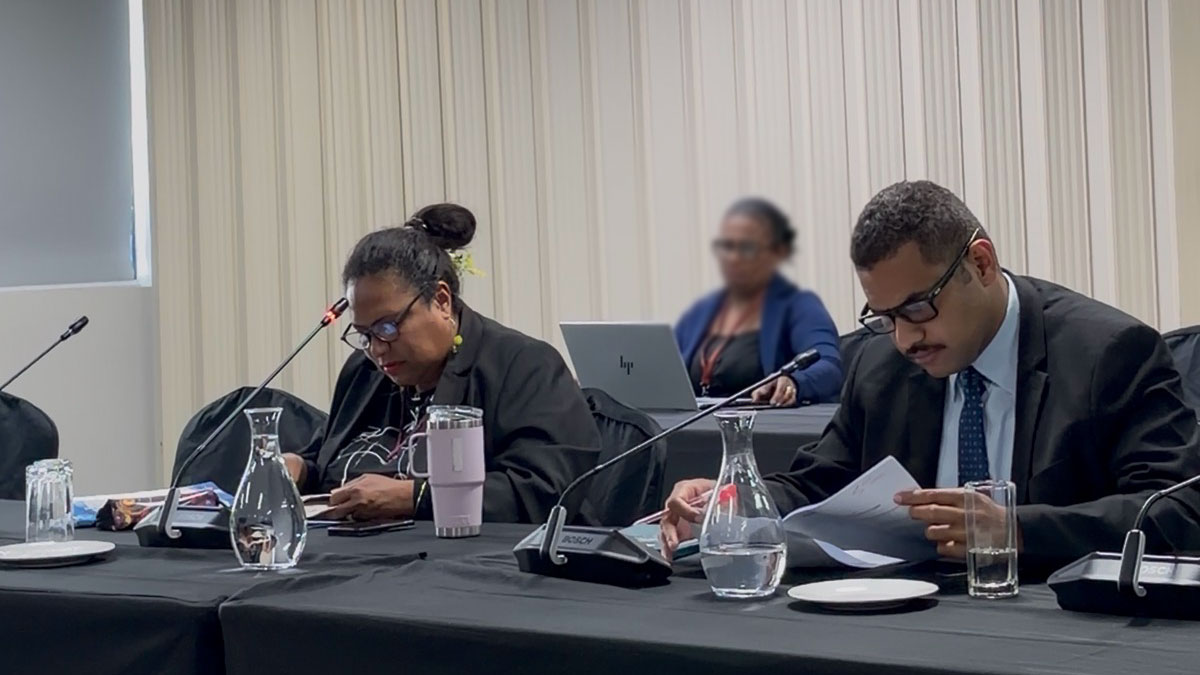
While making her submission to the Constitution Review Commission, Malimali emphasised that Fiji needs stronger independent institutions, less political interference in public appointments, and greater constitutional safeguards to protect citizens.
She says a key recommendation is for FICAC to remain as Fiji's specialist anti-corruption investigation agency but no longer decide whether people should be prosecuted.
She says the agency was created to investigate corruption involving public officials, not political opponents, adding that the agency's independence has also been questioned.
The former FICAC Commissioner was also against abolishing FICAC, warning that doing so would undermine existing enforcement capacity.
She proposed that, instead of abolishing FICAC, it should continue investigating corruption while the Ombudsman's Office independently reviews whether prosecutions should proceed.
INSERT: Malimali on abolishing FICAC 2nd July
Malimali also raised concerns about giving the power to the Fiji Police Force, saying that it has its own crisis of conscience happening.
She says according to information shared with them, about 60 to 70 percent of the Force is compromised, pointing to the increasing number of cases involving police officers being charged with serious offences, including drug and corruption-related offences.
Malimali further called for the Prime Minister and the Attorney-General to be removed from the appointment process for constitutional office holders, saying there is an over-concentration of power.
She also urged the Commission to include temporary special measures in the Constitution to increase women's representation in Parliament.
She says women make up half the population of this country, but they are not proportionately represented in Parliament, with only five of them in Parliament.
Malimali also supported retaining Fiji's proportional representation electoral system and introducing fixed constitutional dates for General Elections and Local Government Elections.
She says fixing election dates in the Constitution would strengthen certainty and accountability, giving the example of the United States of America, where Election Day is held on the first Tuesday in November every four years.
She says embedding the timing of General Elections and Local Government Elections in the Constitution would prevent uncertainty and political manipulation.
Meanwhile, Savu called for the immunity clause to be removed.
He says immunity weakens public confidence and accountability and, to build a Fiji that we can proudly leave to future generations, we must remove immunity and promote accountability, constitutionalism, and the rule of law.
He says they also recommend that the right to privacy should be strengthened to include an article on private communications and data.
He proposed that everyone shall have the right to the protection of his or her personal data, as well as to access and disseminate data of public interest.
Savu says these are imperative provisions, given the extensive use of social media, artificial intelligence, and the much wider access that everybody has to everyone else.
He says they also recommended a constitutional right to petition, stating that everyone shall have the right to submit, either individually or jointly with others, written applications, complaints, or proposals to any organ exercising public power.
He also proposed that everyone should have the right to repel any unlawful attack against his or her personal property, or one that poses a direct threat to the same, as provided for by an Act.
Among their other joint recommendations, Malimali and Savu proposed reducing the maximum number of Cabinet Ministers to 15, introducing mandatory constitutional reviews every 10 years,
reforming judicial appointments, and strengthening civic education to build a stronger constitutional culture.