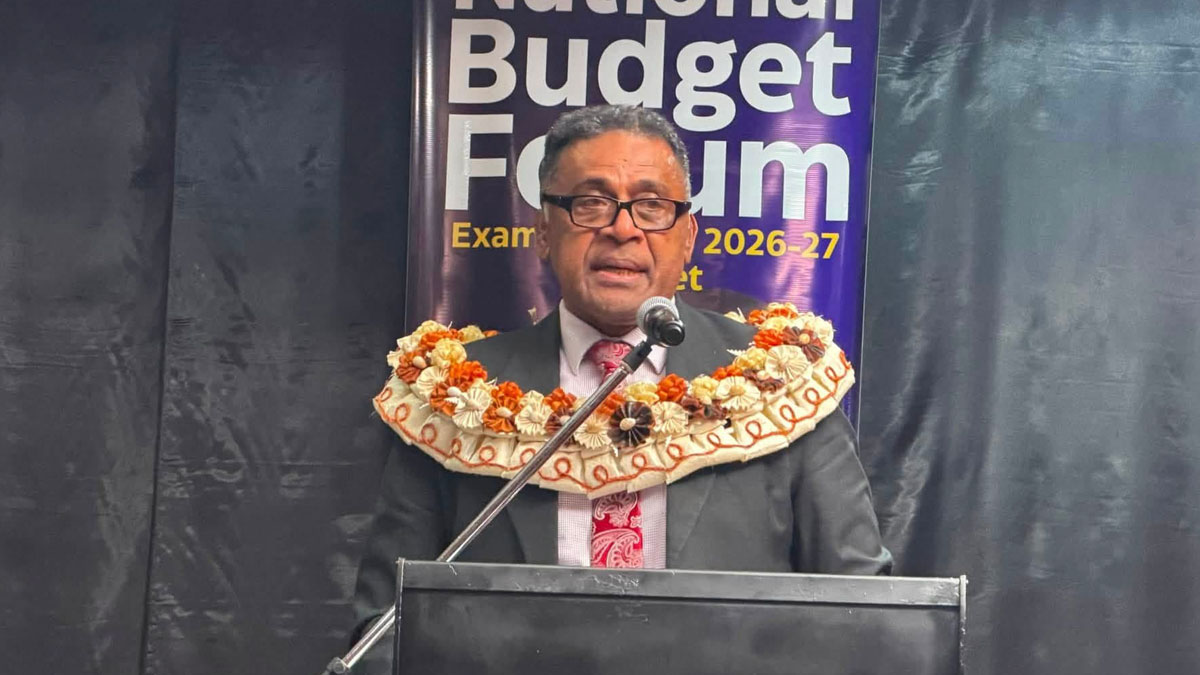
Minister for Finance Esrom Immanuel says the 2026-2027 National Budget is a responsible Budget despite projecting a fiscal deficit of about $1 billion, or 7 percent of GDP, saying responsibility is defined by the choices Government makes during extraordinary circumstances rather than by deficit figures alone.
While speaking at the National Budget Forum organised by Dialogue Fiji, Immanuel acknowledged criticism from some commentators and politicians.
He says responsibility is not determined simply by numbers but by the decisions Government makes when faced with significant challenges.
He says total expenditure has largely been maintained at around the current year's level despite additional commitments.
The Finance Minister says if anyone believes Government should have produced a much smaller deficit, they should also tell the people of Fiji exactly what they would have cut, or what Government should cut in the middle of the crisis.
He asked whether Government should reduce civil service salaries affecting more than 42,000 public servants, cut social welfare allowances, remove the guaranteed $85 per tonne sugarcane price, abolish the $200 Back-to-School Assistance, reduce tertiary scholarships, remove free education, free medicine, free water or subsidised electricity for vulnerable households.
Immanuel also questioned whether critics were suggesting Government should increase VAT, impose VAT on the 22 zero-rated basic food items, raise income tax, corporate tax or increase duties on imported raw materials.
INSERT: Immanuel on responsible budget 2nd July
He says this is why Government believes the Budget is responsible.
The Finance Minister says transparency is a key feature of the Budget, and Government has openly acknowledged that almost 80 percent of expenditure is operational spending, amounting to nearly $4 billion annually.
He says Government requires about $9 million every working day simply to keep public services operating and acknowledges that this is not sustainable over the long term.
He says Government's long-term objective is to gradually shift expenditure towards productive capital investment while slowing the growth of recurrent spending.
Immanuel also responded to claims that Government lacks a long-term economic transformation strategy.
He highlighted four major infrastructure programmes covering health, roads, water and wastewater and flood alleviation worth more than $2 billion over the next four to five years, saying financing of about $1.5 billion has already been secured through development partners.
He says state-owned entities are also progressing major investments in renewable energy, port redevelopment and airport expansion, adding that together, these projects represent an investment of well over $5 billion in Fiji's future.
He adds that these are investments that will improve productivity, strengthen resilience, reduce business costs, create employment and lift long-term economic growth.
On the rising cost of living, the Finance Minister emphasised that Government acted proactively by immediately announcing it would absorb increases in bus fares and electricity tariffs for households earning below $30,000 annually and eligible small businesses after higher global fuel prices led to increased costs.
He also revealed that Government considered recommendations from the International Monetary Fund, including increasing VAT to 15 percent, but decided against raising VAT, income tax or corporate tax and also chose not to impose VAT on the 22 zero-rated basic food items.
He also defended the temporary Tourism Tax, saying it was introduced primarily to support Fiji Airways as the national airline faces significantly higher fuel costs.
He adds that reducing flights would hurt visitor arrivals and negatively affect hotels, restaurants, tour operators, transport providers and thousands of workers.
On public sector wages, Immanuel reminded that civil servants had received salary increases of between 10 and 23 percent over the last two Budgets after years of wage stagnation.
He says while countries such as New Zealand are reducing public sector jobs, Fiji has chosen not to cut salaries despite ongoing fiscal pressures.
He also announced that Cabinet has established a high-level Investment Facilitation Taskforce to fast-track major investment projects by improving coordination across Government agencies and resolving unnecessary bottlenecks.
Immanuel says the Budget has been prepared using a conservative, worst-case scenario, and if the global fuel crisis eases, tourism performs better and Government revenue recovers more strongly than expected, Fiji's fiscal outcome could improve significantly.
He acknowledged that no Budget is perfect and every Budget involves difficult trade-offs.
He says they welcome constructive debate, informed criticism and new ideas.
He says discussions should also recognise the realities facing Government and the difficult choices required to balance fiscal sustainability with protecting the people.