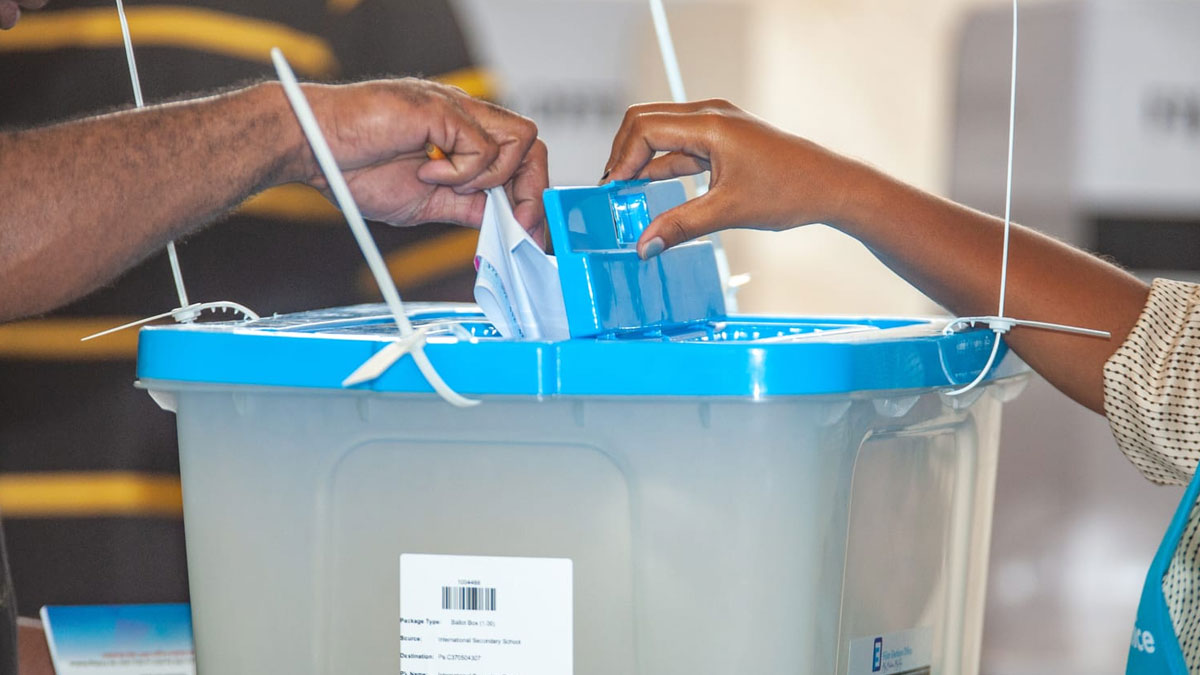
Major changes have been proposed to electoral laws tabled in Parliament, including the removal of the 48-hour campaign blackout, reducing the campaign-free zone from 300 metres to 100 metres, introducing $300,000 and $3 million campaign spending limits for candidates and political parties respectively, and barring people convicted of corrupt electoral practices from voter registration for four years.
Under the proposed Electoral (Amendment) Bill 2026, the current 48-hour period before polling day during which campaigning restrictions apply would be removed, with the restrictions applying on polling day.
The campaign boundary around polling stations would also be reduced from 300 metres to 100 metres, or another boundary determined by the Electoral Commission.
Displaying a political party or candidate’s name, logo, symbol or acronym would not be considered campaigning within the restricted area.
Political parties, candidates and their representatives would also be allowed to provide voters with free transportation directly to or from their assigned polling venue.
They could also provide free refreshments for immediate consumption during the journey or outside the 100-metre boundary, provided they do not influence or attempt to influence a person’s vote.
The Bill would also allow people who use assistive learning or speaking devices to use these devices at polling stations.
Postal voting eligibility would be expanded to include voters who are absent from their polling station because of family or other significant commitments, as well as other grounds approved by the Electoral Commission.
The requirement for statutory declarations for postal voting would also be removed.
The Bill proposes two categories of electoral offences which includes corrupt electoral practices and illegal electoral practices.
A person convicted of a corrupt electoral practice could face up to two years’ imprisonment and a fine of up to $100,000 for a political party, $40,000 for a candidate or polling agent, or $10,000 in any other case.
A person convicted of a corrupt electoral practice would also be disqualified from registering on the National Register of Voters for four years.
For illegal electoral practices, the proposed maximum fines are $40,000 for a political party, $20,000 for a candidate or polling agent and $5,000 for any other person.
A Corrupt Electoral Practices List would also be established under the proposed Electoral (Registration of Voters) (Amendment) Bill 2026.
The Supervisor of Elections would be required to place a person on the list if, within the previous four years, they have been convicted of a corrupt electoral practice under any electoral law.
A person could also be placed on the list if the Court of Disputed Returns reports, during an election petition, that the person is guilty of a corrupt electoral practice.
The list would include the person’s name, voter number, residence and details of the conviction or court report.
The person’s name would be removed from the list after four years from the date of the conviction or court report.
The Supervisor of Elections would also be able to remove from the voter register anyone placed on the list or otherwise disqualified from voter registration under electoral laws.
Meanwhile, the Political Parties (Registration, Conduct, Funding and Disclosures) (Amendment) Bill 2026 proposes campaign expenditure limits of $300,000 for each candidate and $3 million for each political party.
The limits would apply from the first day of the campaign period until 60 days after polling day.
Income pledged or expenditure incurred outside the campaign period for use during the campaign period would also be included when calculating the limits.
Gifts given by candidates or political parties to villages or community groups as protocol to obtain permission to enter their territory would have to be declared and included in campaign expenditure.
The Bill states that such a declared gift would not constitute bribery under the Electoral Act.
Exceeding the campaign expenditure limit would be classified as a corrupt electoral practice.
Candidates, whether elected to Parliament or not, would also have to provide the Registrar with information within 60 days after polling day on the money they received, the amount and source of donations and their campaign expenditure.
Failure to provide the required information would constitute a corrupt electoral practice.
The proposed political party amendments would also allow certain donations that are currently restricted, provided the donation is declared to the Registrar within 60 days after polling day.
The Registrar would be required to publish the donation declaration on the Registrar’s website.
The Fijian Elections Office would be required to publish pre-poll schedules on its website and social media platforms and broadcast them on radio.
The Supervisor of Elections would be able to change a pre-poll schedule because of force majeure, a request from a village or venue to postpone voting, or circumstances that delay or interrupt the deployment of election officials.
Any changes would have to be promptly communicated to political parties, independent candidates, observers and the media.
The Supervisor of Elections would also be authorised to undertake a recount of any ballot box for quality assurance, with an official recount able to overturn a previous decision by a presiding officer.
Discarded ballot papers would be included in the counting and ballot-accounting process.
Provisional results would also be published periodically rather than continuously during the tabulation process.
The Supervisor of Elections would be given powers to direct a person, organisation or entity to amend or cancel an activity that does not comply with Electoral Commission Rules.
A person or organisation affected by such a direction would have three days to appeal to the Electoral Commission, which would also have three days to issue its decision.
The proposed amendments would further remove the prohibition on campaigning at educational institutions and give the Electoral Commission power to make rules relating to the conduct of a referendum.
The bills are now expected to go through the consultation process then come back to parliament for voting and passage.
The general elections must be held between 7th August this year and 6th February, 2027.