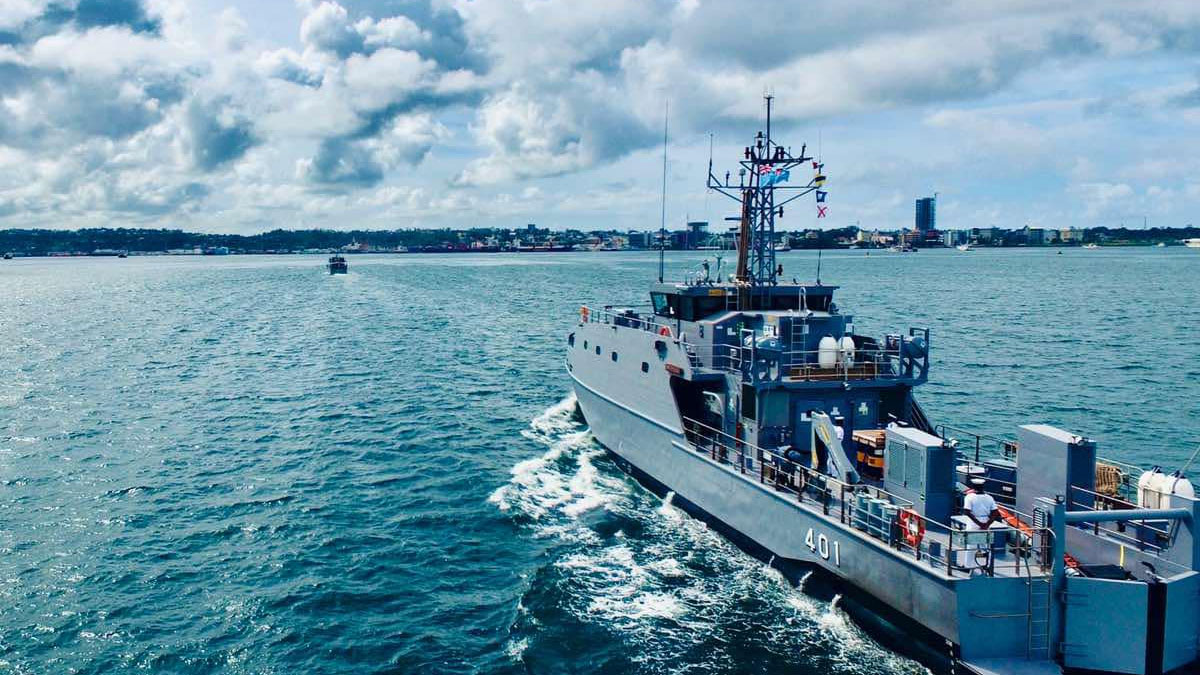
There will be greater security for our marine areas as the Maritime Powers Bill has been passed unanimously, allowing the Republic of Fiji Navy and authorised enforcement officers powers to board, search and detain ships suspected of criminal activity in Fiji waters and, under specified conditions, beyond.
According to the new law, officers can board suspect ships, search vessels and people, question those on board, require documents and seize evidence or proceeds of crime.
They can also direct a vessel to a port or another place in Fiji.
The RFMF Commander can authorise officers from the Navy, military, Police, Counter Narcotics Bureau, Customs, Immigration and other public agencies.
Navy or military officers can exercise powers concerning an offence only when an officer from the agency with specific jurisdiction is unavailable.
The Act also covers Fiji ships wherever they are, subject to another country’s laws when in its waters.
According to the law, authorised officers can take action against a foreign ship in international waters where there are reasonable grounds to suspect it is involved in a criminal offence and the country where it is registered has consented, or the vessel is reasonably suspected of being without nationality.
A ship will be considered without nationality if its master makes no claim of nationality when asked, the country claimed denies that nationality, or it uses the flags of two or more countries according to convenience without establishing a valid nationality.
The Defence Minister can obtain consent from another country for a specific operation or through a broader agreement, and must keep a record of that consent.
These powers must be exercised consistently with the United Nations Convention on the Law of the Sea
Officers can continue a lawful, uninterrupted pursuit beyond Fiji waters after signalling a vessel to stop.
The pursuit must end when the vessel enters another country’s territorial sea, while drones and other unmanned vehicles could assist.
Ships taken for further searches can generally be detained for up to 48 hours, with a court order required for an extension.
According to the law, officers can arrest people without a warrant, non-police officers making arrests must hand the person to Police as soon as practicable after arriving on land, arrested people must be informed of their rights and brought before a court within 48 hours, unless impracticable, then as soon as possible.
The Act states that force must be reasonable and proportionate, with commanding-officer authorisation required under the general rule and firearms could be used to disable a ship only as a last resort, with their use against a person to require a commanding officer’s instruction and necessity to prevent death or serious injury when less extreme means are insufficient.
It also states that the Defence Minister can declare protected areas around essential submarine cables, pipelines and other infrastructure, and damaging or interfering with this infrastructure could attract a maximum $50,000 fine, five years’ imprisonment, or both.
While tabling the Bill, Minister for Defence, Pio Tikoduadua says the sea does not organize itself according to the administrative structures of the government, and the Bill will help strengthen the legal framework for our ocean and security.
Tikoduadua says government agencies are already conducting vital operations, but the legal frameworks supporting their work remain fragmented.
He says relevant agencies need to be able to operate effectively in the maritime environment.
Tikoduadua says the objective is not to concentrate power in one institution, but to ensure that institutions work more effectively.
The Minister says the ocean is Fiji’s economy, security and future, and that the laws protecting the land cannot be strong on land while remaining uncertain at sea.
While speaking in support of the Bill, Leader of Opposition Inia Seruiratu says those tasked with protecting Fiji’s maritime domain should have clear legal authority to carry out that responsibility.
Seruiratu says an important feature of the Bill is that it does not simply give maritime enforcement personnel powers while leaving those powers undefined.
He says instead, it establishes the legal framework within which those powers are to be exercised.
Assistant Minister for Defence Ratu Rakuita Vakalalabure says the Bill is long overdue, establishes a comprehensive and consistent legal framework for the exercise of maritime enforcement powers within Fiji’s maritime zones and, where permitted under international law, beyond those zones.
He says it will strengthen Fiji’s maritime security framework, enhance our ability to combat transnational crime, protect our marine resources, secure our borders, safeguard critical infrastructure and support Fiji’s obligations under international law.
Opposition MP Vijay Nath says while he supports the Bill, he is concerned about the extremely broad definition of “relevant offences”, warrantless searches, and allowing members of the Navy and military to become enforcement officers.
Nath stresses these powers must be clearly defined, proportionate to the seriousness of offences, subject to proper oversight and safeguards, and supported by adequate resources.
Minister for Foreign Affairs Sakiasi Ditoka says the Bill is necessary and timely as criminal networks exploit maritime routes for illicit drugs, people smuggling, human trafficking, illegal fishing and other unlawful activities which affect our communities, economy and national security.
He says a vessel engaged in illegal activity does not necessarily stop because it crosses an invisible line on a chart, adding that this is why regional cooperation is so important.
The Minister says the Ocean of Peace cannot simply be a declaration of principle, it must also mean that the Pacific Ocean is safe for our people, secure for legitimate commerce and increasingly difficult for transnational criminal organisations to exploit.
He says criminal networks have become more sophisticated, technology has changed, and the strategic importance of the Pacific has increased.
Ditoka adds laws must therefore keep pace while remaining firmly anchored in our Constitution, international law and respect for the sovereignty of other states.