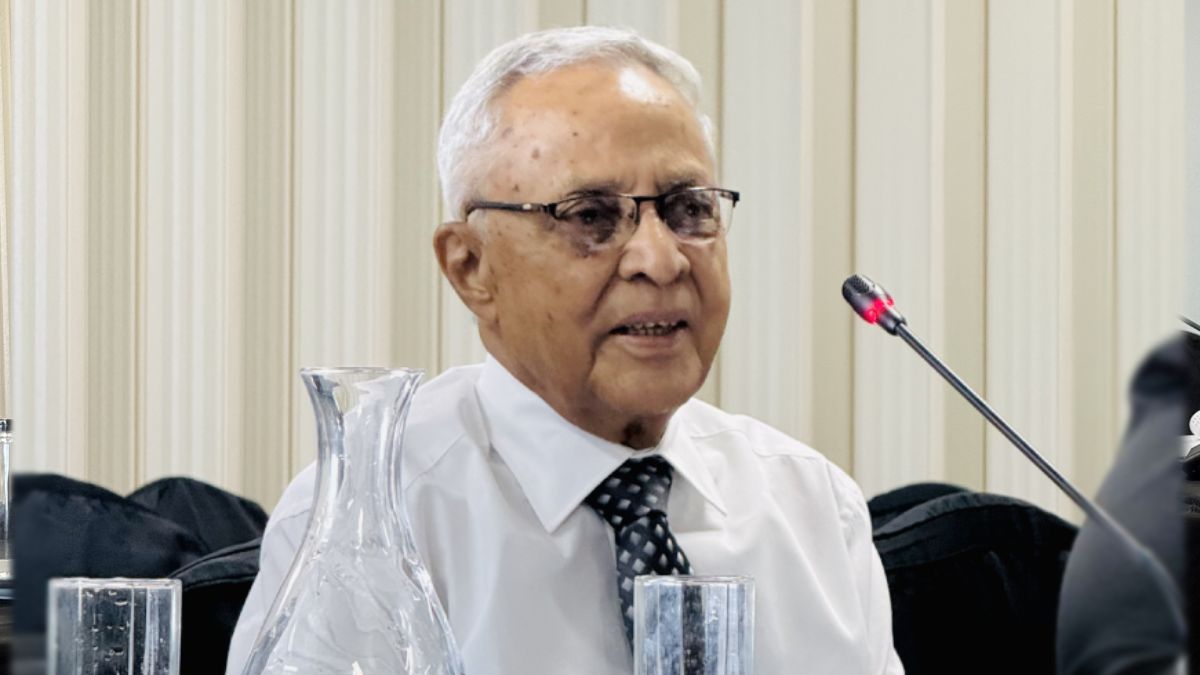
The word Fijian must remain the common and unifying identity for every citizen of Fiji, and there should be no return to ethnic categorisation.
This was highlighted by Fiji Labour Party Leader, Mahendra Chaudhry during the party’s submission to the Constitutional Review Commission.
Chaudhry stresses that Section 5 of the 2013 Constitution, which states that all citizens of Fiji shall be known as Fijians and have equal status and identity, must be defended and strengthened rather than weakened.
He warns against any attempt to reintroduce ethnic categories in passports, birth certificates, electoral rolls or public discourse, saying such moves would undermine national unity and create different classes of citizens.
Insert: Chaudhry on people 7th July
The Fiji Labour Party Leader also questions the democratic legitimacy of the Constitutional Review Commission, saying that while public consultation is important, any comprehensive review of Fiji’s supreme law should first be expressly sanctioned by Parliament.
He says Section 2(5) provides that the Constitution cannot be abrogated or suspended by any person and may only be amended in accordance with the procedures prescribed in Chapter 11 adding Section 46(1) vests law-making authority in Parliament.
He says the amendment process under Sections 159 and 160, as interpreted by the Supreme Court in its 2025 advisory opinion, requires an amendment Bill to be passed by a two-thirds majority of all Members of Parliament, followed by a referendum in which a majority of votes cast are in favour, before presidential assent.
Chaudhry says no provision in the 2013 Constitution authorises the President or Cabinet to establish an ad hoc review commission to examine or propose alterations to the Constitution outside the amendment procedure in Chapter 11.
He says the Commission was established by presidential warrant without prior parliamentary debate, legislation or endorsement, and argues that elected representatives had no opportunity to define the terms of reference, scope or methodology of the review.
Chaudhry says this creates a risk that the review may address issues or propose changes that have not been subjected to scrutiny and democratic input from the legislature.
He says the process bypasses the constitutional amendment pathway and that any recommendation emerging from the Commission must ultimately return to Parliament for legislative action and then to the people through a referendum.
Chaudhry says the Commission’s work may be valuable as a consultative exercise but cannot substitute for parliamentary ownership of the constitutional reform process.
He says allowing the review to proceed without Parliament’s formal involvement from the beginning risks perceptions that the process is executive-driven and that outcomes may be selectively advanced or filtered before reaching the legislature.
On land, Chaudhry says approximately 90 percent of Fiji’s total landmass is iTaukei land, while approximately 6 percent is freehold land and 4 percent is State land.
Chaudhry says that given the proportion of iTaukei land, the policies and practices governing it have a decisive impact on national agricultural output, rural livelihoods, food security and social stability.
He says the absence of a comprehensive national land-use policy has resulted in uncertainty for farmers, under-utilisation of productive land and hardship for long-term tenant families who have invested generations of labour and resources in leased land.
Chaudhry says decisions on whether land is leased for agriculture, reserved for landowners or converted to higher-value residential or commercial uses are often made on a case-by-case basis without a clear strategic framework.
He says this has contributed to conflicting priorities between maintaining productive agricultural land and pressures for subdivision and commercial development, particularly near growing urban centres.
Chaudhry says agricultural leases on iTaukei land are typically granted for 30 years and argues that this is insufficient for meaningful long-term agricultural investment, particularly in sugarcane and other perennial or capital-intensive crops.
He refers to reported agricultural lease-renewal rates of between 77 and 85 percent since 1997 and around 75 percent for recently expired cane leases, while noting that these figures are disputed by cane farmers’ associations.
Chaudhry says many tenant families, particularly Indo-Fijian families with multi-generational ties to the land, have invested heavily in homes, infrastructure and improvements over decades and can face loss of livelihood, displacement and financial hardship when leases are not renewed.
He also raised concerns about rental and premium structures, the returns ultimately received by individual landowners and the distribution of lease income.
Chaudhry calls for a comprehensive national land-use policy, longer and more secure agricultural leases, an independent and transparent review of lease terms, rental methodologies and distribution mechanisms, and the protection of prime agricultural land for food production and national food security.
He says large-scale conversion of productive agricultural leases into commercial, residential or subdivided developments risks undermining food security.
On electoral reform, the Fiji Labour Party proposed replacing the current open-list proportional representation system with a mixed-member proportional electoral model or a similar mixed-hybrid system combining constituency-based representation with overall proportionality.
Chaudhry says the current system uses a single national constituency, open-list proportional representation and a 5 percent threshold, and argues that it lacks local constituency accountability.
He says the present electoral system weakens parliamentary scrutiny of the executive and allows candidates to enter Parliament with relatively small personal vote totals, in some cases fewer than 500.
Chaudhry says the absence of defined constituencies also means there is no clear mechanism for MPs to advocate for and be held accountable for development in specific areas.
He proposed that a substantial portion of parliamentary seats, for example between 50 and 70 percent, be elected from defined geographic constituencies using a preferential voting method such as the alternative vote or single transferable vote.
He says the remaining seats could be allocated through national or regional party lists to preserve overall proportionality.
Chaudhry stresses that the Fiji Labour Party does not advocate a return to the full communal electoral system of the 1997 Constitution.
On parliamentary reform, Chaudhry proposes strengthening parliamentary select committees by enhancing their powers to summon witnesses, require the production of documents and scrutinise government policy and expenditure.
He also proposes limiting the use of fast-track legislative procedures, including concerns raised about Standing Order 51, and ensuring adequate time for debate and committee consideration of significant legislation.
Chaudhry also calls for enhanced public petition mechanisms and improved parliamentary oversight.
The party proposes higher standards for parliamentary representation, including higher thresholds in terms of personal votes or support and stronger disqualification provisions for candidates with serious criminal convictions or findings of corrupt conduct.
The party calls for removing constitutional restrictions preventing dual citizens from contesting elections and reducing the ordinary residency requirement for candidates from two years to one year immediately before nomination.
It also proposes removing disqualification provisions that prevent people from contesting elections after they have served their sentences or when they are not serving a term of imprisonment at the time of nomination.
The party further calls for revoking restrictions on officials and employees of trade unions and trade union federations from participating in political activity.
On independent constitutional offices and commissions, Chaudhry proposes greater parliamentary scrutiny of appointments.
He says the current constitutional arrangements concentrate excessive power in the executive, particularly the Prime Minister, in appointments to key offices and in the management of public debt.
Chaudhry says no person holding current political office or with recent partisan affiliation should serve on bodies responsible for overseeing independent institutions.
He says appointments to independent commissions and key constitutional offices should be subject to scrutiny by a parliamentary select committee.
Chaudhry says the President should exercise appointment authority following committee consideration rather than acting solely on the recommendation of the Prime Minister.
On government borrowing, Chaudhry calls for stronger parliamentary oversight, including annual parliamentary approval of the Government’s overall borrowing strategy and debt ceiling.
He also proposes specific approval or ratification for major individual loans, loan guarantees or contingent liabilities above a defined threshold.
Chaudhry calls for regular detailed reporting to Parliament on debt stock, new borrowing, debt servicing and risks, saying greater oversight would improve transparency, accountability and fiscal discipline.
Addressing race relations, Chaudhry says politicians have exploited race and ethnicity for political gain for decades, contributing to the coups of 1987 and 2000, weakening institutions, discouraging investment and accelerating brain drain.
He says race has been weaponised for political gain and to justify unconstitutional actions.
Chaudhry also says the military has been drawn into politics on multiple occasions, damaging the professionalism of the country’s security forces and undermining democratic norms.
He stresses that iTaukei land and rights are secure and rejects claims that they are under threat from Indo-Fijians or other communities.
Chaudhry says the Fiji Labour Party supports protecting indigenous rights while ensuring equal citizenship, equal opportunity and equal dignity for every Fijian, regardless of ethnicity.
He says the party strongly condemns the use of race-based politics by any political actor and recommends constitutional or legislative measures to discourage the exploitation of ethnicity for political gain.
Chaudhry says the party wants the principle of common and equal citizenship reaffirmed and the Bill of Rights and equality provisions protected from being weakened.
He also calls for reforms to the iTaukei Land Trust Board to improve transparency and returns to landowners and depoliticise land administration so iTaukei landowners receive genuine economic benefits from their land.
Chaudhry says national leadership across communities must publicly reject divisive race-based narratives and commit to building a united and prosperous Fiji based on equal opportunity for all citizens.
He supports civic education programmes that clearly explain protections for indigenous rights and land ownership alongside the principles of equal citizenship to reduce the space for political manipulation.
Chaudhry says Fiji’s future depends on honesty about the past and courage to reject the politics of division, adding that the land is safe, rights are protected and it is time to move forward together as one nation.
On minority representation, Chaudhry calls for proactive, merit-based measures to improve the representation of minority communities in national institutions such as the Republic of Fiji Military Forces, the Fiji Police Force and the Civil Service.
He says concerns persist about the under-representation of Indo-Fijians and other communities in key national institutions.
The proposed measures include targeted outreach, transparent recruitment processes, diversity monitoring with public reporting and capacity-building programmes, without compromising merit or introducing discrimination.
Chaudhry also highlights disparities affecting some population groups in outer islands, maritime provinces and rural areas in accessing services, infrastructure, economic opportunities and development investment.
He says isolation, high transport costs and limited government presence exacerbate these challenges.
On women’s representation, Chaudhry says women remain significantly under-represented in political decision-making.
He supports measures aimed at removing structural, cultural and financial barriers to political participation.
These include encouraging political parties to adopt internal targets and monitoring programmes for women candidates, providing capacity-building, leadership training and campaign support, addressing cultural and societal barriers through public education, and ensuring a safe and respectful political environment free from harassment and violence against women.
He says if special measures such as reserved seats are considered, they should be carefully designed and time-bound and should build genuine capability rather than create perceptions of tokenism or reverse discrimination.
On citizenship, the Fiji Labour Party proposed extending equal citizenship provisions to children born overseas to Fijian parents from all communities.
Chaudhry refers to recent legislative changes, including the Citizenship of Fiji Amendment Bill 2026, which he says introduced facilitative provisions recognising links to iTaukei landowning units for iTaukei children born overseas.
He says the party supports measures strengthening ties between the diaspora and Fiji but argues that streamlined processes should apply equally to children of Indo-Fijian parents and other minority communities.
Chaudhry also calls for removing the prohibition on dual citizens contesting elections.
He says Fiji’s skilled diaspora includes people with expertise in medicine, engineering, finance, technology, education and governance who could contribute to national public life.
On judicial reform, Chaudhry says Fiji faces serious delays in the justice system and calls for comprehensive reforms.
He refers to concerns about cases reportedly pending for 10 to 20 years and says prolonged delays cause serious hardship to litigants.
He also says to delays in serious criminal matters, including sexual violence cases involving children, and cited a case highlighted by the Fiji Women’s Rights Movement in May 2026 involving a young girl who, according to the submission, waited six years for justice before the case was withdrawn.
Chaudhry says the high cost of litigation also places justice beyond the reach of many ordinary citizens.
He proposes active judicial case management with binding time standards for different categories of cases.
Chaudhry also proposes mandatory publication of judgements within a defined timeframe, with three months after final submissions proposed for most cases, and strict limits on adjournments.
He calls for the full rollout of electronic case management, e-filing and digital court records, expanded legal aid and pro bono schemes, enhanced judicial training in case management and technology, and greater use of mediation and alternative dispute resolution.
On political party funding, the Fiji Labour Party proposes placing oversight under the independent authority of the Electoral Commission, within an overarching framework approved by Parliament.
Chaudhry raises concerns about the allocation of public funds to political parties, reportedly around $325,000 a year, without what the party considers sufficient transparency, clear criteria or robust parliamentary oversight.
He says the Electoral Commission should oversee party registration, funding, disclosure requirements, campaign financing rules and compliance.
The party also calls for a review of the roles and independence of the Fiji Independent Commission Against Corruption and the Office of the Director of Public Prosecutions.
Chaudhry says concerns about institutional independence and public trust require a review to ensure these bodies operate with genuine independence, professionalism and accountability.
He says possible reforms should include clearer constitutional safeguards for the DPP’s independence, a review of FICAC’s mandate and governance, and improved coordination between investigative and prosecutorial bodies.
On international human rights obligations, the Fiji Labour Party urges that Fiji’s Constitution and laws be aligned with international human rights instruments to which Fiji has acceded.
Chaudhry specifically refers to the International Covenant on Civil and Political Rights, the International Convention on the Elimination of All Forms of Racial Discrimination, the Convention on the Elimination of All Forms of Discrimination against Women, the United Nations Declaration on the Rights of Indigenous Peoples, the International Covenant on Economic, Social and Cultural Rights, the Convention against Torture and Other Cruel, Inhuman or Degrading Treatment or Punishment, and the Convention on the Rights of Persons with Disabilities.
Chaudhry says constitutional reform undertaken through proper parliamentary and democratic processes would produce outcomes that are more stable, legitimate and reflective of the collective will of the Fijian people.
During the question and answer session, Commissioner Dr John Fatiaki raised concerns that the term Fijian had been used solely for indigenous Fijians from 1970 and was reflected in the 1970, 1990 and 1997 Constitutions.
Dr Fatiaki questioned whether the 2013 Constitution had extended the term to all citizens without the consent or input of indigenous Fijians, saying this was an issue raised during consultations around the country adding the use of the term iTaukei for indigenous Fijians and whether there had been proper consultation on the use of that name.
Dr Fatiaki further notes that Section 5(1) states that all citizens of Fiji shall be known as Fijians and raised the concern that this could imply a mandatory obligation or duty to use the term.
He says one submitter had even suggested a mandatory requirement, with punitive measures, if people did not use the name asking whether there would be a problem if all citizens of Fiji were instead known as Fiji citizens.
In response, Chaudhry says he sees Fijian as a common national identity removed from ethnicity adding people who live in Fiji need a national identity and that he sees Fijian as the most appropriate identity because it ties people to the country they live in and love.
He says a person’s ethnicity can remain while their national identity connects them to Fiji.
Responding to the discussion about the term iTaukei, Chaudhry says his understanding from childhood was that indigenous Fijians were regarded as owners of the land.
He says he does not see the term as derogatory and instead sees it as honouring indigenous Fijians as owners of the land saying ethnicity remains, but Fijian should be seen as a national identity, adding that if a person comes from Fiji, they are a Fijian.
Commissioner Dr Nileesh Goundar also noted Chaudhry’s long involvement in Fiji’s political landscape and said he was one of the few people to have contested elections under all four Constitutions.
Dr Goundar questions whether the election mandate received by FijiFirst provided legitimacy to the 2013 Constitution, noting that the party received 60 percent of all votes cast in the 2014 General Election and 50 percent in 2018.
In response, Chaudhry says the issue had been dealt with by the Supreme Court in its advisory opinion, which accepted that the 2013 Constitution is Fiji’s legal and effective Constitution.
He says the Court gave reasons for considering it the effective and legal Constitution and, in his view, this was mainly because three elections had been held under it and people had accepted it.
Chaudhry says this gives the Constitution legitimacy because people have accepted it and three elections have been held under it.
He also says the Supreme Court opinion made it easier for the Constitution to be amended and that the current process is about dealing with aspects of the Constitution that are not popular with the people.
During further questioning, Commissioner Merewalesi Nailatikau referred to submissions received about having a forward-looking Constitution and raised the example of a possible commission on national unity that could address the collective establishment of a shared identity.
Nailatikau asked his recommendations on learning from Fiji’s experience of race-based politics and moving the country forward.
In response, Chaudhry referred to the Fiji Labour Party’s recommendations and says iTaukei land ownership and indigenous rights are fully protected under the 2013 Constitution and must remain protected.
He says the party strongly condemns the use of race-based politics by any political actor and recommends constitutional or legislative measures to discourage the exploitation of ethnicity for political gain.
Chaudhry says the party also wants the principle of common and equal citizenship reaffirmed and the Bill of Rights and equality provisions protected from being weakened.
He also calls for reforms to the iTaukei Land Trust Board to improve transparency and returns to landowners and depoliticise land administration so iTaukei landowners receive genuine economic benefits from their land.
Chaudhry says national leadership across communities must publicly reject divisive race-based narratives and commit to building a united and prosperous Fiji based on equal opportunity for all citizens.
He also supports civic education programmes that clearly explain protections for indigenous rights and land ownership alongside the principles of equal citizenship to reduce the space for political manipulation.
Reflecting further on race-based politics, Chaudhry says what hurts him most is how much Fiji has suffered as a result of the politics of race.
He says two or three coups had been carried out in the name of protecting indigenous rights and that Fiji has lost two generations.
Referring to the drug crisis, HIV and NCDs, Chaudhry claims these problems stem from the situation he had described while discussing the consequences of race-based politics and coups.
He says people should look at what Fiji was in 1987 and compare it with where the country is today, arguing that Fiji has regressed adding Fiji is submerged in debt that it cannot manage, has lost self-reliance and now depends on aid, loans, remittances and grants to run the country.