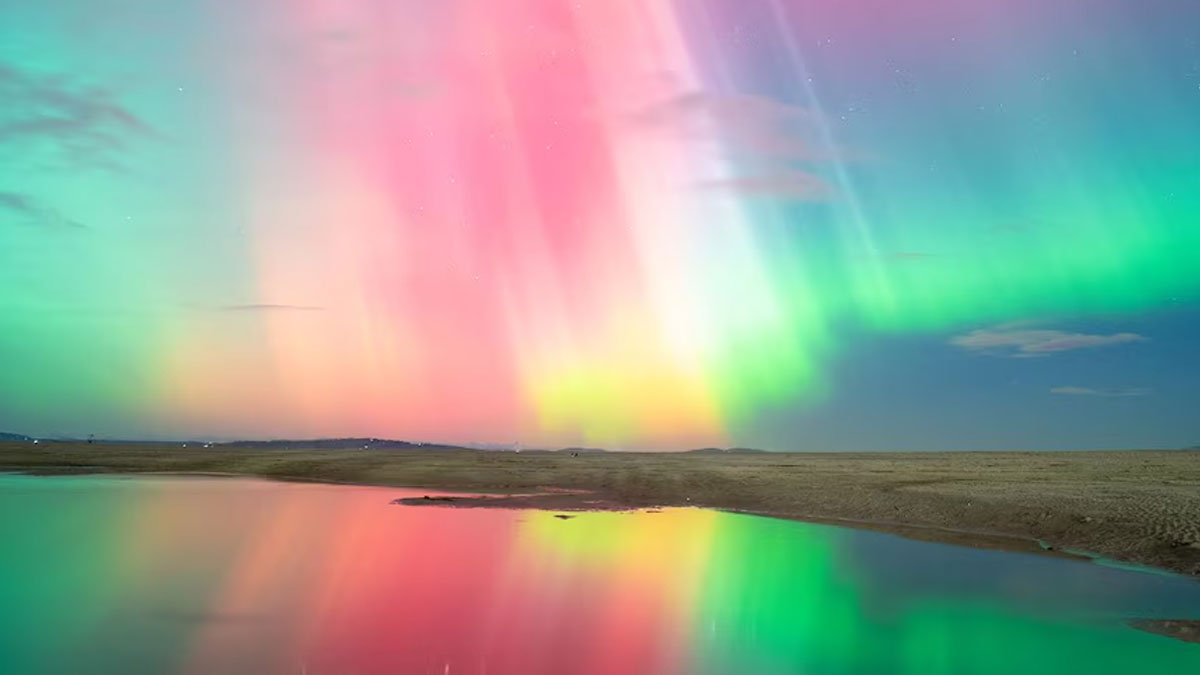
After this weekend's epic aurora australis display, the Bureau of Meteorology (BOM) says there is still a geomagnetic storm underway that may produce visible southern lights in parts of Australia.
But the chances of seeing the lights are much lower now, with the level of storm activity falling.
Here's the latest:
Will I still see the aurora australis?
Monash University associate professor in astronomy Michael Brown says the southern lights might appear again in the coming days.
"But I would be pleasantly surprised if they match Saturday’s performance," he said.
"How bright auroras are and when they arrive is quite hard to nail down."
The NOM has forecast lower-level global geomagnetic activity until 6pm AEST on Tuesday, May 14.
A BOM spokesperson said at this stage, we were at the end of this remarkable global geomagnetic storm.
"While there is still a chance of some aurora activity in Tasmania and southern coastline Victoria tonight, we're not expecting anything as intense as we saw over the weekend," the spokesperson said.
What is the G-scale?
Auroras are the result of geomagnetic storms. These storms occur when large "clouds" containing billions of tonnes of plasma embedded within an ejected magnetic field erupt from the Sun's outer atmosphere, or corona — phenomena known as coronal mass ejections (CME).
CMEs then head towards the Earth where they hit the planet's outer magnetic field and create blue lights at high altitudes and red lights at lower altitudes.
Aurora Australis (Southern Lights) from Tasmania, Australia. pic.twitter.com/trDVuMWTHS
— Dr_Jones_Aust (@Dr_Jones_Aust) May 11, 2024
The size of these geomagnetic storms is measured in what is known as a G-scale.
According to BOM, the G-scale ranges from G1 (minor) to G5 (extreme).
The current planetary geomagnetic conditions are at the G3 — strong level. However, within Australia they are currently lower at G1 – minor level.
When will there be another geomagnetic storm?
The geomagnetic storm that occurred on Saturday night was rated as G5. It reached that level at 9:45am AEST on May 11.
The last time Earth had a G5-level geomagnetic storm was in 2003.
ABC Science commentator Karl Kruszelnicki told ABC News Breakfast auroras could be predicted by looking at earthquakes on the Sun — an area of study known as helioseismology.
"The Sun rotates once every 27 days or 30 days, depending on if you go by the equator or the [north and south] pole," he said.
Northern lights Aurora Borealis recorded from the International Space Station. #Aurora #AuroraBorealis #auroraboreale #AuroraBoreal#Solarstorm #SolarFlare #auroresboreales #AuroraAustralis#NorthernLights #auroresboreales pic.twitter.com/Jcr4Eh3qbB
— Fighter_4_Humanity (@Fighter_4_Human) May 12, 2024
"What happens is the Sun rotates and there's a hotspot on the surface and it comes around and throws something at it.
"We can get warning of that by looking at vibrations on the surface."
By analysing the vibration waves across the Sun, he added, scientists could tell there if something on the other side which had a small chance of being thrown at Earth as the Sun rotated.
The other way to predict auroras, Dr Karl said, was the 11-year Sun cycle, which is currently headed towards its peak.
"So if we’re lucky, we will get more [auroras]," he said.
"But on the other hand, we do not want our electronic toys like our watches and our computers and our GPS to drop dead on us."
Story By: abc.net.au
Original Story link: https://www.abc.net.au/news/2024-05-13/aurora-australis-displays-still-possible-but-less-likely/103839790
