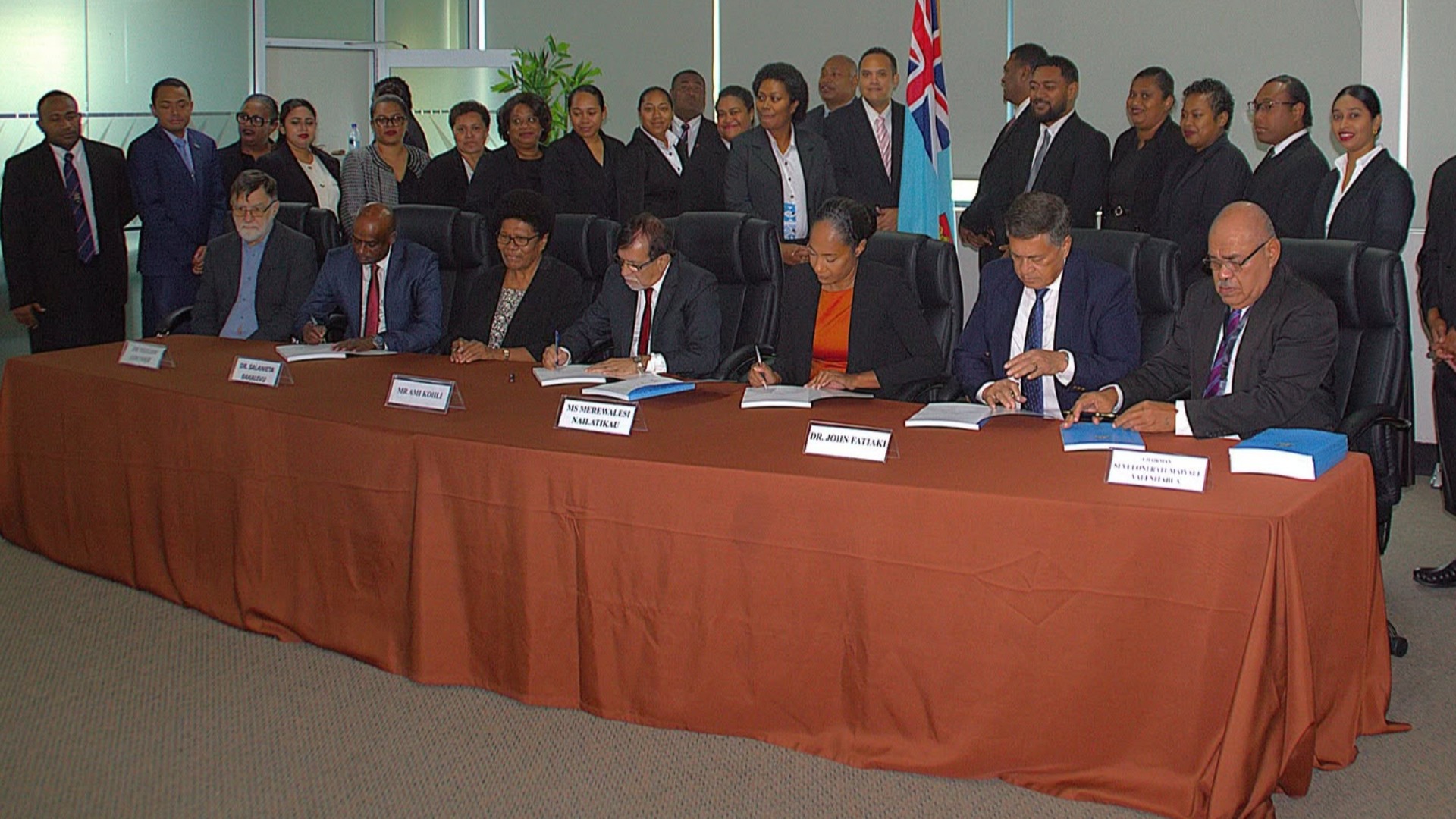
The Constitution Review Commission is recommending the removal of coup-related immunity, a 60-seat Parliament, changes to the constitutional role of the military to focus on external defence, and the Prime Minister to only serve two terms in Government and Cabinet to have 15 members.
The Commission’s recommendations include repealing Chapter 10 of the 2013 Constitution, which provides immunity from criminal, civil and professional liability for certain past actions.
The Commission recommends that the Government could seek another Supreme Court determination on whether Section 159 can be repealed, particularly in relation to the permanent entrenchment of the immunity and preservation provisions.
If the immunity and preservation provisions remain, the Commission recommends an adapted Oath of Reconciliation and Allegiance for immunity beneficiaries, drawing on the Ghai Commission draft, as a harm-reduction measure.
The Commission also recommends prohibiting any future immunity for a person in relation to actions taken or omitted in furtherance of an attempt to establish a government other than in compliance with the Constitution.
It proposes amendments to establish that any such attempt is unlawful and cannot be protected by immunity.
The Commission further recommends changes to FICAC by separating its investigative and prosecutorial powers.
Under the proposal, FICAC would have investigative powers only, while the authority to prosecute would rest exclusively with the Director of Public Prosecutions.
The FICAC Commissioner would be appointed by the Judicial Services Commission.
The Commission proposes that State-related corruption and maladministration could be investigated by the Ombudsman, while FICAC would investigate non-State corruption and maladministration.
The Commission also recommends amendments to the constitutional role of the military, to affirm the primacy of democratic civilian authority and clarify that the military’s focus is external defence.
Any military assistance to civil authorities, including during natural disasters or emergencies, would be subject to written law and confirmation by Parliament.
The Commission further proposes clarifying birthright citizenship by requiring at least one parent to be a citizen or permanent resident, while permanent residency would also serve as a pathway to citizenship.
The Commission also recommends recognising Rotumans as an indigenous community of Fiji through a separate constitutional chapter on Rotuma.
They recommend constitutionally establishing a seven-member Presidential Appointment Commission to appoint the President.
The proposed commission would comprise the Prime Minister, Leader of the Opposition, three representatives from the Boselevu Vakaturaga, one representative from the Fiji Council of Churches and one representative from interfaith religions.
They would also have to be free from political party office or candidacy for at least eight years, equivalent to two parliamentary terms.
The Speaker of Parliament would serve as Acting President if the President is absent or the office is vacant, with a two-term limit for the President and each term lasting three years.
The Prime Minister would also be limited to two terms, with each term lasting four years.
Cabinet would comprise 15 members, including the Prime Minister and up to 14 Ministers.
Under the bicameral Parliament, the Attorney-General could be appointed from either the Lower or Upper House, but would not have voting powers when appearing in a House of which they are not a member.
The Commission recommends that responsibility for providing independent legal advice to the Government be vested in the Solicitor-General as a civil servant, while the Attorney-General would serve in a ministerial role overseeing matters of justice.
The Commission recommends vesting legislative authority in a bicameral Parliament comprising a House of Representatives and a Senate.
The Commission proposes a smaller 60-seat Parliament, comprising 41 members in the House of Representatives and 19 members in the Senate.
It recommends introducing a Mixed Member Proportional electoral system, combining 26 constituency-based first-past-the-post seats and 15 proportional party-list seats.
Under the proposal, constituency seats would account for 63 percent of the seats and proportional party-list seats for 37 percent.
The Commission recommends reducing partisan appointments to the Senate by reducing political appointments and nominations from the Prime Minister and Leader of the Opposition, including the BLV.
It also recommends that Senate appointees be non-partisan, respected individuals drawn from across Fiji society and reflect the country’s diversity, including women and youth.
An independent Constituency Boundaries Commission would be established to consider whether boundaries need to be redrawn after every census.
The Commission also recommends merging the offices of the Supervisor of Elections and the Electoral Commission into a single structure.
Under the proposed structure, the Supervisor of Elections would serve as Chief Executive Officer and report to a five-member Electoral Commission, with the Supervisor serving as an ex officio, non-voting member.
The combined Electoral Commission, rather than the Supervisor alone, would have authority to register, suspend or deregister political parties, while registry and polling functions would remain separate.
The Commission recommends introducing constitutional provisions for a caretaker government.
It also proposes making election dates more predictable by specifying the term of Parliament and restricting major changes to electoral laws within nine months before the end of a parliamentary term.
The Speaker’s role would be reaffirmed, including providing that the Speaker acts as President when the President is absent, as was the case under the 1997 Constitution.
A President and Vice-President of the Senate would be elected from within the Senate.
The Commission recommends replacing the Parliamentary Emoluments Committee with an independent Salaries and Benefits Commission, to be chaired by the Chair of the Public Service Commission.
The Commission also recommends recognising English, iTaukei, Rotuman, Hindi and sign language as official languages of Parliament.