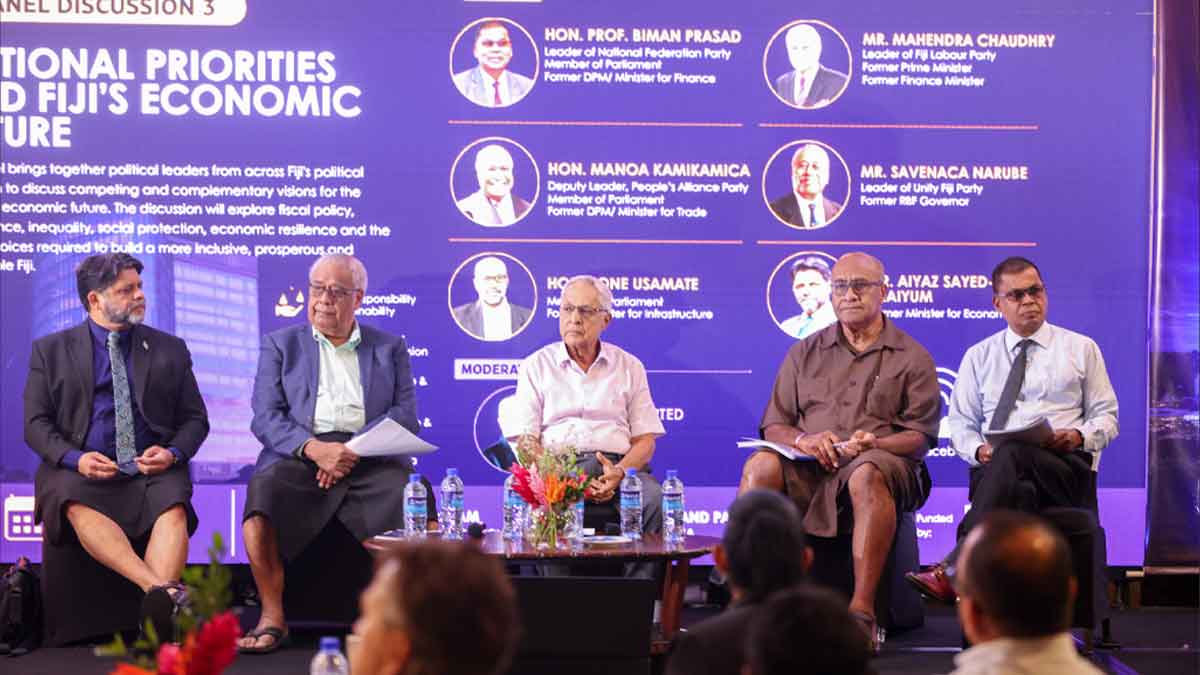

While speaking during a panel discussion during the State of the Fijian Economy Dialogue Professor Prasad the Government's priority right now is to ensure that, as a country, we maintain supply chains, keep the economy running and protect jobs and incomes.
He says Fiji has faced challenges with fiscal management over the past three to four decades and governments of all political persuasions have had to deal with this and at times, governments have pursued populist or vote-driven policies that have added to the country's fiscal burden.
Professor Prasad says that some may argue that nominal debt is more important than debt-to-GDP ratios.
He says both measures matter, however, if the economy is growing and borrowing is being used to fund critical infrastructure such as health and education, then that borrowing can be justified.
The former Deputy Prime Minister and Finance Minister says the Government must continue pursuing reforms that improve productivity, strengthen public institutions, make it easier to do business, reform state-owned enterprises and support micro, small and medium-sized enterprises.
He further says the debt-to-GDP ratio was reduced over the last three years but it is likely to increase this year given the current global circumstances, and that is understandable.
Professor Prasad believes the current situation in the Middle East will eventually resolve itself in the not-too-distant future due to significant international pressure.
Former Minister for Economy Aiyaz Sayed-Khaiyum says the government needs to provide a stimulus and targeted assistance to ordinary, marginalised Fijians as well as dramatically cut back on operating expenditure.
He says the total operating expenditure of $3.9 billion in the current budget is greater than the entire national budget of $3.7 billion in 2022, which shows where the priorities lie.
He says there has been enormous levels of wastage and when the largest political party has all of its Members of Parliament appointed as Ministers or Assistant Ministers, it naturally raises questions.
The former Minister further says there was no need to increase the VAT because after coming out of COVID, the economy was growing and we were able to repay our debts.
Sayed-Khaiyum says currently, around 80 to 85 percent of the budget is being spent on operating expenditure, with only a small portion going towards capital projects.
He warns that Fiji could face a recession if tensions in Iran and the wider Middle East continue to escalate, although that is beyond our control.
He says government spending helps stimulate the economy, as we saw during COVID-19 when $360 assistance packages were provided to businesses.
He says more spending should be directed towards productive development projects, targeted assistance for vulnerable groups and support for small businesses, while operating costs should be significantly reduced.
Unity Fiji Leader and former Reserve Bank of Fiji Governor Savenaca Narube says Fiji's debt is now approaching 85 percent of GDP so we need to create fiscal space, however, its ability to act is constrained if it does not have sufficient fiscal space or financial resources.
He says it would be inappropriate to focus on raising revenue at this time, and instead, the focus should be on improving tax compliance and reducing government expenditure.
Narube says the Government should consider reducing non-essential spending, including reducing ministerial salaries to 2022 levels, cutting overseas and local travel, reducing travel allowances, postponing the purchase of new government vehicles, and reviewing expenditure on bodies such as the Constitution Review Commission and the Electoral Commission.
He is also encouraging the Government to consider a 15 percent reduction across all non-essential expenditure.
Narube also says that the Government can use existing price-control mechanisms to review margins on price-controlled items.
He says it could also consider reducing customs duties on fuel while increasing duties on luxury goods in a revenue-neutral manner.
He has also suggested that Fiji stabilise the value of our currency, which has depreciated against major currencies.
The Unity Fiji leader says the government must also prioritise tackling corruption as it diverts resources away from those who need them most, misuses taxpayer funds, distorts the efficient allocation of resources and contributes to many of the social problems we face, including the drug crisis.
Narube also says that economic diversification through the sustainable development of our natural resources should be given a priority as well.
Fiji Labour Party Leader and former Prime Minister Mahendra Chaudhry says good governance requires integrity, accountability and trust, but believes these principles have steadily eroded in Fiji.
He says the coalition government promised to reduce the cost of living, lower the national debt, cut the size of Cabinet, reduce the salaries and privileges of politicians, combat corruption, and promote accountability and transparency in government.
Chaudhry says once elected, many of those promises quickly disappeared; VAT was increased and remained high for two years despite growing public hardship, parliamentary salaries and allowances were increased while ordinary families struggled with rising food, fuel and utility costs.
He says only now, in an election year and after considerable public criticism, has the Government announced a reduction in ministerial salaries and many Fijians view this not as responsible leadership, but as an act of political expediency.
Chaudhry says on public debt, fiscal responsibility remains another area of serious concern.
He says it is not acceptable that governments have normalised the practice of negotiating and signing major loan agreements without seeking prior parliamentary approval.
He says large borrowings and sovereign guarantees should require parliamentary approval before any commitment is made.
The former Prime Minister says this would strengthen transparency, improve oversight and restore discipline to public finance.
Chaudhry adds political appointments, misuse of parliamentary procedures and a lack of accountability are undermining the effectiveness and independence of public institutions.
Meanwhile, the 2026-2027 National Budget will be announced on the 26th of this month.
