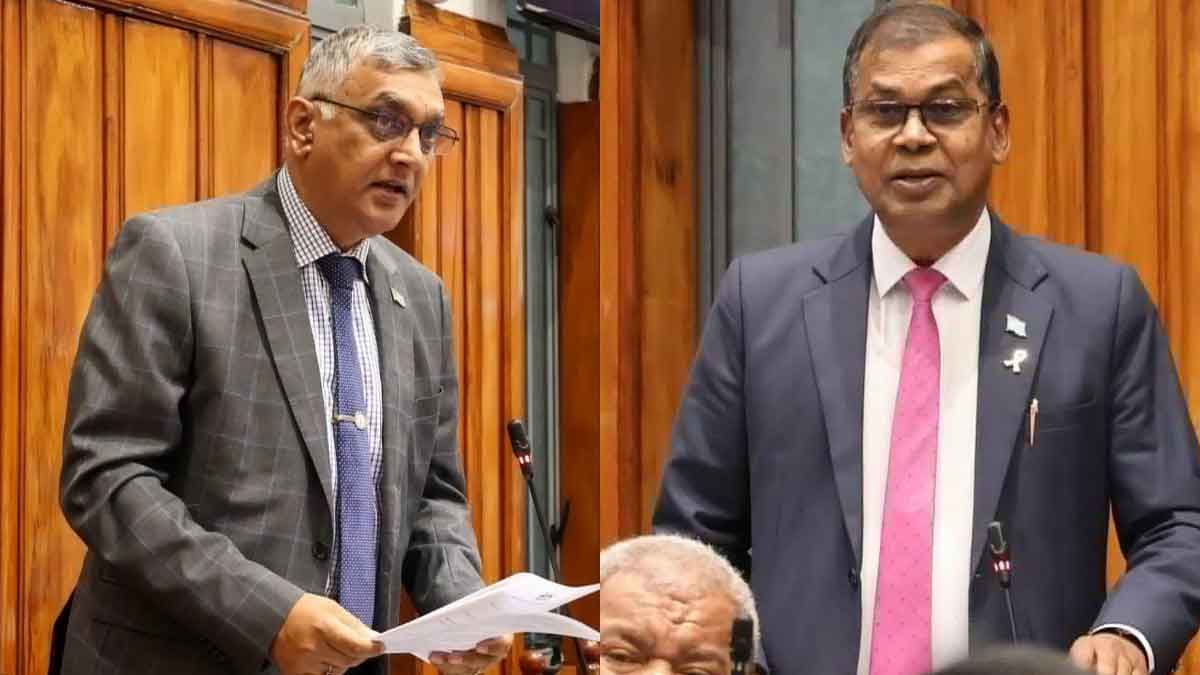
Opposition MP Virendra Lal says Fiji must strengthen the teaching of standard Hindi in schools, with students given access to qualified teachers, appropriate textbooks, digital learning resources and engaging classroom materials.
Lal raised the issue in Parliament in his End of the Week Statement, saying education institutions have a critical role in preserving standard Hindi and students should realise that learning the language will not result in forgetting Fiji Hindi.
He says a young Fijian should be able to speak their native language at home, English in a professional environment and study standard Hindi to read literary works, understand religious contexts and use it for international purposes.
He says Hindi should not be presented as simply another examination subject, but as a living language with relevance to contemporary Fiji.
The Opposition MP says the gradual erosion of standard Hindi in formal dialogue, broadcasts, education and cultural activities is a matter of concern.
However, he stresses that standard Hindi and Fiji Hindi are not rival languages and have their own distinct roles and functions.
He says Fiji Hindi is the creation of generations of Indo-Fijians in Fiji, while standard Hindi holds immense significance as a language of religion, culture and education, connecting Indo-Fijians with India’s rich literary and cultural heritage.
Lal says Fiji Hindi should be recognised for its unique Fijian identity and heritage, while standard Hindi should be maintained for formal, educational and wider cultural purposes.
He also calls for teaching materials to be contextualised to the Fijian environment, saying that a language becomes meaningful when learners can use it to talk about their families, their communities, their environment, their history, and their aspirations.
Former Deputy Prime Minister Professor Biman Prasad says schools are critical for preserving both Vosa Vakaviti and standard Hindi.
Professor Prasad says the languages need strong teaching from primary to secondary education, supported by trained teachers, contemporary textbooks and attractive digital resources.
He says students should encounter the languages through stories, poetry, music, theatre, debate, film and digital media.
He says the current Government has also allowed Members of Parliament to speak in both Fiji Hindi and standard Vosa Vakaviti, which sends a significant message to young people and those in schools.
He adds that the Government has also supported the teaching of Hindi and Vosa Vakaviti as formal curriculum in schools and provided funding and scholarships for students to undertake Hindi programmes.
The former Deputy Prime Minister says this demonstrates that the Government is moving away from the previous approach and restoring standard Hindi as an important part of Fiji’s cultural and educational heritage.
He says technology can also be an important ally in preserving languages, with Fiji needing to encourage digital Hindi and Vosa Vakaviti content, podcasts, children's programmes, online dictionaries, oral history archives and educational applications.
He says artificial intelligence also creates opportunities for translation and language preservation.
He stresses that when a language disappears, communities lose more than a means of communication; we lose memories, we lose stories, we lose humor, songs, philosophies, and a particular way of understanding the world.
He says there is now a bipartisan understanding that teaching standard Hindi is very important, just as teaching Vosa Vakaviti is important and critical for preserving Fiji’s culture, tradition and heritage.