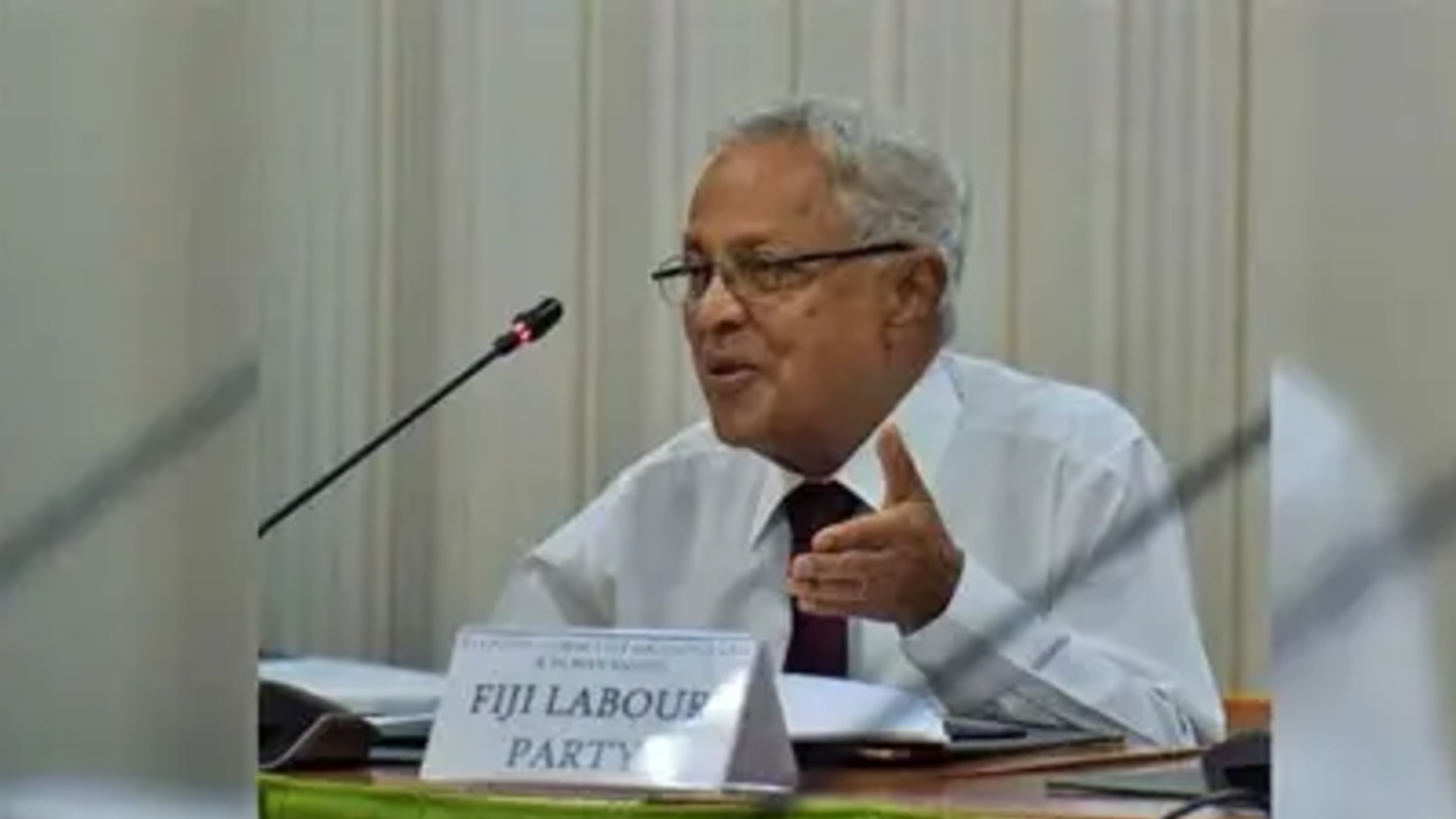
Fiji Labour Party Leader Mahendra Chaudhry says the proposed Constitution (Amendment) Bill No. 32 of 2026 is divisive, discriminatory and undemocratic, warning that it could undermine equal representation and create further divisions among Fiji’s multiracial communities.
Presenting the party’s submission to the Parliamentary Special Committee on the Constitution (Amendment) Bill, Chaudhry says the entire constitutional review process has been flawed from the beginning and that the Government has failed to give Parliament and the public adequate time to examine the proposed changes.
Chaudhry says the Government delayed taking concrete action until the final six months of its tenure and is now attempting to push through major constitutional and electoral changes just two months before the next general elections.
He says several critical bills are being considered within a short period, leaving Parliament and the public without sufficient time to read, scrutinise and debate their implications.
The Labour Party leader also questions the process followed in developing the proposed amendments, comparing it with the process that led to the 1997 Constitution.
He says the 1997 Constitution review took almost four years, beginning with a bipartisan parliamentary committee in 1993, followed by the appointment of the Reeves Commission in 1995, extensive public consultations and seven months of political deliberations and negotiations before the Constitution was unanimously passed in July 1997.
Special Committee Member Siromi Turaga points out that the circumstances surrounding the 1997 Constitution were different because of the events of 1987, but Chaudhry says he is comparing the process rather than the historical background.
He says that the current coalition Government had sufficient time to begin the constitutional review earlier but did not do so.
Turaga also clarifies that the Constitution Review Commission was appointed under the Commission of Inquiry Act, as was the commission involved in the 1997 constitutional review.
He says the Constitution Review Commission was appointed in March this year without a parliamentary mandate, which he argues breached Sections 1(5) and 1(6) of the 2013 Constitution.
He says the Commission handed its report and draft constitution to the President on 31st August, with the report tabled in Parliament on 22nd September.
However, Chaudhry says a different draft constitution was subsequently introduced as Bill No. 32 on 30th September, following the suspension of Standing Orders.
Special Committee Member Praveen Bala asks about the party's position on having a Senate, what its composition should be if one is retained, and whether its members should be elected or appointed.
Chaudhry responded by saying that the Labour Party supports a unicameral Parliament and believes Fiji does not need a Senate.
However, he says if a second chamber is considered necessary, it should be an elected Senate, with nominations done away with completely.
Turaga also questioned about the representation of the Bose Levu Vakaturaga in the Senate and whether its representatives should be nominated or elected, while Chaudhry says that Senate members should be elected, pointing to Australia and the United States as examples.
Under the proposed arrangement, Chaudhry says 14 of the 23 Senate members would be appointed by the Great Council of Chiefs, while the Prime Minister and Leader of the Opposition would have discretion over the remaining appointments.
He says there are no specified seats guaranteeing representation for minority communities, which he says make up 38 percent of Fiji’s population.
Chaudhry also objected to the proposed constitutional recognition of Christianity and its values, saying he has no problem with Christian values but believes the State, Church and religion should be kept separate.
Turaga further questioned whether Chaudhry acknowledges Christianity as a core value of Fijian society under the 1874 Deed of Cession.
Chaudhry agrees that the British brought Christianity but reiterates that he has no problem with Christian values warning that giving Christianity special status could alienate minority religious communities and create fears of religious segregation and inequality.
Chaudhry further argues that the proposed constitutional arrangements favour indigenous rights and institutional structures over universal and equal constitutional rights for all citizens.
When Turaga asks whether he supports indigenous rights, Chaudhry says he has no problem with them and maintains that indigenous rights have always been protected under Fiji’s previous constitutions.
He also questions the proposed electoral arrangements, particularly the allocation of five reserved seats for maritime communities, saying there are no equivalent reserved seats for minority communities or women.
He says women constitute 50 percent of voters and refers to the Electoral Law Reform Commission's recommendation for reserved seats for women as a temporary measure.
When Chaudhry questions the allocation of the five maritime seats, Turaga clarifies that the arrangement comes from recommendations made through Justice Fatiaki's electoral consultation and says the report provides reasons for the proposed allocation.
Chaudhry also questions the decision to place the Yasawa group under maritime communities instead of Ba Province, saying this was not a recommendation made by the Electoral Commission or the Office of the Supervisor of Elections.
He says if reserved seats are necessary, the representation of other communities must also be considered.
The Labour Party leader also raises concerns about the lack of special provisions for land rights for minority communities, particularly landless families in rural areas who face difficulties securing land for housing and livelihoods.
He says the non-renewal of agricultural leases has contributed to the decline of the sugar industry, with farmers losing access to land they depend on for their livelihoods.
Chaudhry further warns that the proposed Constitution concentrates too much executive power in the Prime Minister without sufficient accountability safeguards.
He also questions the Government's handling of reports produced by various commissions, including the Electoral Reform Commission and the Constitution Review Commission, saying millions of dollars have been spent on inquiries and reviews whose reports and recommendations have subsequently been set aside.
He also raises concerns about the proposed abolition of FICAC and the transfer of its functions to the Police, saying Fiji needs a stronger anti-corruption institution to address corruption.
