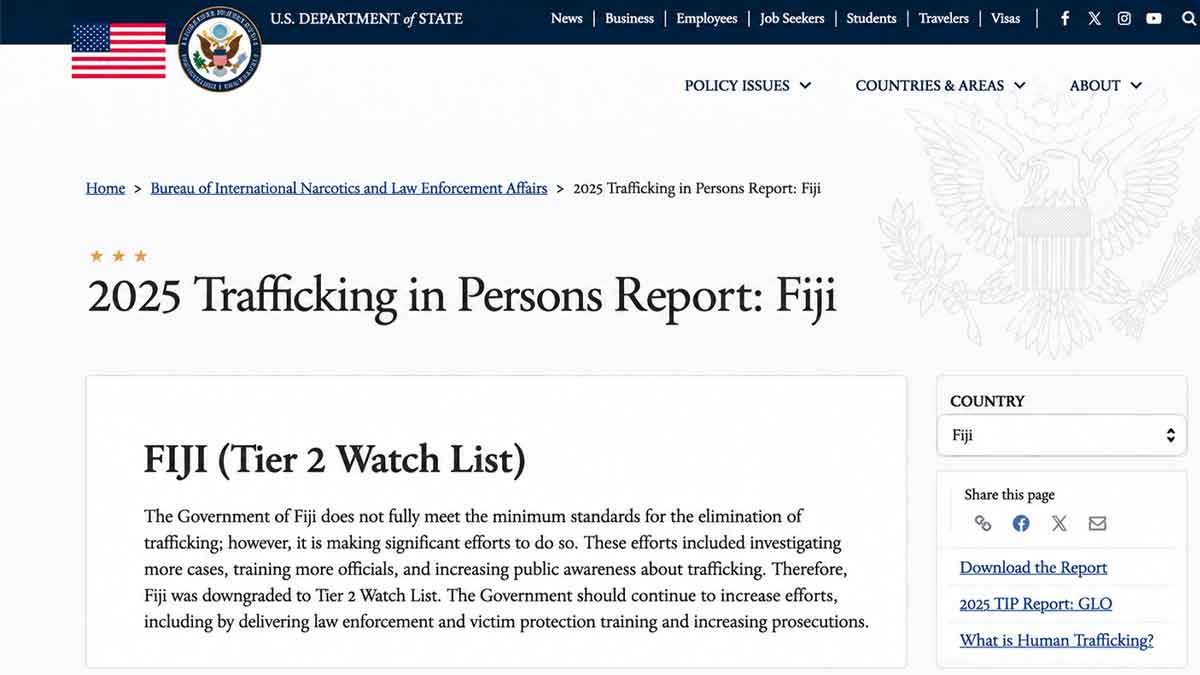
Police, Minister for Immigration Viliame Naupoto and Minister for Policing Ioane Naivalurua are yet to comment on what is being done in relation to the Trafficking In Persons Report on Fiji published by the US Department Of State.
When asked by fijivillage News, Prime Minister Sitiveni Rabuka confirms he has asked Minister for Immigration Naupoto to quickly sort out the issue regarding Fiji remaining in the US Tier 2 watch list for human trafficking for the third consecutive year as we may lose our preferred recipient status for some of the US grants and aid if we are downgraded to Tier 3.
Fiji is at risk of losing hundreds of million dollars in assistance from the United States across different sectors if it is downgraded to Tier 3 ranking in next year's US Department of State's Trafficking In Persons report.
This year's Trafficking In Persons report states that the Government of Fiji does not fully meet the minimum standards for the elimination of trafficking.
The US report says the Fiji government did not demonstrate overall increasing efforts compared with the previous reporting period.
Fiji was granted a waiver, in accordance with the Trafficking Victims Protection Act, from an otherwise required downgrade to Tier 3 because the government has devoted sufficient resources to a written plan that, if implemented, would constitute significant efforts to meet the minimum standards.
Therefore, Fiji remained on Tier 2 Watch List for the third consecutive year.
The report also says family members and domestic partners exploit women in forced criminality to sell illicit drugs or participate in drug trafficking in Fiji through threat of violence, abuse, and psychological coercion.
It says children are also increasingly at risk of exploitation in forced criminality to sell illicit drugs.
The report further says the traffickers exploit Fijian and Chinese national women and children in massage parlours and commercial sex establishments operated by Chinese nationals, particularly in Suva.
It says in some cases, massage parlour owners arrange for female Fijian employees to engage in commercial sex acts with clients in hotels or commercial sex establishments.
The report adds that some Fijian children are at risk of sex and labour trafficking, including domestic servitude, as families follow a traditional practice of sending them to live with relatives or families in larger cities, where they are vulnerable to exploitation in domestic servitude or sex trafficking in exchange for food, clothing, shelter, or school fees.
It says foreign yacht owners and foreigners hiring locally owned yachts dock in rural Fijian islands and seek young women, usually children, for marriage; some of these women and children subsequently become exploited in forced labour or sex trafficking.
It further says that taxi drivers or other facilitators transport Fijian child sex trafficking victims to hotels in popular tourist areas or to private yachts at the request of foreign tourists seeking commercial sex acts.
The report highlights that Fijian children are at risk of forced labour in agriculture, retail, or other sectors.
It says rising levels of poverty, often resulting in increased school drop-out rates, also contribute to increased risks of perpetrators exploiting Fijian children in commercial sex and forced labour.
The US report says children as young as 12 are exploited in sex trafficking, sometimes by family members to purchase food and other essentials for their families.
