Families in Uciwai, Nadi, have been struggling with water shortages for years, raising questions about why it has taken the El Niño drought for action to be stepped up, despite the community having previously received water infrastructure.
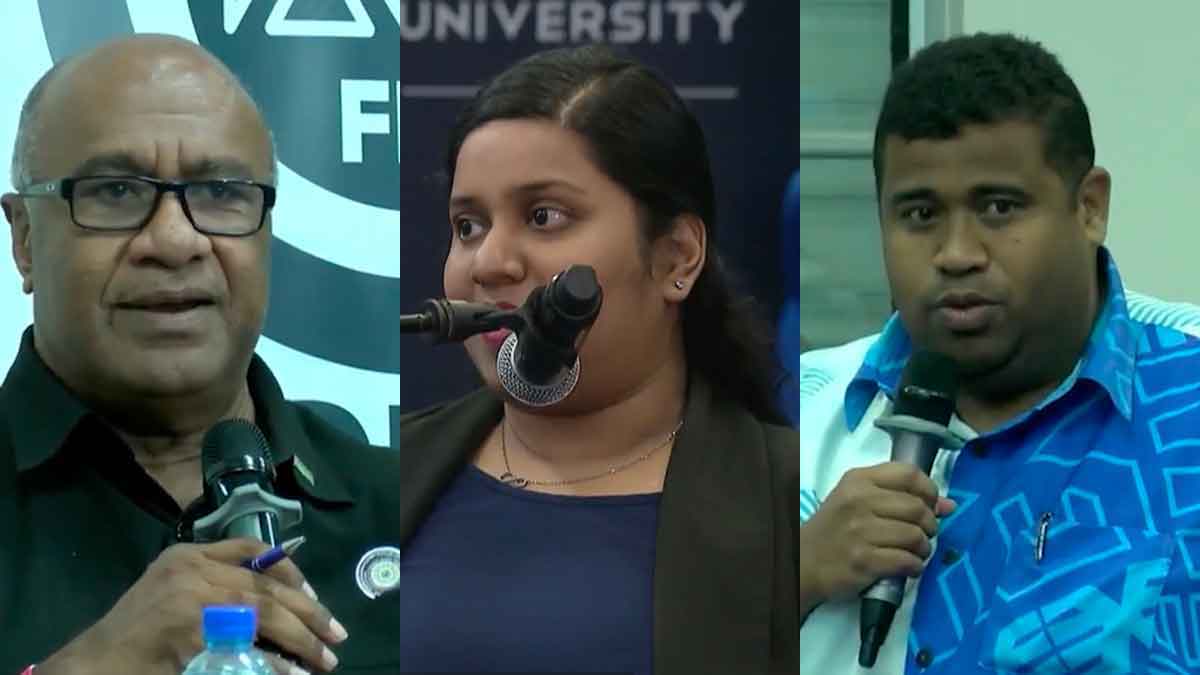
The issue was strongly raised by law student Khushboo Raj during the Fijian Media Association Town Hall Forum in Nadi, where she challenged political leaders on their responsibility to help struggling families and ensure communities have access to basic necessities.
Questioning the panel, Raj asked where is the humanity in leadership and why politicians could not use their own resources, time and personal commitment to reach out to the people who voted for them instead of depending on Government funding for every community activity.
She says elected leaders have a responsibility to represent the people, support struggling families, assist vulnerable communities and listen to senior citizens.
Using Uciwai as an example, Raj says the previous government had worked on the water tap line, but questioned why the current Government was unable to ensure even a drop of water reached the people through the piped water system.
She says families are not asking for bottled water or luxury, but need basic water to shower, cook, wash and live with dignity.
Raj also questioned why politicians spent much of their time attending consultations, media forums and meetings instead of going out into communities to see how people are living.
Raj says Fiji needs leaders who serve their communities before, during and after elections, and not only when they need votes.
Responding to the concerns, Deputy Prime Minister Manoa Kamikamica says he felt part of Raj's question was a personal attack on politicians, but wanted to respond honestly.
Kamikamica says politicians do a lot of things to support people without making those contributions public.
He says he is currently supporting a family consisting of a woman and four children after the fathers of all the children deserted their wives.
Kamikamica says he supports the woman every week and does not publicise the assistance because he believes it is something that should be done as part of his responsibility as an individual.
He also reveals that someone approached him last week requesting assistance to purchase water for a settlement in Nadi, and he provided the money.
Kamikamica says he wanted to share these examples because he did not want people to assume politicians were insensitive or did not care about the country.
He says all 55 Members of Parliament care deeply about Fiji and that was why they are in Parliament.
On the specific concerns about Uciwai, Kamikamica says Nadi youth Ria Dutt had raised the same issue during the previous Town Hall meeting in Nasinu.
He says he remains in contact with her and had received an email about water issues in Labasa and Uciwai.
Kamikamica says he immediately forwarded the complaints to the Chief Executive Officer of the Water Authority of Fiji, who follows up on the issues.
He says whenever Dutt does not receive a response or the problem is not addressed, she sends him a reminder and he forwards the matter again to the WAF CEO.
Acting Manager Regional Operations Western Joeli Rabuatoka confirms that the water challenges in Uciwai have been ongoing, with WAF communicating through emails and referrals received from the community.
Rabuatoka thanks the Deputy Prime Minister for his involvement and says WAF has been supplying water to the area over the past week.
He says the authority has also been monitoring water-cut schedules to maintain the supply of water to the community.
Rabuatoka says WAF has taken further steps to verify families in the area and supply tanks to assist them during the current El Niño challenges.
He explains that Uciwai is located at the extent of the water supply system and says WAF is working on a long-term investment plan that includes upgrading the Nagado treatment plant.
Rabuatoka says the authority needs to increase production because of the growing demand in Nadi and Lautoka, and has also invested in infrastructure towards Nawaicoba.
He says WAF anticipates seeing the outcome of these investments in the next financial year.
However, when asked in why it had to take the El Niño before something was done to assist the people of Uciwai, considering it had been going on for a number of years, Rabuatoka says WAF has limited funding for water carting on an annual basis.
He says the El Niño situation has allowed the authority to access additional funding to increase water carting operations.
Rabuatoka says more trucks have been funded to assist with water deliveries to affected communities.
National Federation Party Leader Professor Biman Prasad thanks Raj for raising the concerns and says he could relate to her approach of confronting politicians, recalling that he was similar when he was a university student.
Professor Prasad agrees that the concerns about water are valid and says he has personally heard many stories from communities over the past month.
He also acknowledges the work of WAF, particularly its CEO, who he says has responded efficiently to requests he has personally referred from communities throughout the country.
Professor Prasad says the CEO's efficiency in responding to requests and ensuring water reaches communities has been exemplary.
Referring to his time delivering the previous national budgets, Professor Prasad says the Government allocated about $7 million in the last budget for 1,700 boreholes.
He says the allocation covered 1,000 boreholes for Viti Levu, 500 for Vanua Levu and 200 for the islands.
He explains that boreholes were considered for areas where extending piped water supplies would take considerably longer.
He acknowledges that not as many boreholes as he would have liked had been dug and made operational, but says more are being developed.
Professor Prasad also says his party and its members have been responding to requests from communities by distributing bottled water to people who need drinking water.
He says he sympathises with people affected by the drought and had seen the extent of the situation in the West during a visit the previous day.
Professor Prasad warns that conditions could worsen over the next one or two months.
However, Opposition MP and People First Party representative Rinesh Sharma questions the progress of the Government's borehole programme and its preparedness for El Niño.
Sharma says the announcement about the 1,700 boreholes was reported in the media on the 14th of February 2025, with a budget allocation of around $5.7 million.
He says the Government had an ambitious plan, but believes it is important for the Opposition to hold the Government accountable.
Sharma says that over the last 11 years, only 232 boreholes had been drilled, with 88 having recirculating systems.
He also refers to warnings issued to the nation about the expected severe effects of El Niño, comparing the current situation with the 1997 and 1998 El Niño events.
Sharma says preparedness should have been a priority, particularly when the Opposition raised concerns during the 16th July budget debate.
He says one of their opposition members, Vijay Nath, had moved a motion calling on the Government to increase funding to prepare for El Niño, but the motion was defeated.
Sharma says the Government has now introduced a $20 million package, but October had already passed and was one of the driest months.
He argues that the Government's response has been more reactive than proactive, despite the Opposition having raised the need for increased preparedness earlier.
Meanwhile, some political parties preparing to contest the next general elections also shared their proposed solutions to the country's water challenges, with representatives from We Unite Fiji Party, Kingdom Unite All People's Party, Liberation of Fiji Party and Next Gen Alliance Party outlining their approaches to addressing the ongoing shortages.
We Unite Fiji Leader, Ruveni Nadalo says the issue raised by Raj about humanity is an important part of his party's agenda.
Nadalo says his party is planning other ways of ensuring a consistent supply of water instead of only responding when a crisis occurs.
He says the approach of waiting until El Niño arrives before taking action is similar to monkey see, monkey do.
Nadalo also questions whether the $20 million package is actually in place to resolve the current water challenges.
He says his party has plans to address the El Niño situation should it come into government.
On immediate assistance, Nadalo says he cannot understand why people have to order water through WAF when communities are already experiencing serious shortages.
He raises concerns about the time taken to deliver water, saying that people in Uciwai, Nadi and Lautoka have been waiting for extended periods.
Nadalo says some people have to wait two weeks after ordering water, while others have waited as long as two months.
He also asks about two water tanks located in Uciwai and whether they are operational.
He says he believes more water trucks should be engaged to assist affected communities.
He suggests engaging Fiji Sugar Corporation lorry contractors, particularly as the sugar cane-cutting season has ended and some trucks are now parked.
Nadalo says the immediate solution should be to engage as many available trucks as possible to deliver water to local communities.
He also questions the process involved in ordering water, saying requests have to be approved in Suva before being referred to WAF's Western Office.
He says the Water Authority needs to provide clarity on that process.
Nadalo says that, at this point, it is too late to address the problem through long-term solutions alone, and more trucks need to be engaged to improve water deliveries.
Liberation of Fiji Party representative Veronica Ralogaivau Malani says a more proactive approach is needed when addressing the country's water challenges.
Referring to the $20 million package, Malani proposes that WAF work together with the iTaukei Land Trust Board to identify water catchment areas in communities affected by shortages.
She says this could involve establishing partnerships with landowners to secure access to suitable water catchment areas for WAF.
Malani says the first step should be to conduct a stocktake of all affected areas, particularly in the Western and Central Division.
She specifically mentions Tailevu, where she says water had not been delivered for the last four to five weeks.
She proposes that the $20 million package be used to provide immediate water supplies to affected communities while WAF and the relevant authorities identify alternative water catchment areas.
Malani says the longer-term solutions could then be left to the next government, but stresses that immediate action is needed because people are suffering, particularly in the west.
She says communities are experiencing significant heat and worsening water challenges.
NextGen Alliance Party Deputy Leader Noeleen Billings says people in the North are also suffering severely from the drought.
Billings says livestock are dying, with farmers having to collect small leaves from the sides of roads to feed their cattle and goats.
She also says fish ponds are drying up and fish are dying.
Billings reveals that some people in the North are digging their own boreholes, but the cost is about $12,000 for each borehole.
She says if funding has been allocated to address the water situation, communities in the North would also like to receive assistance to dig more boreholes.
Billings stresses that access to water is a basic necessity and warns that without water, people risk dying or becoming sick from drinking unsafe water.
She says communities in the North also face challenges with salt water and suggests that desalination plants could be another option to make use of available salt water.
During the discussion on longer-term water infrastructure, WAF Chief Asset Management Officer Josaia Koroilavesau explains that the authority is working on major pipeline developments to improve supply from Nagado towards South Nadi.
Koroilavesau says WAF intends to install infrastructure wherever land and access are available while continuing to work through other requirements.
He explains that the project will not necessarily involve constructing one continuous pipeline from beginning to end, but will involve laying sections of pipeline between different points.
Koroilavesau says infrastructure development is affected by several requirements, including land acquisition, access to sites and environmental assessments.
He says these processes can take years before contractors are able to move into locations and begin construction.
Koroilavesau also refers to the authority's master plan, saying, "Our master plan was launched back in 2014."
He says WAF has been working on the plan and has already upgraded the plant in Nagado.
He says the authority is also working on raising dam levels in Vaturu.
Koroilavesau says WAF is also looking at expanding its system between Natadola and Momi.
He says these are alternative water sources the authority has already been engaging with and that it now has enough information and data to proceed with feasibility studies and designs.
He stresses that WAF cannot simply construct infrastructure without first ensuring it is climate-resilient, sustainable and capable of providing a continuous water supply during El Niño events.
Koroilavesau says the current El Niño conditions have allowed the authority to measure river levels at proposed water sources and assess whether they can sustain supply during severe climatic conditions.
He says some of the proposed water sources have experienced significant declines, with levels dropping to figures that have never previously been recorded.
Koroilavesau says this information will help WAF identify the more sustainable sources and move forward with developing them.
Meanwhile, WAF Manager Design Jone Vunidaiga clarifies the status of the two tanks, explaining that the tanks at Nawaicoba are not operational yet.
Vunidaiga says WAF is still testing the pipelines that will feed the tanks in Uciwai.
He says an additional cut-in is also required, which would cause further disruptions to the water supply at a time when communities are already experiencing shortages.
Vunidaiga says WAF is therefore adjusting its timelines for the cut-ins and other projects that are ready but have not yet been connected.
He says the authority is mindful of the disruptions that could occur once the connections are undertaken and that it will take some time for supply to return to normal.
Providing further background on the water supply system, Vunidaiga says there has been only one main water source supplying Nadi and Lautoka since 2014.
He identifies this as the Nagado or Vaturu dams.
Vunidaiga says the authority has not yet diversified its main water sources and is now looking at alternatives.
He says WAF has long-term development plans with donor partners and that teams are already working on a current donor-funded programme with the Asian Development Bank.
Vunidaiga reiterates that from 2014 until now, the Vaturu source has been supplying Nadi and Lautoka.
He says Nadi receives 100 percent of its water supply from this system, while Lautoka receives about 70 percent, with the remaining supply supplemented by other sources in Saru and Buabua.
Vunidaiga says Nadi is a major contributor to the system and explains that the Nadi-Lautoka area is densely populated and has a large number of tourism establishments that consume significant amounts of water.
He adds that the manufacturing sector is another important consideration because businesses depend on water services to continue operating.
Responding to concerns that the Government has been reactive, Kamikamica says Cabinet has been monitoring the water situation since around April this year and conducting assessments.
He says approximately two million litres of water have already been distributed during that period.
Kamikamica says most of the water was delivered to the islands and several other locations experiencing critical water shortages.
He explains that the decision to raise the situation to critical levels and activate the state of emergency was based on the monitoring and assessments that had been taking place over time.
Kamikamica says the country has not yet reached the peak of the drought, with weather authorities forecasting that the worst conditions will occur in January.
He says the state of emergency was activated in preparation for that peak, when conditions are expected to become much worse.
Kamikamica says he has also come to realise since joining Government that establishing infrastructure in Fiji involves a lengthy process.
He says it is not simply a matter of deciding to build something and having it constructed immediately.
