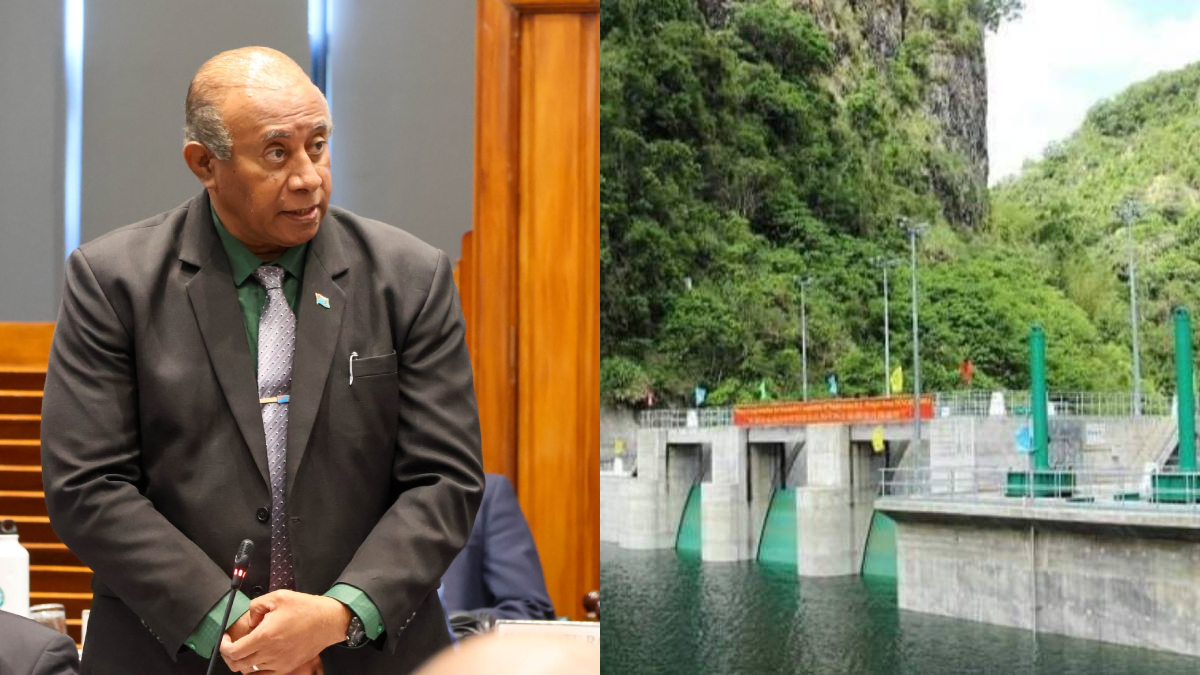
As below-average rainfall due to El Niño is expected to continue into the first quarter of 2027, Minister for Public Works Ro Filipe Tuisawau says EFL will activate its power plan as a last resort to conserve water at Monasavu Dam and safeguard the company's financial sustainability.
While speaking during the debate on the review report on EFL's 2025 annual report, Ro Filipe says below-average rainfall is affecting the two hydroelectric schemes, Nadarivatu and Monasavu, in terms of the amount of electricity they can generate.
He says Nadarivatu Hydro has been restricted to generating a maximum of 5 megawatts during the day for two to three hours to meet peak demand.
Ro Filipe says its total installed capacity is 44 megawatts, with two 22-megawatt units, however, generation is limited because of low or zero rainfall.
He confirms that in the case of Monasavu, the dam level as of yesterday, 3rd November, was 728 metres above sea level while the minimum safe level is 715 metres.
The Minister says as we have been receiving below-average rainfall, and Monasavu is currently operating at 30 percent of the total generation requirements for Viti Levu to conserve water.
He warns at this generation level, if we continue to receive only 50 percent of average rainfall, forecasts indicate that the Monasavu dam level will reach the minimum safe operating level towards February.
Ro Filipe says as a mitigation measure, EFL activated its contingency plan in June this year and has ordered an additional 16 one-megawatt containerised diesel generators to supplement electricity supply in Viti Levu during this dry weather period.
He says eight one-megawatt generators are expected to arrive at the end of November and will be installed and commissioned in December while the remaining eight generators are expected to arrive and be commissioned in December this year or early January next year.
Ro Filipe further says EFL's new three-by-10-megawatt heavy fuel oil power stations are under construction in Vuda where the total 30-megawatt heavy fuel oil power plant, which is expected to be 30 to 50 percent cheaper to operate than diesel generation, is expected to be commissioned in December 2026.
He says it will supplement electricity demand in Viti Levu and provide relief for generation from Monasavu Dam, allowing EFL to conserve water.
Ro Filipe says industrial diesel oil prices have more than doubled to $4,637 per metric tonne, while heavy fuel oil has increased to $2,311.
He also confirms EFL is spending about $1 per unit to generate electricity using diesel and 50 cents using heavy fuel oil, compared with the regulated retail price of 48.4 cents per unit.
EFL has accumulated $28 million in fuel cost under-recovery up to October and has requested an 8-cent tariff increase, which remains on hold as the Government assesses the situation.
Meanwhile, Ro Filipe has defended EFL staff, saying they are working day and night to manage the challenges facing the company.
This follows concerns raised by Opposition MP Vijay Nath about delays in responding to power outages and the availability of technicians after hours, during weekends and public holidays.
Ro Filipe says the Government is also working to address the challenges affecting rural electrification projects, including shortages of construction materials and skilled workers, land access issues and adverse weather conditions.
He says 24 rural electrification projects worth about $6.9 million are currently under construction and are expected to benefit 609 households, with completion expected by July next year.
Minister for Finance Esrom Immanuel says EFL's fuel expenditure increased to about $200.9 million in 2025 and has doubled in the current financial year, placing further pressure on the company's finances.
He says EFL's borrowings also increased from $225 million in 2024 to $287 million in 2025, largely to support infrastructure investment and maintain security of electricity supply.
Immanuel says one of the major challenges EFL has faced since 2019 is the lack of a Government-approved tariff increase to enable the company to undertake necessary capital expenditure.
He says EFL has identified investment requirements of about $2 billion, with the Government currently looking at $1 billion for the immediate future and about $400 million over the next one to two years.
The Minister says the Government is working with EFL to identify financial solutions that balance the company's long-term sustainability with affordable electricity for consumers.